Logistics Document Processing Workflow Redesign for Freight and Customs
Cross-document validation prevents costly port holds and compliance failures before cargo moves.

Logistics document processing workflow redesign for freight and customs is a redesign of the handoffs between document intake, cross-validation, and TMS ingestion. The governing requirement is that extracted fields must agree across the shipment before they become data that agents can act on. Accuracy within one document is not enough to keep cargo moving.
Why freight document pipelines fail before a single container moves
A document stack arrives in an operations inbox, including a Bill of Lading, Commercial Invoice, Packing List, Certificate of Origin, and Arrival Notice. Each document describes part of the same movement, but the pipeline often treats each as an isolated record. The container number on the arrival notice must match the one on the B/L, and the cargo descriptions and weights on the invoice must match those on the packing list. The structural failure is that legacy systems were not designed to enforce those relationships automatically.
Template-based OCR adds another source of silent failure. When a carrier changes its B/L layout, extraction can return wrong values without reporting a processing failure, allowing errors to enter the TMS. Manual entry error rates of one to four percent create a similar background of exceptions across hundreds of shipments per month. Neither better reading nor faster entry resolves the missing cross-checks. Filing deadlines then turn an unresolved data problem into a compliance problem, with fines.
Which document types to tackle first and why the sequencing matters
The starting point should reflect downstream risk. At the workflow level, sea freight automation begins with booking confirmation processing and container milestone tracking, while air freight begins with AWB data extraction and flight status monitoring. Within a production document pilot, commercial invoices are the logical first target. They are semi-structured, come from a finite set of known counterparties, and carry fields frequently mismatched against customs declarations, namely value, quantity, HS code, and buyer/seller.
Bills of lading come second because they carry the container number, vessel, voyage, port pair, consignee, and cargo description referenced throughout the shipment. Errors in this record propagate into downstream checks. Packing lists come third because they reconcile invoice quantities and B/L cargo descriptions, and can cause holds that initially appear to be invoice problems. Dangerous goods declarations and phytosanitary certificates belong later, after the core three are stable. Their validation depends on regulatory schema that changes independently of document format, making them a separate expansion.
How a production extraction pipeline is actually architected, layer by layer
Intake begins with designated operations mailboxes and attachments in PDF, image, and EDI formats. Before AI processing, a pre-filter removes cover sheets, duplicates, and attachments that are not needed, so the expensive stages handle only material that needs action. Classification then identifies the document type and selects the extraction schema. A mistake here contaminates the next stage even when the extractor appears to work correctly. Extraction must come after classification and use what the document means.
A container number, for example, has a four-letter prefix followed by seven digits regardless of where it appears. But reading the text is only part of extraction, because multi-column tables, merged packing-list cells, and the reading order in multi-page B/Ls show how the values fit together. Validation checks the output against format rules, existing TMS shipment data, date ranges, and value thresholds. Cross-document reconciliation then compares the related fields within the shipment. The action layer writes high-confidence output to the TMS and sends low-confidence or exception fields to human review.
These stages are sequential for each document, but different documents can move through them concurrently. That distinction matters for two hundred to three hundred page batches, where throughput need not depend on processing every document end to end before starting another. In a multi-agent architecture, a Planner Agent decomposes the document set, Domain-Specific Agents handle separate tasks, and an Orchestrator coordinates state and resolves conflicts. A Human Oversight Layer handles flagged exceptions.
The Audit / Prove layer preserves the ability to reconstruct the processing chain. It must show what arrived, what was extracted and from where on the page, which rules passed or failed, and what the system of record shows. It must also explain what the agent decided and why. This is not merely a processing history, because customs dispute resolution depends on connecting a recorded value to its source and the checks applied to it.
Where cross-document validation failures actually occur and what they cost
A weight mismatch can leave a container idle at port while operations works out which document is wrong. The invoice may look valid, and the packing list may look valid, yet their disagreement can trigger a hold or inspection. Demurrage charges escalate after the first week, so reconciliation becomes a time-sensitive operational task. The failure is especially difficult when the extraction system has reported success on both documents.
The comparisons are specific. Container numbers must agree between the arrival notice and B/L, while cargo description and weight must reconcile across the invoice, packing list, and B/L. HS codes on the invoice must match those on the customs declaration, and the declared value on the invoice must match the one on the customs entry. Invoice quantities must also match the packing list, with even a one-unit discrepancy capable of triggering manual review. CBP and customs authorities use automated risk scoring to compare declared data with past patterns and other documents in the same entry.
Silent row drops deserve separate attention because they can evade ordinary field validation. An extractor may omit line items from a multi-page packing list while returning a record that looks complete and contains no visibly missing fields. The total then fails to reconcile with the invoice, despite the pipeline reporting success. PayCargo describes an operation automatically indexing three hundred thousand documents a month. At that scale, even a small mismatch rate can overwhelm the exception queue, making completeness checks as important as the correctness of individual values.
HS code classification and compliance timing as hard constraints the pipeline must enforce
Classification checks must sit upstream of filing because a later correction does not undo the consequences of an incorrect or late submission. Under the 24-hour U.S. Customs Advanced Manifest System rule, vessel cargo manifests must be filed 24 hours before loading at the foreign port. AI prepares and validates manifest data from the BOL and packing list, but the licensed provider files. The one-hour CBSA ACI eManifest rule for highway cargo is likewise a hard deadline.
Maersk identifies the lack of centralized classification data as a cause of overpaid duties and inadequate customs preparation as a cause of shipment delays. Maersk Trade & Tariff Studio extracts attributes from uploaded documents, product links, or item photographs and generates classifications using customs-specific data. Its output has confidence scores and sources that can be traced, such as binding rulings and regulatory guidance, while regulatory monitoring helps deal with changes before they affect shipments. Flexport's AI Auditor reviews entries in real time, illustrating the distinction between checking before consequences accumulate and auditing afterward.
Why confidence scoring and exception routing are not optional features
Roughly two in five document AI implementations underperform their ROI projections, with absent field-level confidence scoring a primary reason. Without it, reviewers must re-examine every output because the system gives them no basis for concentrating on exceptions. Confidence scoring is therefore infrastructure for allocating human attention. Its value depends on whether it identifies the fields and records that need intervention.
Low-confidence fields should enter a review queue with the source page and extracted value shown side by side. The reviewer corrects the field, the correction becomes a training signal, and the threshold recalibrates. The Prove layer supplies the evidence needed to understand the decision without manually reconstructing the entire document history. Confidence must also account for completeness, so a packing list containing forty-seven of fifty line items raises a field-count mismatch against the invoice total.
Integrating structured output into a TMS so agents can act on it
A validated extraction can still fail at the final handoff. TMS writes depend on field mapping, and brittle integrations can break when schema updates change the target record. CargoWise, SAP TM, and Oracle TMS provide APIs mature enough to support real-time data pushes from external AI systems. That capability makes integration possible, but it does not remove the need to map the extraction schema to the TMS field model. A generic key-value store is not a substitute for a structured shipment record.
High-confidence extractions can be written automatically, fields with low-confidence scores need review before they are written, and failed classifications need a separate inbox that keeps the original attachment. Between carriers and the TMS, the translation layer must accommodate carrier-specific formats and operational edge cases, including unusual supplier formats and custom margin rules. Only then can agents use the record for delivery scheduling, customs entry filing, invoice generation, or compliance checks within the applicable controls. The decision about infrastructure therefore turns on where these translation and workflow requirements belong.
Choosing between full forwarding platforms and specialist AI layers for document workflows
Full forwarding platforms and specialist AI layers solve different scope problems. CargoWise, GoFreight, Logistaas, Descartes, Magaya, and Logitude manage multiple forwarding workflows within a broader platform. Raft, Freightmate, and Freightify connect to an existing platform to automate narrower workflows. Standard, repeatable operations favor a full platform, while unusual formats, custom validation logic, and deep TMS requirements favor purpose-built extraction infrastructure.
CargoWise fits large, multinational, operationally complex businesses, while Descartes addresses compliance-heavy and multi-office forwarding. Magaya combines forwarding with warehouse and inventory workflows, and GoFreight emphasizes usability and accounting connectivity for SMB and midsize forwarders. Logistaas has built-in document AI and lists its price per user publicly. These differences matter when the forwarding platform itself is the bottleneck.
A specialist layer is the narrower option when the core system works but document processing, customs preparation, or AP automation consumes the team's week. Raft adds AI orchestration around an existing core, while Freightmate focuses on document extraction, customs-entry preparation, and AP automation. Custom infrastructure APIs offer classification, extraction, splitting, and validation primitives for teams whose workflows do not fit a single platform model. Deployment claims must be read at their stated scope. Raft says workflows can deploy in days and Freightmate says a proof of concept can start in days, whereas GoFreight gives 4–8 weeks and Magaya gives 30–90 days for implementation, none of which establishes customs-ready performance across every document type.
How to sequence a realistic redesign across a fifty-document shipment without stalling
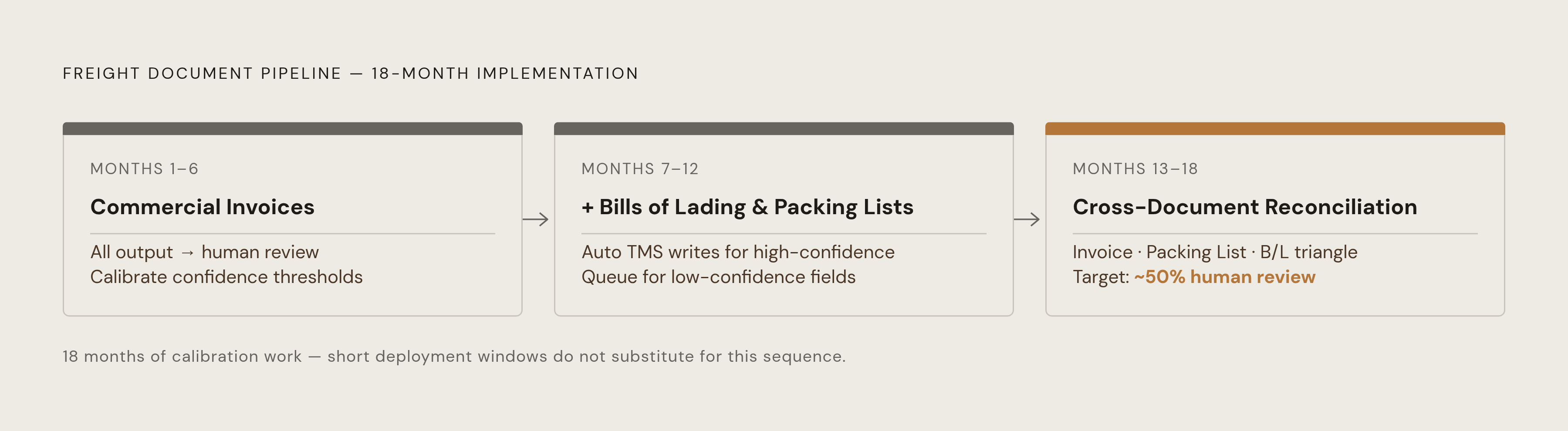
Months one through six should focus on commercial invoices with mandatory human review of all output. The purpose is to calibrate confidence thresholds against actual customs acceptance data on the operation's trade lanes. The scope should stay the same until the scores reliably predict holds. Pre-filtering and the Prove layer belong in this phase because processing cost and document traceability affect every later expansion. TMS field mapping also needs work from the start, well before the final integration.
Months seven through twelve add bills of lading and packing lists, with automatic TMS writes for high-confidence extractions and a structured queue for low-confidence fields. The operational measure is the ratio of exceptions to throughput. Months thirteen through eighteen enable cross-document reconciliation across the invoice-packing list-B/L triangle and surface container number and weight mismatches before customs entry drafting. The target is to reduce human review to roughly half of all output. Short deployment windows do not replace this longer work of calibrating decisions against customs outcomes.
At full shipment scope, independent documents and document pairs can run concurrently while dependent checks wait for their inputs. The B/L number, for example, must be extracted before the arrival notice can be reconciled against it. With exceptions separated from accepted records and each accepted value traceable to its source, a fifty-document shipment becomes structured, agent-ready data rather than a faster route for silent errors into the TMS.