Exception Handling Workflows in High-Volume Document Automation
Exceptions are permanent in document automation, not a problem to solve away with better models.

The same top-performing model, given the same prompt, scored nearly nine points higher on clean digitally generated invoices than it did on scanned receipts. That spread is the whole argument in miniature: accuracy is not a fixed property of a model, but a function of what the model is looking at. Exception handling in document automation is a structural feature of the problem. It's a structural feature of the problem, and any system designed as though exceptions were a transitional phase on the way to zero will be perpetually surprised by its own production logs.
The intuitive assumption goes like this: automate the pipeline, tune the model, and exceptions shrink toward some negligible tail over time. That's not what happens at scale. Even the best-performing accounts payable teams in the industry field exceptions on nearly one document in ten, and the industry average sits well above that best-in-class mark. Running a few hundred thousand documents a month through a pipeline with a 90% clean-pass rate makes the absolute count of exceptions requiring some form of intervention a substantial operational burden. It's an operational reality with its own staffing, latency, and cost profile.
The deeper point, and the one that reframes everything downstream, is that most exceptions are not extraction failures at all. A parser can correctly read every character on a page and still produce an exception, because the failure lives somewhere else: a business rule violation, a missing purchase order match, a vendor format the workflow doesn't recognize. As Parseur's benchmark analysis puts it, a better parser on its own will never get you to zero. That single observation should reorganize how engineering teams think about the problem. Exception handling is a core design requirement from the outset, not something a parsing team eventually solves away downstream. It's a permanent operating condition, and it needs to be designed in from the first architecture diagram, not patched in after the first angry email from finance.
What causes exceptions in production document pipelines
The first is document-quality degradation. Scanned versus digital origin, skew, low DPI, shadows falling across a page, mixed media within a single packet, all of these erode performance in ways that have nothing to do with model capability. OCR-only systems fall well short of perfect accuracy even under good conditions, and that gap widens further once the input gets messy. This is the category the Fraunhofer spread illustrates directly: the model didn't get worse, the input did.
The second cause is structural: layout and formatting complexity that breaks the assumptions most extraction pipelines are built on. Multi-column layouts, nested tables, dense mathematical formula fields, and unconventional page structures all fall into this bucket, and it's telling that the OmniDocBench benchmark added 296 new pages in its v1.6 release specifically to cover these categories, because earlier benchmark versions had underweighted them.
The third cause deserves its own category rather than a subheading under document quality, because handwriting is a structurally different recognition problem." It's a structurally different recognition problem. Across the Nanonets IDP Leaderboard, which evaluated more than sixteen models against over nine thousand real documents as of March 2026, not one model came close to the accuracy frontier models reach on digital printed text, a benchmark that itself exceeded 98%. Handwriting recognition is a different task wearing the same label. It's a different task wearing the same label.
Layer onto that the specific challenge of sparse, unstructured tables, which the same leaderboard found to be the hardest extraction task tested. Most models landed below 55% accuracy on this category, and only the top two models handled it consistently, still performing well below their own results on dense, structured tables. A form with scattered, irregularly spaced fields is a fundamentally harder target than a clean grid, and no amount of general model improvement erases that gap on its own.
All of this points to a KPI problem that quietly undermines a lot of pipeline evaluation: character-level accuracy is the wrong number to watch. The Stack AI 2026 guide asks the right question: what accuracy is needed at the field level to automate the workflow safely? That reframing, from character accuracy to field-level accuracy, is the hinge the rest of this piece turns on. Three root causes exist, each demanding a different response.
Why confidence scoring must gate the pipeline
Traditional exception handling treats confidence as a dashboard metric. A score drops below some fixed cutoff, the document gets flagged, a human eventually looks at it. That's a reporting posture, not a control posture, and it fails to distinguish between a recoverable low-confidence extraction and one that's quietly, catastrophically wrong.
The cost of that passive stance is visible in the Nanonets leaderboard's handwritten form extraction results. That's a materially worse failure than a flagged low-confidence field. A flagged field gets caught. A hallucinated value on a blank field looks like a successful extraction right up until someone downstream acts on it.
Confidence scoring has to operate at the field level, not the document level, because document-level averaging hides exactly the failures that matter most. A document with forty high-confidence fields and two catastrophic ones will still average out to a healthy-looking score, and that average is precisely what a document-level gate would wave through. Field-level confidence thresholds also need to vary by field type: a wrong date field and a wrong line-item total carry very different downstream consequences, so treating them with the same cutoff is a category error baked into the scoring logic itself.
Once confidence is measured at the field level, a report becomes a routing signal, deciding not just whether a document goes to a human, but which recovery path it takes next. That same logic extends naturally into model orchestration: harder pages get routed to a more capable, more expensive model, while cheaper parsers handle the pages that don't need it, a pattern already described in analysis of receipt OCR pipelines. Confidence, in this framing, is the trigger for escalation generally, whether that escalation lands on a bigger model or a human reviewer. That is the conceptual shift the rest of this piece depends on: confidence is not a number you log, but a switch you build the pipeline around. According to the Nanonets IDP Leaderboard, handwritten form extraction consistently hallucinated on blank fields, a failure mode consistent across models (not model-specific), with every model clustering between 80–84% on this task.
Designing exception routing as a first-class system layer
Document automation is often described in three layers: OCR digitizes the page, IDP extracts structured fields from it, and document AI agents complete the actual business workflow.
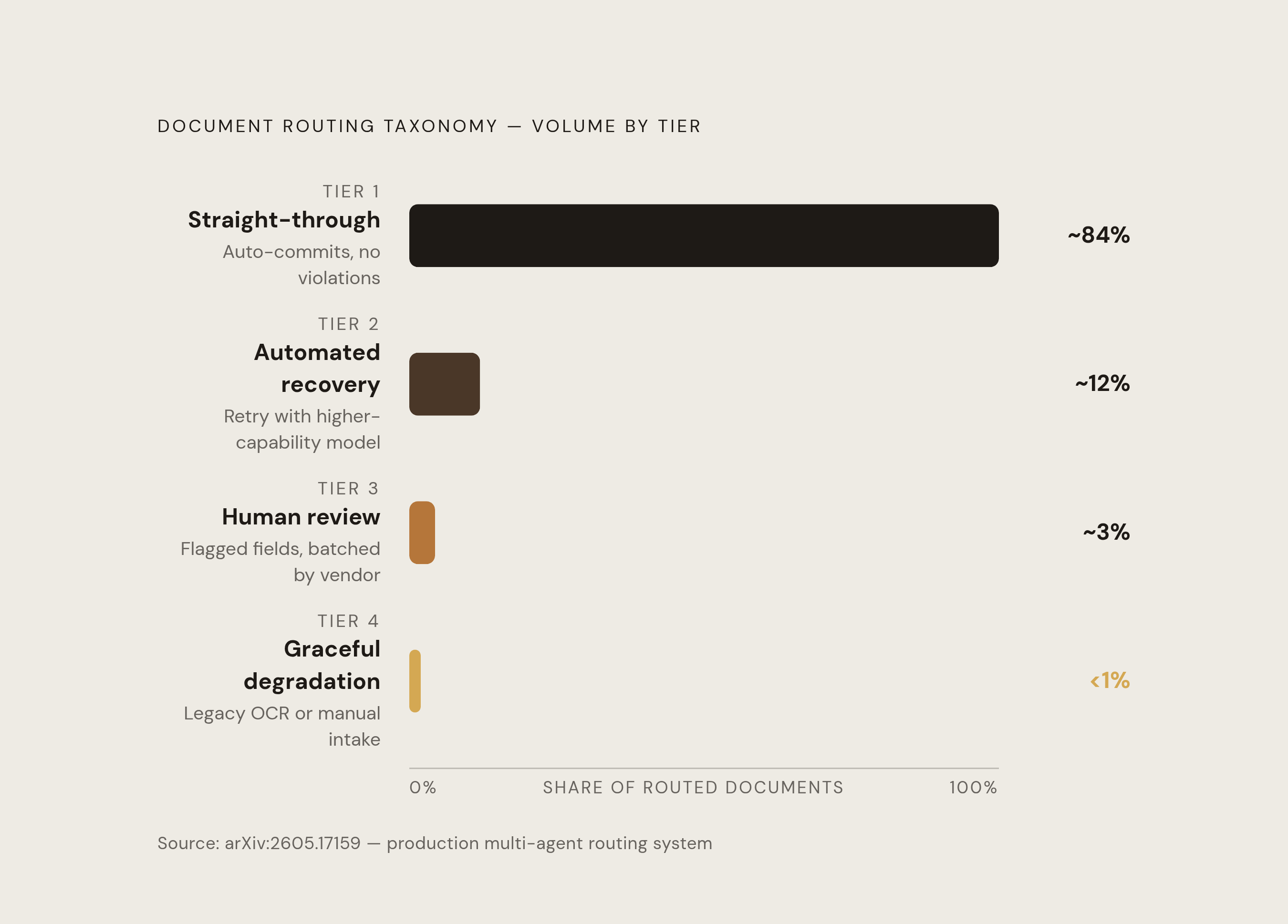
A practical routing taxonomy sorts documents into four tiers, and the tiering itself is the architecture.
Tier 1 is straight-through processing: high confidence across every field, no business-rule violations, and the document commits automatically with no human touch. Tier 2 is automated recovery: a document with low confidence on specific fields but otherwise clean gets retried, often with a higher-capability model, and can be run through contextual correction methods such as layout-aware models that reason about field proximity, then re-scored before any human ever sees it. Critically, the review interface should surface only the flagged field in its immediate context, not the entire document, which preserves throughput for everything that doesn't need that level of attention. Tier 4 is graceful degradation: unrecognized formats, badly degraded images, or an explicit operator override fall back to manual intake or a legacy system entirely.
That four-tier structure isn't theoretical. A multi-agent document processing system documented in arXiv:2605.17159, with production data running through January 2026, routed only a small share of its volume to fallback, a handful of documents to legacy OCR and a slightly larger number through a manual portal, while the overwhelming majority completed the entire pipeline end to end without any fallback at all. That's what a well-built tiering system is supposed to produce: the exceptions get sorted, most of them get resolved automatically, and only a thin, well-bounded slice ever needs a human or a manual process.
First, route on field-level signals, never document-level averages. Second, separate the routing decision from the recovery action itself, so the logic that decides where a document goes stays legible and auditable independent of whatever's happening inside the model. And none of this works if pre-processing happens after routing instead of before it: standardizing DPI, deskewing, denoising, and classifying document type all need to happen before a confidence score is even computed, per the Stack AI enterprise guidance. Splitting and classifying a mixed packet before field extraction matters for the same reason. Routing a multi-document packet as a single unit guarantees an exception because the packet itself was structured wrong from the start.
Building the human review queue so it does not become the bottleneck
Every exception that reaches a human reviewer is, in a sense, evidence of a routing failure further upstream. If the review queue is growing, the system either isn't catching recoverable failures early enough at Tier 2, or it's over-escalating things that didn't need a human at all. According to the Ardent Partners 2025 data referenced in Parseur's 2026 analysis, the industry average exception rate for AP teams is well above best-in-class, with even top performers fielding exceptions on nearly one in ten documents. It reflects how well the pipeline handles recoverable failures before they ever reach a person.
Designing the review interface itself affects how fast and accurately reviewers work. Reviewers decide faster and make fewer mistakes when they see the flagged field in its document context, alongside the specific evidence that triggered the flag, rather than being handed the entire document and told to find the problem. Batching matters just as much: a reviewer working through thirty instances of the same vendor's malformed invoice format moves faster and more consistently than one bouncing between thirty unrelated exception types.
Time-boxing review assignments isn't an efficiency nicety, it's a cycle-time requirement. An exception sitting unworked in a queue is a cycle-time problem by definition, and the Ardent Partners 2025 benchmark puts average accounts payable cycle time at 9.2 days against a best-in-class figure of 3.1 days. That gap matters beyond throughput, because cycle time gates early payment discounts independently of whatever the extraction accuracy looks like. A perfectly accurate pipeline that sits on invoices for a week and a half still loses the discount.
The MADP system's framing of human-in-the-loop review captures the right posture here: the validation interface exists to allow selective human intervention on edge cases while preserving throughput for the majority. That's the whole design philosophy in one sentence. The majority path stays fast precisely because the minority path, the genuine exceptions, is kept small and well-bounded. And the cost of getting this wrong isn't abstract. Manual data entry costs businesses an average of $28,500 per employee annually, so a bloated review queue is a direct cost that scales with volume, and it scales in exactly the wrong direction as the business grows.
Feeding corrections back into the pipeline so accuracy compounds over time
A pipeline that routes exceptions to a human and then discards the correction once it's made is solving the same problem over and over, forever. If a reviewer fixes a malformed field on a given vendor's invoice today, and that correction never makes it back into the system, the same vendor's next invoice generates the same exception next month. That's a permanent tax dressed up as a workflow.
Corrections need to be captured at the field level, linked specifically to the document instance and the extraction configuration that produced the original error, not just logged as a generic "fixed" event. And schema versioning needs to let teams test proposed configuration changes against the accumulated history of past corrections before deploying them, so a change that fixes today's failure pattern doesn't quietly reintroduce a failure pattern that was already solved months earlier.
The scale of what a properly closed feedback loop can unlock shows up clearly in a pharma industry case: a specialized document intelligence deployment processing scanned pharma documents through OCR and NLP automation reported 81% fewer data-entry errors and 73% faster review time. Those numbers are directional evidence of what's possible with structured feedback, not a benchmark to replicate exactly in a different industry. Gains of that scale come from the combination of initial automation and captured correction data working together, not from a better model deployed in isolation. A model upgrade alone doesn't produce compounding improvement. A feedback loop does.
Instrumentation and observability that make exception patterns visible at scale
An exception-handling system without instrumentation fails quietly, which is in some ways worse than failing loudly. A new vendor introduces a slightly different invoice format, scan quality shifts because someone switched printers, a schema drifts out from under the pipeline, and none of it triggers an alert, because any single document's failure is statistical noise at production volume. The degradation is invisible until someone notices the exception queue creeping upward weeks later.
Confidence score distributions over time, broken out by field type and document category, catch a distribution shift as an early warning sign before accuracy visibly degrades in outcomes. Exception rate by tier, tracking automated recovery against human escalation against graceful degradation, tells a different story: rising Tier 3 volume without a corresponding rise in Tier 2 volume means the automated recovery path has stopped catching things it should be catching. And correction rate per field flags which specific fields are being fixed most often, which points directly at where targeted model tuning or a routing rule adjustment would pay off.
Single-metric monitoring is a trap here, and the IDP Leaderboard illustrates why cleanly: a model ranked seventh overall scored higher than the top-ranked model on one specific benchmark dimension. Watching one number obscures the kind of capability profile differences that make model routing decisions worth making. Production observability has to be multi-dimensional, matched to the actual capability profiles of the models running in the pipeline, not collapsed into a single accuracy score.
Speed belongs in that same observability layer, and it needs to be measured the way Parseur's 2026 framing defines it: from the moment a document arrives to the moment validated data lands in the ERP. That definition matters because it puts the exception-handling layer inside the SLA clock, not just the extraction step.
Compliance and audit requirements that exception workflows must satisfy by design
In regulated industries, exception handling is a legal concern as much as an operational one. Every routing decision, every human correction, every model override is an auditable event, and a pipeline that can't reconstruct why a document went where it went has a compliance gap regardless of how accurate its extraction was.
The pharma sector shows what's at stake when this goes unaddressed. Surveys indicate that more than two-thirds of pharma companies name document processing as a top compliance bottleneck, with inconsistent forms directly causing late filings and audit issues.
Meeting that bar requires a few specific things built into the audit trail from the start. Every routing decision needs to log the confidence signal that triggered it, not merely the fact that escalation happened, but the reason. Every human correction needs to be attributed to a specific reviewer, timestamped, and linked back to the original extraction output, because the correction is part of the permanent record, not a silent replacement for what the model originally produced. Tier 4 graceful degradation events need to be explicitly flagged in the record rather than silently absorbed into the pipeline's output as though nothing unusual happened.
Deployment architecture is part of this compliance picture too. Self-hosted and bring-your-own-cloud options matter for sensitive document categories where data can't leave a controlled environment under any circumstances, because compliance constrains where exception data is allowed to travel just as much as it constrains how that data gets handled once it arrives. A routing tier that sends a flagged document to an external service for a second opinion might be architecturally elegant and legally impermissible at the same time, and that tension has to be resolved in the design phase, not discovered during an audit.