Redesigning Mortgage Underwriting Workflows Around AI Document Extraction
AI document extraction at intake eliminates the bottleneck that slows every downstream step.

Mortgage underwriting has always been a document problem wearing the clothes of a credit decision. The slowest, most error-prone part of the process is not the judgment call itself but the messy work that comes before it: sorting and reading loan files. The fix is not more automation layered on top. It is rebuilding the workflow so that accurate, structured extraction of the full loan file becomes the foundation every downstream step depends on.
Why the loan file is the real bottleneck in mortgage underwriting
A single loan file bundles W-2s, pay stubs, bank statements, tax transcripts, appraisals, and entity documents. Most arrive as inconsistent scans, fax images, or phone-camera PDFs. The diversity is not confined to document type. A bank statement alone has hundreds of layouts at different institutions, and tax forms come in multiple variants. The person opening every PDF to determine whether it is a W-2, a bank statement, or a title document before parsing can begin is the single biggest bottleneck between application and close.
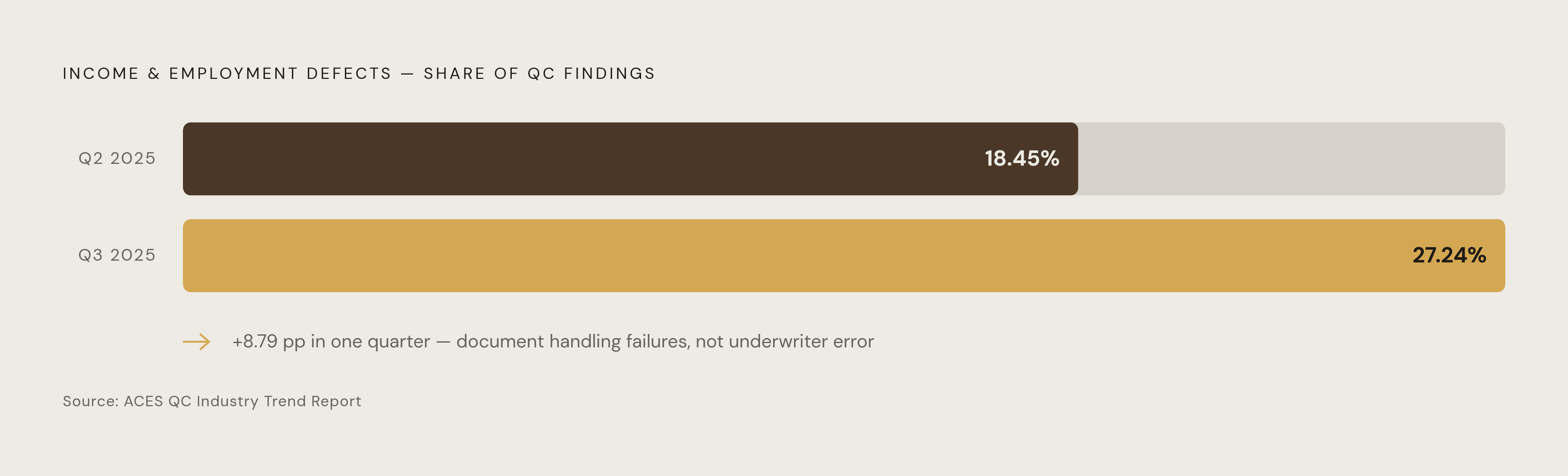
The errors that matter most trace back to this layer. Income and employment defects are the largest category in mortgage quality control, rising from 18.45% in the second quarter of 2025 to 27.24% in the third, according to ACES QC industry trend data. A tax transcript misread as a bank statement, a doctored pay stub that slides through intake unchecked, an income figure carried over from the wrong field. None of these are failures of underwriter judgment. They are failures of document handling.
The cost is structural, not incidental. The Mortgage Bankers Association's production cost data shows independent mortgage banks carrying significant per-loan origination costs, with labor-heavy manual steps accounting for most of the gap. Manual processing introduces errors at every handoff, and every handoff is a place where a document can be misfiled, misread, or missed entirely. The bottleneck is not the underwriter reviewing a file. It is the file itself.
How the shift to AI document extraction changes what is possible at intake
The shift at intake is a change in kind, not degree. Traditional OCR converts scanned images to text. AI-powered OCR understands context, identifies key data points, and automates decision-making. The distinction matters because context awareness is what lets the system know that the same field means different things across document types.
RPA scripted repetitive clicks and broke the moment a document changed format. An AI agent classifies a scanned pay stub, extracts dozens of fields, cross-checks them against the application, and passes a decision-ready file upstream, but it needs no format-specific template. The pipeline treats classification, extraction, cross-checking, and discrepancy flagging as one continuous operation with a full audit trail, rather than a series of disconnected manual tasks.
The operational evidence is concrete. TD Bank launched its first agentic AI model for mortgage and HELOC applications and reported that pre-adjudication processing dropped from roughly fifteen hours to a matter of minutes. Classification speed matters as much as accuracy: sub-five-second classification per document is the threshold that keeps files moving at the pace a closing timeline demands. If a tool takes minutes per document, it moves the bottleneck instead of removing it.
Fraud checking belongs at the same step as classification. A doctored pay stub or an altered tax transcript should get flagged the moment it is identified, not three steps later after an underwriter has already begun reviewing it. The intake layer is where the file first touches the system, and it is the only point where catching a problem costs almost nothing downstream.
What a production-grade extraction pipeline actually looks like end to end
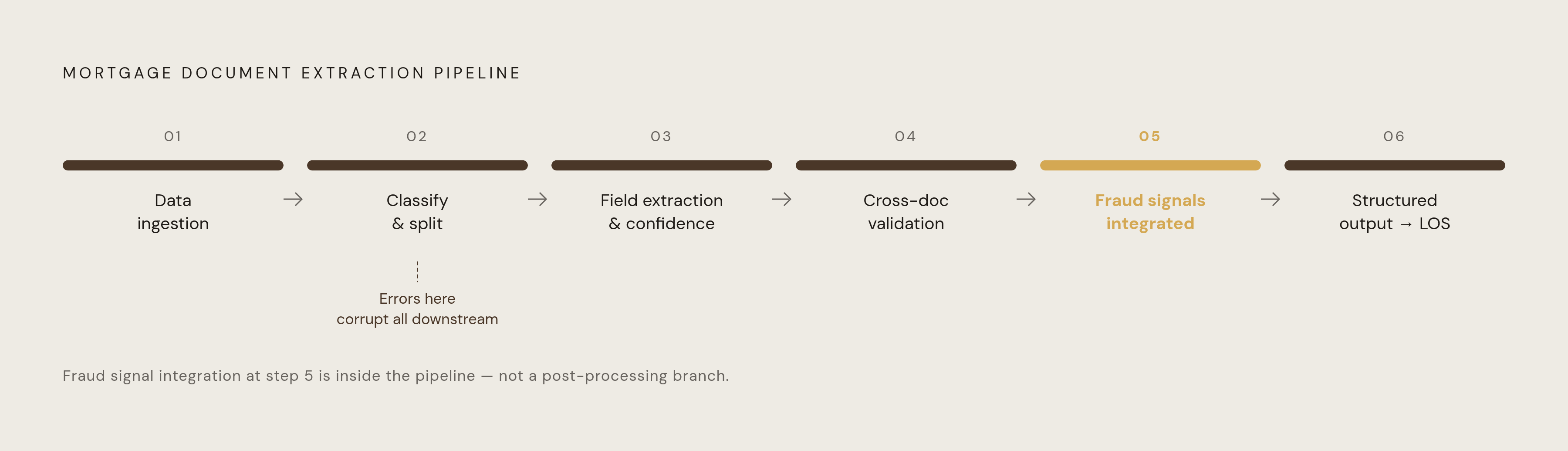
A production pipeline is not a sequence of point solutions bolted together. It is an integrated architecture where each step feeds the next: data ingestion from mixed-format sources, then document classification and splitting, then field-level extraction with confidence scoring, then cross-document validation, then fraud signal integration, and finally structured output routed to the loan origination system or underwriting platform. Splitting complex loan packages is a step that deserves more attention than it gets. A multi-borrower file or a correspondent lender submission can bundle document types that need to be separated before classification and extraction can run correctly. Getting this wrong corrupts every downstream step, because a W-2 extracted as part of the wrong borrower's file is worse than no extraction at all.
The integrated architecture shows up in what end-to-end platforms now do. Ocrolus runs document classification and indexing through income, asset, and credit analysis, and then all the way to condition generation and resolution. Lenders analyze borrower asset, income, and credit data alongside automated underwriting system findings, and they generate selling-guide-aligned conditions. Fraud detection sits inside the pipeline rather than beside it: as of October 12, 2026, every Ocrolus mortgage customer receives Ocrolus Detect, which checks bank statements, pay stubs, and W-2s for tampering and assigns each document an authenticity score with reason codes for edited text, unreconciled balances, and post-creation file changes. With Resistant AI integration, Detect also catches documents that generative AI created or edited.
The accuracy ceiling of any single model argues for an ensemble approach. Combining multiple models rather than relying on one has been shown in benchmarking to dramatically increase average extraction accuracy. The architecture question is not which single tool to plug in. It is how the pieces validate each other.
Why extraction accuracy on real loan documents is harder than vendor benchmarks suggest
Vendor accuracy figures measure performance on clean files. Real loan documents are faxed pages, phone-camera scans, low-resolution PDFs, and handwritten forms. The gap between benchmark performance and production performance is the central empirical risk in pipeline design. A tool that performs well on curated test sets will misclassify a meaningful share of real-world submissions.
The scale of the gap is visible in the contrast between headline numbers. A system can process mortgage documents in under two minutes at around 90% accuracy across approximately 60 document types. That is roughly nine points below the top production benchmarks, and a nine-point gap compounds across a high-volume loan pipeline. Methodological discipline matters as much as the headline figure. Domain-specific benchmarks on real production documents, covering document types across logistics, healthcare, financial services, and real estate, scoring structural page reconstruction and whether downstream reasoning on parsed output produces correct answers, are the only reliable proxy for production performance.
One failure mode deserves particular attention because standard benchmarks do not penalize it. A pipeline that extracts nearly all fields but silently drops entire rows in large-array extraction, multiple pay periods, or multiple bank statement months reports a misleadingly high accuracy score while producing structurally incomplete loan data. The benchmark counts the fields it saw, not the rows that vanished.
Confidence calibration is the strongest objection to relying on accuracy alone. A model that reports high confidence on an incorrect extraction is more dangerous than one that flags uncertainty, because the high-confidence error routes straight through to the underwriting decision without human review. This is where the design response begins.
How confidence scoring and human-in-the-loop routing prevent extraction errors from becoming underwriting errors
Confidence scoring at the field level, paired with configurable routing thresholds, is what allows a high-accuracy pipeline to also be a safe one. Uncertain values, failed cross-document checks, and document mismatches route to human review. High-confidence data continues automatically. The objective is not to reopen every file but to surface only the extractions that carry real uncertainty. If every extraction routes to human review, the pipeline has digitized manual work, not reduced it. It has digitized it.
Thresholds should be configurable by field, document type, loan program, or risk level. Gross monthly income on a W-2 warrants a tighter confidence threshold than a secondary address field, because the downstream consequence of an error is asymmetric. A wrong secondary address gets corrected at closing. A wrong income figure gets baked into a debt-to-income ratio and a rate sheet.
Human-in-the-loop is a deliberate architectural choice that makes high accuracy achievable, not a compromise. Catching errors before they reach the underwriter is a product responsibility. Built-in evaluation and confidence scoring distinguish a production-grade extraction layer from a prototype that works on demo documents. The time saved compounds because an underwriter who receives a file with extraction already validated spends review time on judgment, not transcription.
What regulators now require from AI-assisted underwriting pipelines
The 2026 regulatory environment has removed optionality from pipeline transparency. Lenders using AI in underwriting must document extraction lineage, provide explainable adverse action reasons, and demonstrate that every automated step can be audited. These requirements flow directly back to how the extraction layer is built.
The CFPB's Circular 2026-03, issued in May 2026, explicitly addresses how lenders must handle explainability when AI is involved in credit decisions. This is distinct from the April 2026 final rule amending Regulation B, which addressed disparate impact, discouragement, and special purpose credit programs rather than AI explainability. Fannie Mae's AI and ML governance Lender Letter and the updated interagency model risk management standards, issued by the OCC, Federal Reserve, and FDIC in coordination on April 17, 2026, landed within the same window. Lenders who were cautiously watching the space may not have caught up with how thoroughly the compliance landscape has been formalized.
In 2026 regulators are scrutinizing three AI practices in lending: adverse action explanations for algorithmic credit declines, fair lending bias in ML credit scoring models, and data provenance in AI-assisted underwriting. All three trace back to the extraction layer. Every field extracted from a bank statement, pay stub, tax return, or W-2 must be tied back to its precise source location in the original document, giving underwriters confidence-scored lineage that examiners now expect when reviewing AI-assisted credit decisions.
The regulatory push toward explainable document intelligence, recording OCR confidence scores, source file hashes, and full extraction lineage, has a practical benefit. It makes AI-processed files more auditable and defensible than manually processed ones when a calculation is later disputed. The infrastructure must also meet security and compliance standards commensurate with loan file sensitivity: SOC 2, HIPAA, and GDPR certification, zero data retention policies, and self-hosted or BYOC deployment options for lenders who cannot route sensitive borrower data through shared cloud infrastructure. Getting the extraction layer right is what makes the compliance layer tractable.
Why consumer trust in AI underwriting has declined even as lender adoption has grown
Lender adoption of AI underwriting has accelerated, but consumer trust in AI has moved in the opposite direction. The divergence is a design problem, not just a communications problem. Borrowers who do not trust the process are more likely to dispute decisions, request manual review, or abandon applications.
Most consumers want AI clearly labeled, and they reject unapproved automated valuations and show low tolerance for AI errors. The strongest objection from borrowers is not speed or convenience. It is the perception of an opaque process that cannot explain a denial, which is exactly the failure mode the CFPB's adverse action guidance addresses. Transparency about what the AI did and did not decide is a borrower experience requirement, not just a regulatory one.
The structural response is human-in-the-loop architecture, communicated clearly. AI handles extraction and validation. A human underwriter makes or reviews the final credit decision. This is operationally true, and it is now a compliance requirement under Regulation B. The trust gap is not a reason to slow AI adoption. It is a signal about what the pipeline must surface to borrowers.
What rebuilding the workflow around extraction actually requires in practice
Rebuilding the workflow means making the extraction layer the explicit foundation that every downstream step depends on: income verification, cross-document validation, risk scoring, condition generation, audit trail. It is not an automation add-on layered onto an existing process. The sequencing question comes first. Classification and splitting must come before extraction, and fraud signal integration must happen at classification, not as a downstream audit step. If the order is wrong, errors propagate before they can be caught. The accuracy question follows: benchmarking the extraction layer on document quality conditions that match actual loan file intake, scanned, faxed, handwritten, mixed-format, is the only way to know whether production performance will match vendor claims.
The confidence question is operational. Field-level confidence scores with configurable routing thresholds by document type, field sensitivity, and loan program are what make selective human review viable rather than theoretical. The lineage question is simultaneously the answer to the examiner's question, the underwriter's audit need, and the borrower's adverse action explanation: every extracted field must carry a traceable reference to its source location in the original document.
The integration question determines whether any of this ships. An API-first extraction layer with pre-built integrations into loan origination systems, SDKs in the languages engineering teams already use, and agent skill templates is what makes it possible to go live in days rather than months. The compliance question runs through all of it: SOC 2, HIPAA, GDPR, with self-hosted deployment available for lenders who cannot route borrower data through shared infrastructure, and PCI compliance supported through self-hosted deployment. A platform built as document processing infrastructure rather than a point solution is what the architecture requires. The quality of that foundation determines whether everything built on it holds.