AI-First Patient Intake and Prior Authorization Workflow Design
Document extraction accuracy determines whether AI-first prior auth workflows succeed or fail.

Prior authorization is a persistent bottleneck in healthcare because it consumes clinical hours and delays patient care. The standard framing treats it as a workflow problem: too many steps, too much manual effort, too little automation. The structural reality is different.
Why prior authorization is an AI infrastructure problem, not just a workflow problem
Physicians complete roughly 39 prior authorization requests per week and spend hours on each one, according to a 2026 Develop Health analysis citing AMA survey data, and the burden falls hardest on small practices that lack administrative staffing. That burden is well documented. What gets less attention is the mechanism underneath it: prior authorization is a chain of tasks reaching from intake through evidence assembly and payer matching to submission, status tracking, and appeal, and every link in that chain depends on reading a document correctly. A workflow tool that routes the chain more efficiently does nothing if the document at the front of the chain was misread.
Regulatory pressure is now forcing the issue. CMS-0057-F set 72-hour turnaround for urgent requests and seven calendar days for standard requests beginning in 2026, with FHIR-based Prior Authorization APIs required by January 2027, and payers must publicly report approval rates and average decision times by March 31, 2026. These deadlines compress the window in which a document error can be caught and corrected. But the 2026 HealthEdge Annual Payer Report found that the vast majority of payers have adopted AI, and they cite prior authorization and claims adjudication among the highest-impact deployment areas. Wide adoption has not made the document extraction problem disappear. If anything, it has exposed it: the automation layer is only as good as the document layer beneath it.
What the AI-first PA pipeline actually requires from its document layer
A production prior authorization pipeline is a multi-stage, multi-agent workflow, and the document layer is load-bearing at every stage rather than a preprocessing step that happens once at the front. Workhint's 2026 AI prior authorization workflow guide describes the canonical pipeline as running through intake and completeness checking, clinical evidence extraction covering chart notes and labs and imaging and medications and prior treatments, payer criteria matching, submission with form prefill and final review, status tracking, and appeal or resubmission. Each stage consumes documents in different formats and for different purposes, so each one makes its own demands on how those documents were parsed and extracted.
Documents arrive through every channel a healthcare organization operates: fax, phone, provider portal, and API/EDI. The document layer has to handle format heterogeneity before any agentic logic can run, because an agent that reasons over a misparsed fax produces confident errors rather than correct decisions. Evidence extraction is the most demanding stage in the chain, since the system must pull diagnosis codes, clinical notes, labs, imaging results, and medication history, then match each extracted field to payer-specific criteria. Denial risk intelligence, which flags requests with elevated denial probability before submission so clinical teams can strengthen the evidence package, is only possible when extracted fields are accurate and traceable back to their source in the record. The same infrastructure feeds appeal generation: when a payer denies a request, the system parses the denial reason, pulls supporting evidence from the note, and drafts an appeal. That step fails entirely if the original extraction was incomplete or uncited.
Where extraction accuracy actually breaks down on clinical documents
OCR and extraction accuracy on clinical documents is not a solved problem, and the failure modes that matter most for prior authorization are precisely where current systems are least reliable: handwritten notes, mixed layouts, and continuous numeric fields. Well-formatted printed clinical text reaches high accuracy, but real-world mixed clinical and pharma documents, the kind that dominate PA packages, fall into a lower range because of layout noise and quality issues. If a benchmark does well on clean typewritten text, it says little about a patient record assembled from fax pages, handwritten margins, and lab printouts.
Handwritten physician notes are a particular liability. Traditional OCR handles physician handwriting poorly, and illegible handwriting is a documented source of medication errors, so a practical pipeline has to route handwritten sections to vision-language models rather than treat that as an optimization. Numeric field extraction degrades sharply as well: continuous numeric measures such as lab values, dosing data, and vital signs are extracted far less reliably than binary or categorical fields, which matters directly for PA packages that include lab results or dosing histories. Error propagation compounds the problem, because recognition errors, layout noise, and inconsistent formatting in OCR output create text that is hard for downstream models to interpret and that lacks native compatibility with EHR schemas. The implication is that a general-purpose model applied to clinical documents does not solve the layout, handwriting, and numeric extraction problems. Specialized vision models and a system harness designed for clinical document variability are required.
How extraction failures propagate into denial rates and downstream agent quality
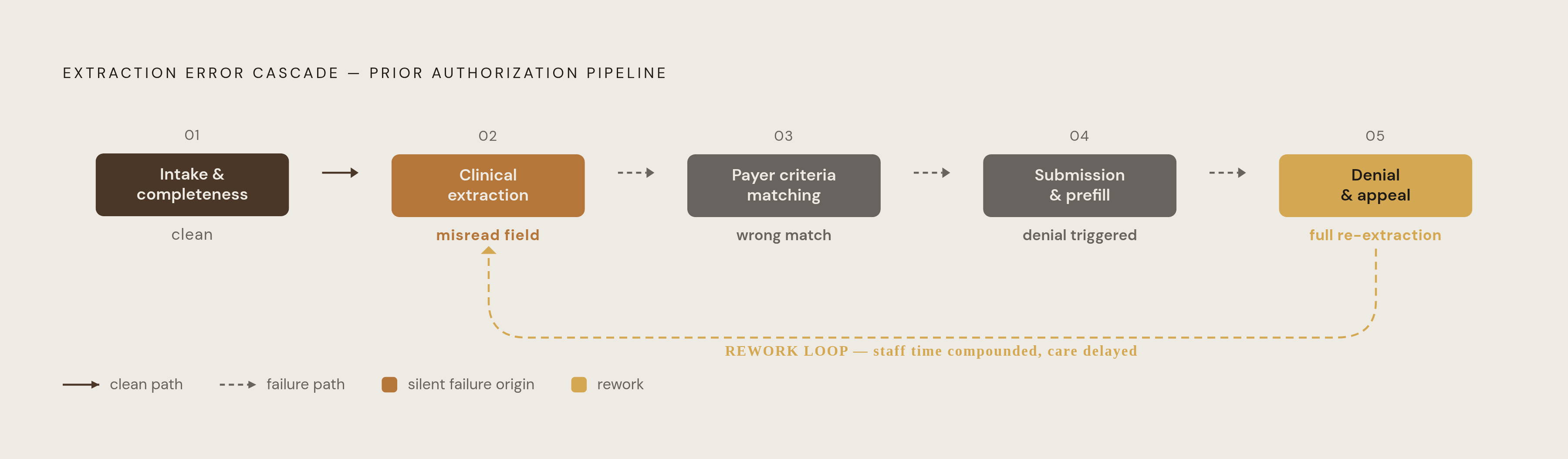
A missed field or misread value in the extraction stage does not stay local. It degrades every downstream step: the evidence package is incomplete, the payer criteria match is wrong, and the denial rate rises on a submission that looked complete from the outside. First-pass approval rate is the operational KPI that captures this, because AI tools that use clinical evidence extraction and LLM-enriched form filling improve it by improving documentation quality before the request reaches the payer. Extraction quality is a direct input to that rate, not a background variable.
The inverse holds as well. When a payer denial arrives because supporting evidence was missing or mis-cited, the appeal workflow must re-extract and re-assemble the same documents, compounding staff time and extending the delay to patient care. The most damaging failure mode is the silent one. A system that fails loudly, flagging low-confidence extractions and routing them to exception handling, is recoverable. A system that submits confidently on wrong data produces denials that look like payer decisions rather than infrastructure failures. The document layer is where first-pass rates are won or lost, because the difference between a clean submission and a denied one is often a single misread field that no downstream agent ever saw.
What a production-grade document infrastructure layer looks like for PA workflows
A production-grade document infrastructure for prior authorization is not a single OCR step. It is a system that handles parsing, extraction, classification, splitting, and confidence scoring as coordinated capabilities, each tuned to the specific demands of clinical document types. Parsing and extraction must handle heterogeneous clinical documents including chart notes, labs, imaging reports, faxed intake forms, and handwritten annotations, with field-level accuracy and source citation back to the original record rather than a summary output. Document splitting and classification are prerequisites before extraction can run: a PA package arriving as a multi-page fax must be split into its component documents and each classified by type before the right extraction logic can be applied. That step is often underestimated in pipeline design, and skipping it means applying the wrong extraction model to the wrong document type.
Confidence scoring is a non-negotiable production requirement. Low-confidence extractions must be flagged and routed to human review instead of auto-submitting, because that is what keeps exception queues small and audit trails complete. Large-array extraction, pulling all lab values, all medications, and all prior treatment fields from a long clinical document, must explicitly penalize dropped rows, because a system that extracts most fields correctly but silently omits rows produces a structurally incomplete evidence package that causes denials without surfacing as an error. The system harness matters more than which frontier model sits underneath: performance on splitting, extraction, and parsing depends on the surrounding infrastructure, including data routing, model selection per document type, confidence thresholds, and exception handling. If you adopt an API-first, modular architecture, you can add parsing and extraction incrementally, starting with your highest-volume document types and layering in more capabilities without rebuilding the pipeline every time a document type or payer requirement changes.
The compliance layer that clinical document infrastructure must satisfy
Every system in the prior authorization pipeline that touches protected health information carries the same HIPAA obligations that apply to human workforce members, and AI pipelines built for enterprise search were not designed with PHI governance in mind. HIPAA requires a signed Business Associate Agreement with any vendor processing PHI, audit controls under 45 CFR §164.312(b), minimum necessary access to PHI, and a 60-day breach notification clock. These requirements apply to the document infrastructure layer, not just the application layer above it, because the document layer is where PHI first enters the automated pipeline and where it persists.
AI decision logging adds a specific retention obligation: every autonomous decision must be stored in immutable, tamper-proof storage for the full required retention period, making audit trail completeness an infrastructure specification rather than a feature. Self-hosted and BYOC deployment options are not optional for sensitive clinical environments. They are the architectural requirement for organizations that cannot accept third-party data retention on PHI, particularly in healthcare settings subject to HIPAA and state-level data requirements. The connection to the confidence-scoring architecture is direct: an audit trail that records which extractions were flagged as low-confidence and who reviewed them is only as complete as the document layer's scoring mechanism, which means compliance and extraction quality are the same design decision made twice.
How to evaluate whether a document infrastructure layer will hold up in production PA
The right evaluation criteria for document infrastructure in prior authorization workflows start from the failure modes that cost money in production: dropped fields, misread numeric values, and unsplit multi-document faxes. Vendor-reported aggregate accuracy rates on clean data do not tell you what you need to know. Require benchmark transparency that matches your document population. If a benchmark runs on printed structured text, it will not predict performance on a mixed-format PA package with handwritten annotations, so you should look for benchmarks on real-world clinical document types that explicitly measure dropped rows and extraction completeness, not just correctness on extracted fields.
Confidence scoring deserves evaluation as a first-class capability. A production-ready system should flag low-confidence extractions for human review instead of auto-submitting, and you should look at how exception routing works, what the audit trail captures, and whether you can configure the confidence threshold to your organization's clinical risk tolerance. Payer connectivity and submission channel coverage should be assessed as a separate layer from document extraction. Prosper's 2026 guide identifies broad payer connectivity across portals, APIs, fax, and phone as a core buying criterion, because gaps in connectivity push submissions back into manual workflows regardless of extraction quality. Compliance architecture must be demonstrated before production: BAA availability, zero data retention policy or BYOC or self-hosted deployment, SOC 2 and HIPAA certification, and audit log retention meeting the six-year documentation standard should all be confirmed before any PHI touches the system.
Time-to-production matters as an infrastructure criterion in its own right. A document pipeline that takes months to configure and validate delays the revenue and care-access benefits the automation is meant to deliver, so you should ask whether the platform's API surface, SDKs, and pre-built templates for clinical document types let a team go live on a meaningful document volume in days rather than months. The measure of success is first-pass approval rate improvement traceable to extraction quality, not automation rate in isolation. Track field-level extraction accuracy on the actual PA document mix, first-pass approval rate before and after, and exception queue size as the operational signal that the document layer is holding up. Better documents in means better decisions out, and the infrastructure layer is where the automation commitment gets made or broken. Teams that invest there before layering agents on top get a pipeline that holds up under production load. Teams that don't get a compelling demo that fails the first time a fax arrives with a handwritten note on page three.