Template-Based OCR Failure Modes in Production
Why template-based OCR fails silently when document layouts shift.

Template-based OCR breaks down in production for a structural reason, not a bad-luck reason: it reads position on a page, not meaning, and the moment a document's geometry shifts, the system has no way to notice. An engineer draws bounding boxes over a sample document, tells the system "this rectangle is the invoice number, that one is the total," and runs OCR inside each zone. The layout is the program. That works fine in a demo, since the template gets built and tested on the same document it will later be graded against. It stops working once volume and vendor variety climb, and by then the team has usually already built its ROI case on the demo number.
The whole approach rests on one assumption: that a document's geometry stays fixed and known ahead of time. Every failure mode below is that assumption coming apart, one vendor redesign at a time.
A vendor reships the same invoice format but shifts the header block half an inch to make room for a new logo. The data hasn't changed. The template, still reading fixed coordinates, now pulls the PO number into the field marked "invoice number." Nothing in the pipeline objects, because nothing was built to object.
Coordinate drift is dangerous rather than merely annoying. The extraction step returns a value, the value passes validation, and the mistake becomes visible only when a payment lands in the wrong account. No exception fires. The system reports success because, from its point of view, nothing went wrong: it found text inside a rectangle and handed it over. A coordinate that lands on the right spot and one that lands two inches off look identical to the software, since the software was never checking meaning to begin with.
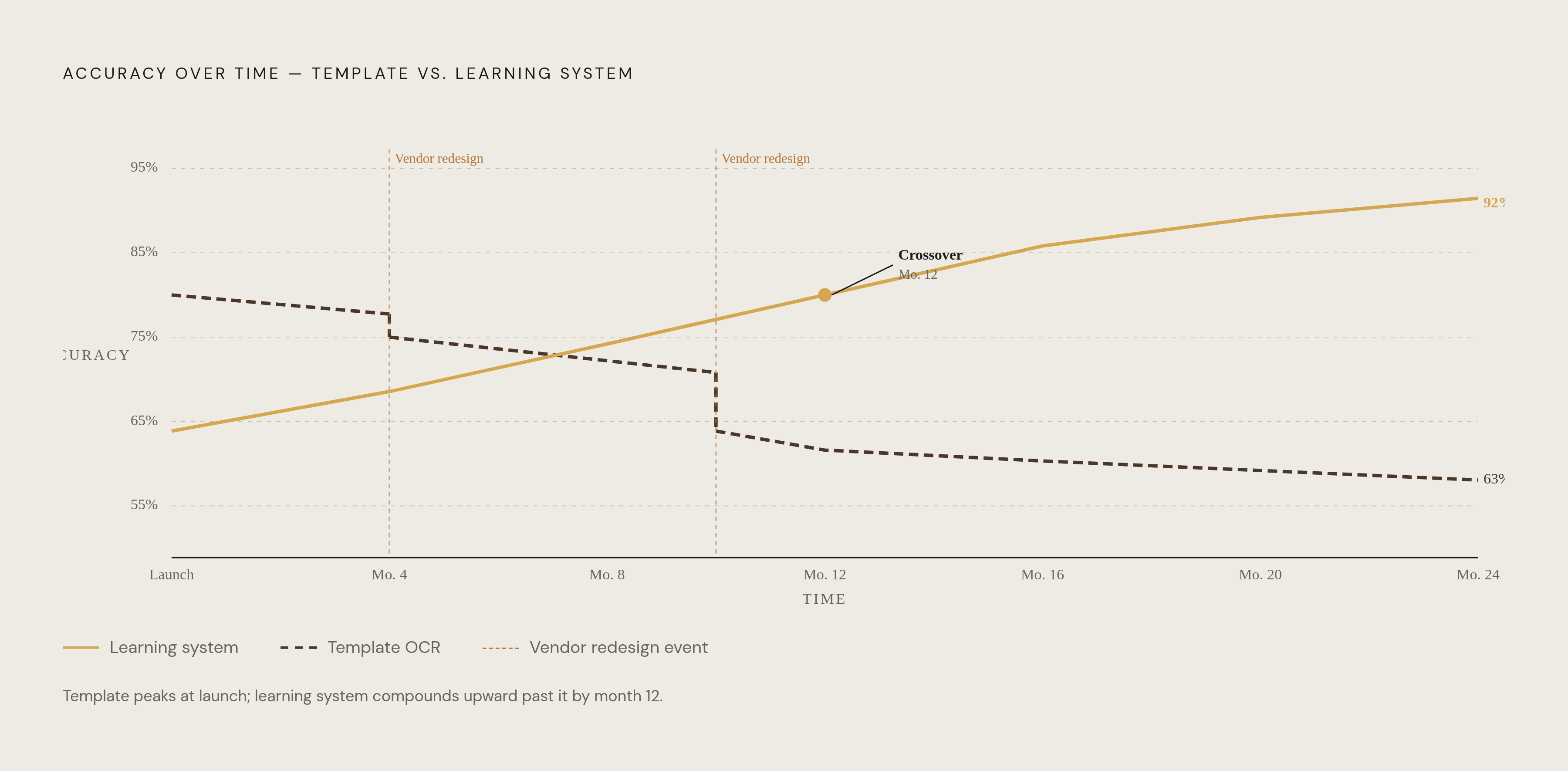
This is not a once-a-year edge case. Every vendor redesign, every new letterhead, every reformatted header is a live trigger. A template sits one layout change away from breaking, and when it breaks, it breaks quietly. Catching it takes a downstream check, a validation rule, or a human reading the output line by line, and none of those come free.
Three additional failure modes that compound with coordinate drift
Coordinate drift rarely occurs alone. Three companion failures tend to ride with it, and together they turn one misalignment into a cascade.
Page breaks move when line items move. A vendor adds a few extra rows to an invoice, everything below gets pushed further down the page, and the page-level coordinates the template was built on no longer line up with anything. Nothing about the vendor or the format has changed, just the length of one order, and that's enough to misfire on its own.
Scan geometry adds a second layer on top. Documents don't arrive in one clean format. Some come in as high-resolution PDFs, some as phone photos taken in bad light, some as faxes, some as scans at whatever DPI the sending office's machine happens to run. A template built against a crisp PDF has no mechanism for adjusting when the same document shows up rotated a few degrees, cropped differently, or compressed hard enough to blur the edges. There's no feedback loop. The template can't notice it's misaligned, so it can't correct for it, and it will happily extract from the wrong coordinates with the same confidence it had on the clean PDF.
Regex sprawl is the scar tissue left behind by the other two. Every time a date format, a currency symbol, a thousand-separator, or an odd tax line breaks an extraction, someone patches it with another regex rule stacked on the last one. Each patch solves yesterday's failure and nothing else. After enough of these, the pipeline turns into a pile of fixes for fixes that no single engineer fully understands anymore. The worst version hits when all three collide at once: a rotated scan of a longer-than-usual invoice from a vendor who just redesigned their header runs into coordinate drift, page-break shift, and scan geometry variation in the same document, at the same time.
What 70–85% accuracy means for a real production workload
Template-based OCR in logistics operations typically is between 70% and 85% accuracy right out of the box. That leaves 15% to 30% of fields needing a human to catch and fix by hand, and that gap, not the headline number, is where the real cost lives.
On an invoice with roughly 70 fields, correcting a bad extraction often takes about as long as retyping the whole document from scratch. Once that's true, whatever time savings the system was supposed to deliver quietly evaporate before the month closes. This is the reported baseline for logistics specifically, under ordinary operating conditions, not a bad month, and it holds before anyone has spent a dollar shoring it up with maintenance.
The fixed ceiling caps how well the system can ever perform, regardless of the percentage itself. A learning system improves with more data and more corrections over time. A template does not: it performs best on day one and only drifts downward as document formats shift underneath it. Even where confidence scores exist, they do not tell reviewers which specific fields are most likely wrong within the error share. The entire 15% to 30% error share lands on human reviewers undifferentiated, because the system cannot tell them which fields deserve a second look and which don't.
The maintenance burden that never appears in the original ROI model
Every distinct layout needs its own template. A mid-size accounts payable team handling several hundred vendor formats is really maintaining several hundred small pieces of software, each built, tested, and kept current on its own schedule. Treating that as a one-time setup cost, rather than an ongoing engineering commitment, is the single most common miscalculation in the original business case.
New suppliers bring their own tax on top of that. A vendor can't be processed at all until someone builds and tests a template for their specific layout, and that onboarding lag hits hardest right when a company least wants friction: during a new supplier relationship. Compare that to automated extraction systems used elsewhere in logistics, where the first document from a new carrier gets processed the same day it arrives, no template build required.
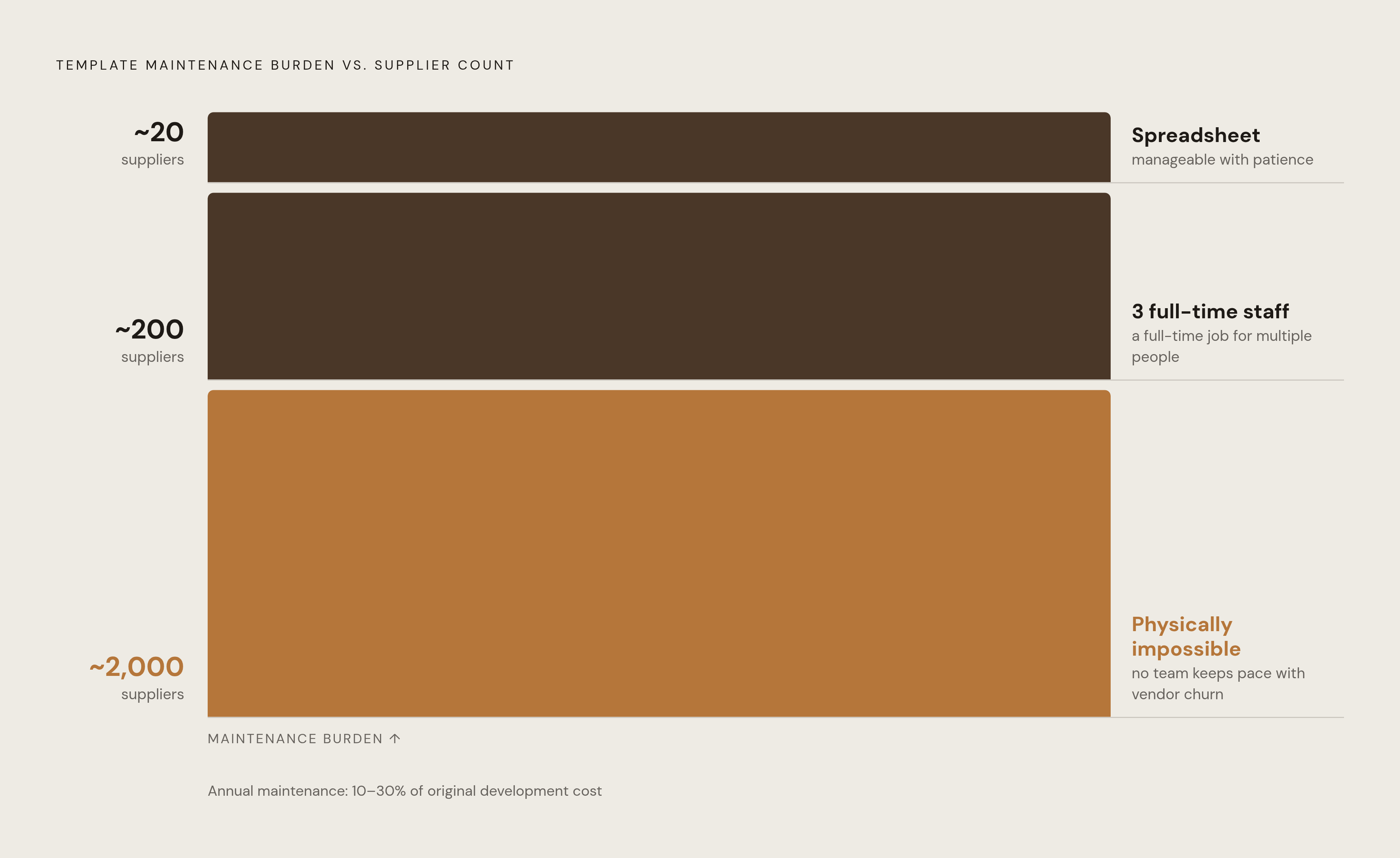
At real scale this appears in headcount. A company pulling invoices from over 200 suppliers ends up with three full-time staff whose entire job is template upkeep: rebuilding zone maps, testing extractions, rolling back changes that broke something downstream. Twenty suppliers is manageable with a spreadsheet and some patience. Two hundred is a full-time job for multiple people. Two thousand doesn't work, not as a budget problem but as a matter of physical possibility, since no team can build and maintain templates fast enough to keep pace with vendor churn. Ongoing maintenance and model updates typically run 10% to 30% of the original development cost every year, a recurring line that almost never made it into the spreadsheet that justified buying the system in the first place. That original math assumed stable layouts and no maintenance. Neither assumption survives contact with real volume and real vendor variety.
OCR model drift: the separate degradation that compounds template fragility
Template fragility is one problem. Model drift is a different one, and it stacks on top rather than replacing it. Model drift is the gradual decline in a trained model's accuracy as the documents it sees in production drift away from whatever it was trained on.
What drives this in OCR isn't abstract. Print quality gets worse, paper stock changes, a scanner gets swapped for a cheaper one, compression artifacts creep into images. These are physical shifts, not statistical noise in a training set. The effect appears most clearly in regulated workflows: KYC checks, healthcare intake forms, claims documents, where a small change to an ID format or a form layout produces the same extraction failure over and over until someone finally notices the pattern.
Template maintenance and model drift are additive, and that's what catches teams off guard. A team can rebuild every template correctly, keep every zone map current, and still watch accuracy slide, because the underlying recognition model is drifting against document characteristics nobody adjusted for. The standard defense is to record Character Error Rate, Word Error Rate, and average confidence scores against a representative production sample at deployment, then check every future measurement back against that baseline. Skipping that step makes a template alignment failure indistinguishable from a model recognition failure. Both look identical from the outside: wrong output, no warning.
The danger of silence in these failure modes combined
Every failure mode covered so far shares one trait: the pipeline hands back a value and calls it a success. Coordinate drift returns the wrong field's contents with no flag raised. Scan geometry misalignment returns garbled text that still happens to pass a regex check. Model drift returns output that reads as plausible but has no real support in the image it came from.
Research on generative OCR risk points to a mechanism behind that last failure. Autoregressive decoding favors whatever looks most semantically plausible, so when the actual visual evidence is thin, the model fills the gap with what researchers call "unsupported substitutions": text that reads fine but was never grounded in the image at all. Average accuracy on a benchmark can stay high even as the risk of a severe, unnoticed error grows in the tail.
Template systems share that blind spot, and coordinate-match logic gives no indication of how far a hit drifted from the intended field. A coordinate match gets treated as a correct extraction, full stop, no matter how far it drifted from the field it was supposed to hit. The engineering fix researchers have proposed is explicit accept-or-abstain logic, using something like geometric multi-view consensus, so the system either produces a transcription it can stand behind or refuses to answer at all. Abstaining becomes part of the contract instead of a failure of it. Without that kind of confidence infrastructure built in from the start, most teams find out about these failures the hard way: a downstream error surfaces long after the extraction layer has moved on to the next document.
Where template OCR still holds, and its structural limits
Template OCR is not wrong everywhere, and treating it as universally obsolete would be its own kind of mistake. It holds up fine when document geometry is genuinely fixed (government forms built to a legal layout standard are the clearest case), when volume stays low enough for a small team to keep templates current by hand, and when the cost of an occasional missed field is small enough to absorb with manual review.
Past that point, it becomes the wrong tool. The failure modes turn into real operational risk once several conditions show up together: multiple vendors whose layouts shift on their own schedules, documents with variable line-item counts that move page breaks around, a mix of PDFs, scans, photos, and faxes landing in the same intake pipeline, regulated workflows where a silent misread carries compliance exposure, or volume high enough that manually reviewing that 15% to 30% error share consumes much of the efficiency gain the automation was meant to deliver.
The scaling ceiling is the cleanest warning sign available to a team deciding what to do next. As the number of suppliers or document types grows, template maintenance cost grows right alongside it, and the operational math falls apart well before the accuracy numbers do. Newer document processing systems built around vision models, with classification, extraction, validation, and confidence scoring wired together as connected stages rather than bolted on after the fact, address these failure modes structurally instead of patching them with one more regex rule or one more reviewer. The choice between template and a vision-based system isn't a matter of taste. It comes down to whether the geometry, volume, and variety of the documents a team handles today have already outgrown the assumptions the template was built on, and for any operation processing more than a couple hundred vendor formats, that threshold has usually already been crossed.