Audit Trail Requirements When AI Replaces Human Document Review
Regulators now require AI systems to automatically record their reasoning, not just their outputs.

Audit Trail Requirements When AI Replaces Human Document Review.
Traditional Audit Logs and the Compliance Gap Created by AI Document Review
When an AI system replaces a human document reviewer, the audit trail has to do something logs were never built for: reconstruct a full decision chain, including what the model saw, which version of it ran, how confident it was, and where a person could have stepped in but didn't. Getting that record right, across the frameworks now governing document processing, is what separates a defensible AI pipeline from one that becomes a liability the moment a regulator asks a hard question.
Human reviewers leave a trail almost by accident. Someone opens a file, someone marks it up, someone signs off, and the who-and-when writes itself into the process. AI systems don't do this. An output appears with no visible reasoning behind it unless an engineering team has gone out of its way to capture that reasoning as a deliberate design choice. That distinction, between operational logs and a compliance audit trail, matters more than most organizations initially treat it. Logs record system state and errors: did the server respond, did the job fail, what was the latency. A compliance audit trail documents the governance process itself: what policy was in effect at the time, what data the AI touched, and whether a human actually exercised oversight or just rubber-stamped an output.
The failure mode is not hypothetical. A regulator asks for the decision chain behind a specific case, the organization goes to check its logs, and finds only an output sitting there with no reasoning, no surrounding context, and nothing resembling an audit trail. Part of what makes this so persistent is that AI systems are non-deterministic in a way a server simply is not. Proving compliance means being able to reproduce and explain an output. That's a fundamentally different evidentiary standard, and most legacy logging infrastructure wasn't built to meet it.
Governance hasn't caught up either. McKinsey's State of AI survey found that only 28% of AI-using organizations report direct CEO oversight of AI governance, and only 17% report board-level oversight. That gap between what regulation now expects and what organizations have actually implemented is exactly where audit failures originate. And the stakes are not abstract. Loan approvals, medical triage decisions, KYC checks, insurance claims: this is the terrain where AI document review is now operating, and "the model decided" stopped being an acceptable answer to a regulator some time ago. The question this raises is specific and practical: what, exactly, must an audit trail capture when an AI system takes over for a human reviewer, and what makes that record hold up under examination?
The regulatory frameworks that now require a documented AI decision chain
Three frameworks anchor this field, and they don't carry equal legal weight. The EU AI Act (Regulation (EU) 2024/1689) is legally binding for high-risk systems, while the NIST AI Risk Management Framework and ISO/IEC 42001 remain voluntary, though both are referenced heavily by regulators and by enterprise procurement teams doing vendor due diligence.
The EU AI Act's Article 12 requires that high-risk AI systems be technically capable of automatically recording events (logs) over the system's entire lifetime Kognitos / AI Audit Trail Requirements 2026. Article 19 sets a minimum retention period of six months Kognitos / AI Audit Trail Requirements 2026. Article 13 demands enough transparency that a deployer can actually interpret what the system produced, and Article 11 mandates technical documentation, with the specific content spelled out in Annex IV: design decisions, training data, evaluation results Kognitos / AI Audit Trail Requirements 2026. The word "automatic" in Article 12 is doing real work here Kognitos / AI Audit Trail Requirements 2026. It means the system itself has to generate the logs; a human jotting notes about what the model seemed to do afterward does not satisfy the requirement. And "lifetime" means from deployment straight through to decommissioning Kognitos / AI Audit Trail Requirements 2026.
Enforcement carries teeth: fines reach €15 million or 3% of global annual turnover for non-compliant high-risk systems Velt / AI Decision Audit Trails Kognitos / AI Audit Trail Requirements 2026. A May 7, 2026 agreement pushed the headline high-risk obligations back, to December 2027 for stand-alone Annex III systems and August 2028 for Annex I product-embedded systems, but the logging and human-oversight expectations were left in force regardless Velt / AI Decision Audit Trails Kognitos / AI Audit Trail Requirements 2026. Compliance teams that read the delay as a reprieve on documentation are misreading it.
US public companies now have their own anchor point. In February 2026, COSO published "Achieving Effective Internal Control Over Generative AI," which requires audit trails complete enough to capture prompts, inputs, outputs, model and configuration versions, and evidence of human review, sufficient to reconstruct what the AI acted on and to demonstrate that a control functioned as designed. That guidance is fast becoming the internal-control reference point for SOX purposes. It matters because the SEC announced a dedicated SOX enforcement group in March 2026 aimed at audit firm misconduct, and AI-touched controls are squarely inside that scope. A control that can't show the COSO linkage may not survive PCAOB AS 2201 scrutiny.
Industry-specific rules stack on top of this baseline rather than replacing it. HIPAA requires six-year retention, a unique user identification rule, and PHI access logging.
NIST's AI RMF organizes itself around four functions, Govern, Map, Measure, Manage, and it names concrete artifacts, model cards, evaluation records, runtime monitoring logs, as the evidence that makes traceability something more than a slogan https://www.techtarget.com/searchcio/tip/4-steps-to-remain-compliant-with-SOX-data-retention-policies. It's already referenced by federal agencies and several state AI laws. ISO/IEC 42001 takes a different angle: it treats the AI lifecycle as something that keeps evolving. The audit ledger has to be dynamic rather than a static snapshot taken at deployment. Under Clause 9.1 and Annex A, traceability has to span data provenance, ongoing behavioral monitoring, and operational change management.
The vocabulary shifts from framework to framework, logs here, records there, documentation somewhere else, traceability elsewhere still. The terminology shifts from framework to framework, but every one of these frameworks is asking for the same underlying record. PCI DSS v4.0 Requirement 10 requires logs capturing user ID, event type, date and time, success/failure, and event origination, with 12 months of retention and 3 months immediately available Velt / AI Decision Audit Trails. SOX requires 7 years of audit work papers, though SOX itself mandates no specific operational log retention period. EU AI Act Article 12 requires a minimum of 6 months, and up to 10 years post-deployment for high-risk systems, the longest floor across any framework Velt / AI Decision Audit Trails. Under Freddie Mac Section 1302.8, enforced since March 3, 2026, and Fannie Mae LL-2026-04, enforced since August 6, 2026, mortgage AI decisions must produce logs satisfying these guidelines. FDA 21 CFR Part 11 requires that audit trails be computer-generated, time-stamped, and secure, independently recording the date and time of operator entries and actions that create, modify, or delete electronic records.
The 12 fields an AI audit trail must capture to satisfy cross-framework requirements
Treat what follows as a floor. Compliance teams preparing for 2026 audit cycles are already running gap assessments against schemas like this one, well before an external auditor ever shows up. The pattern that emerges across the relevant frameworks converges on a 12-field minimum schema, each field tied to a specific regulatory demand.
A timestamp, NTP-synced and recorded in UTC, is the baseline: it establishes exactly when a decision occurred, and system clock drift is no longer something an auditor will forgive. A unique decision ID lets an examiner pull a single case back out of the record for reconstruction. Authenticated human user identity is, by most accounts, the most frequently missed field: when AI accesses regulated data under a service account or an API key rather than an identified person, it fails HIPAA's unique user ID rule outright.
AI system identity and version identifies the platform itself and supports change management obligations. Model identity and version has to go further than a label like "GPT-4," which is not specific enough; version pinning has to be precise enough that a decision remains reproducible even after the underlying model gets updated. Inputs received, with source attribution, means the exact data and context the model saw at decision time, including any retrieved context from a retrieval-augmented pipeline and any system prompts in play. The specific policy, rule, or prompt invoked needs its own field too, so the instruction set that shaped the output can be reconstructed later.
Reasoning, expressed in language a person can actually read, is non-negotiable under Article 13 and under COSO's 2026 guidance. A confidence score is not a substitute for reasoning; the record has to let someone who isn't an engineer understand what the system concluded and why. The output itself has to be logged in full, not trimmed down to a summary, because for regulated decisions the output log functions as the system of record. Action taken in downstream systems connects that decision to whatever actually happened next in the organization's records or workflows.
Human review, where applicable, needs its own field too, and it has to include reviewer identity, what the reviewer saw, what they changed, and how long the review took. An "Approved" tag with nothing behind it is not evidence.
Data lineage deserves separate attention as its own requirement, distinct from the twelve fields above, covering where the input data actually came from and what filtering, flagging, or modification it underwent before it reached the model Kognitos / AI Audit Trail Requirements 2026. That detail turns out to be essential for privacy investigations and for bias audits down the line. In agentic and RAG-based document workflows specifically, the retrieved chunks are frequently the single most important part of the trail, because they explain why the model landed on a particular output. Logging only the user's original question while dropping the system prompt and the retrieved context is a common gap, and a consequential one.
Audit gaps in document AI pipelines that generic logging misses
Document review pipelines aren't a single step. They move through ingestion, preprocessing, OCR, layout analysis, extraction, validation, and output, and every one of those stages is a place where the audit record can quietly break.
Accuracy isn't uniform across document types, and the audit record needs to reflect that rather than flatten it. Clean, born-digital PDFs reach accuracy in the range of 98 to 99.85%. Low-resolution or older scans drop to 85 to 94%, and handwriting or degraded archival material can fall as low as 60 to 85% raw. A confidence score logged at extraction has to reflect which of these regimes the document actually fell into. A single blanket confidence figure applied across wildly different input quality is, in effect, misleading documentation.
Version pinning is harder in document AI than it tends to be in general-purpose AI applications, because vision-language models, layout parsers, and OCR engines can all get updated independently of one another. A pipeline that logs something like "document AI system v2" without pinning each component model underneath it fails the version-tracking requirement, even if it looks compliant on the surface.
The shift toward agentic document processing is accelerating this problem. Gartner's Intelligent Document Processing report found that 67% of enterprise document processing initiatives were evaluating agentic approaches, up from 23% just two years earlier. Agents cross-reference related documents, flag anomalies, and route decisions autonomously, and each intermediate step counts as its own decision event that may need its own audit record. Teams commonly log only the final output while skipping the tool calls made along the way, but every external database, API, or knowledge base an agent queries is a data source that has to appear in the trail.
A quieter failure mode sits inside large-array extraction, pulling a set of rows out of a table, for instance. A system can silently drop rows without throwing an error. If the audit trail records only the final output and never logs an expected row count or a completeness check against it, that failure becomes invisible, and unauditable after the fact. Batch and real-time processing carry different risks here too: batch systems process large volumes asynchronously, which makes attributing any single decision to a specific moment harder, while real-time systems face latency pressure that tempts teams to defer logging, a shortcut that only gets discovered once an audit is already underway.
Building the Human Oversight Record into the Pipeline
Regulators aren't asking whether a human clicked an approval button. They're asking whether a qualified human actually reviewed the AI's output before any action was taken on it, and the audit trail has to prove that distinction, not merely gesture at it. That expectation runs through both industry commentary and the EU AI Act's Article 26, though the Digital Omnibus on AI (Regulation (EU) 2026/1744), in force since July 27, 2026, delayed Article 26's high-risk deployer obligations to December 2, 2027.
A compliant human-in-the-loop record needs to show what the reviewer actually saw, including the AI's confidence scores and any fields the system flagged. It needs to show what the reviewer changed, because an edit is evidence of engagement in a way an unchanged rubber-stamp approval simply isn't. It needs to capture how much time elapsed between the AI's suggestion and the human's decision, since that gap is a reasonable proxy for how substantive or perfunctory the review was.
Service accounts recur repeatedly in practice as the most common gap organizations encounter. AI systems frequently access regulated data under a service account or an API key, with no log tying that access back to the individual who actually directed it. HIPAA's unique user identification rule, GDPR's accountability principle, and SOX's individual attribution requirement all demand identity at the level of a person, and service account logging structurally cannot supply that.
Some tasks simply have to stay with a person, full stop. Finalizing a regulatory submission, approving a labeling change, making a legal determination, and serving as the sole author of record on a document carrying signature authority: these cannot be delegated to AI, and any audit trail showing AI performing them without documented human sign-off is a liability on its face. COSO's 2026 guidance extends the oversight requirement further: active governance is expected not just at deployment but whenever the model or its configuration changes Kognitos / AI Audit Trail Requirements 2026. The human oversight record has to cover change events themselves, not only routine day-to-day processing. Building confidence thresholds directly into the pipeline, so that low-confidence extractions route automatically to a named reviewer and that routing action gets logged on its own, turns human oversight into a structural output of the system rather than an afterthought bolted on for compliance's sake.
Retention, tamper-evidence, and the storage architecture that holds up under examination
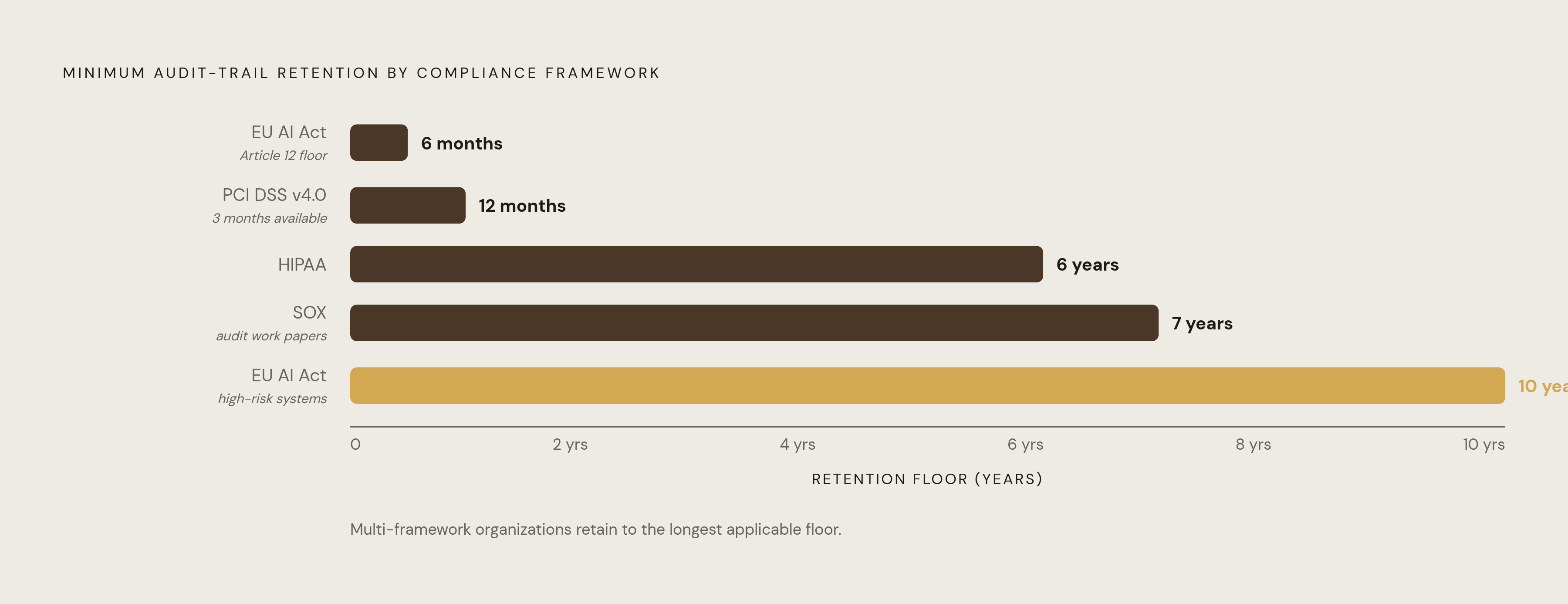
Retention floors differ sharply by framework, and an organization operating under more than one has to retain to whichever floor is longest.
Retention length means little without integrity. Standard relational databases fail compliance in this context because records inside them can be altered silently, with no trace left behind. Cryptographic chaining and append-only log structures are the implementation pattern regulators and auditors expect instead.
The real test of audit-readiness isn't theoretical. An organization has to be able to reconstruct, for any given stretch of time, what actions an AI agent took, what data it touched, what policies applied, and what the outcomes were, and it has to be able to do that in a form a compliance officer can actually navigate, not one that requires a data engineer and a multi-hour dig through raw log files. If producing that answer takes an afternoon of engineering archaeology, the organization isn't audit-ready, no matter how much data it happens to be sitting on. EU AI Act Article 12 requires a minimum of 6 months, and up to 10 years post-deployment for high-risk systems. SOX audit work papers must be retained for 7 years. HIPAA requires a retention period of 6 years. PCI DSS v4.0 requires 12 months of retention with 3 months immediately available. An organization subject to multiple frameworks must retain to the longest applicable floor (for a healthcare company handling AI-reviewed loan documents for EU persons, that floor is 10 years).