Benchmarking Document AI Accuracy Claims Against Production Reality
Vendor accuracy claims typically drop 15 to 25 points in production reality.

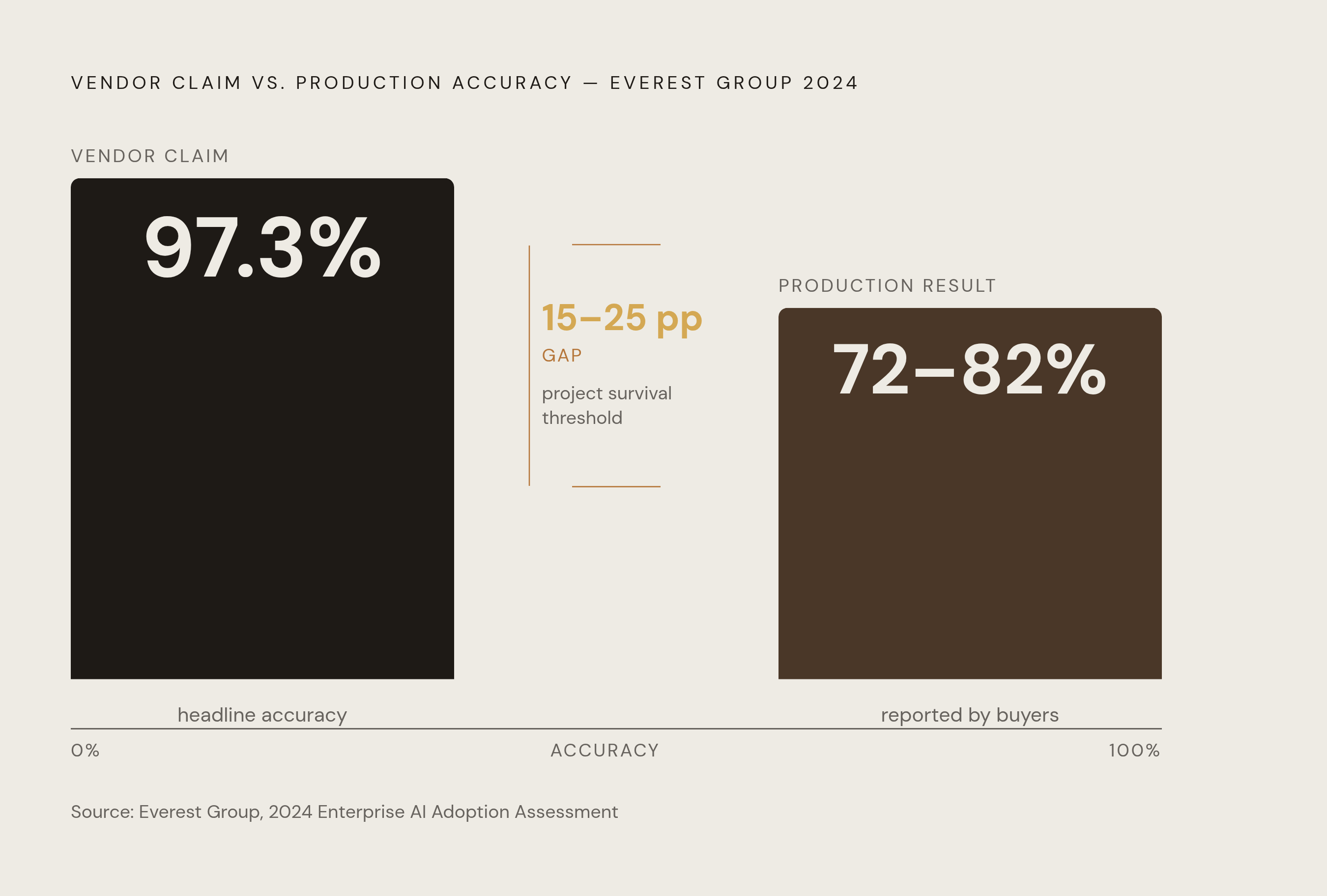
A vendor's accuracy claim tells you almost nothing about how their system will perform on your documents. The number comes from a benchmark the vendor chose, scored against a test set the vendor curated, using a metric the vendor picked because it flatters the result. None of that is fraud. It's just how benchmarks work, and it's exactly why the gap between a "97.3% accuracy" The headline figure and what a production pipeline actually processes can diverge widely enough to sink an automation project before it starts.
That gap has a name in enterprise procurement circles now, and it isn't small. Everest Group's 2024 assessment of intelligent document processing vendors found enterprise buyers consistently reporting a drop of 15 to 25 percentage points between what vendors claimed and what they actually got once the system touched real production volume. That's a gap large enough to separate a project that pays for itself from one that quietly gets shelved a year in. That's the difference between a project that pays for itself and one that quietly gets shelved a year in.
Averaging usually causes the gap. A document AI system can hit 99% accuracy on clean, common invoices from a company's top suppliers, the kind of documents that look almost identical to what the vendor trained and tested on. Feed the same system a one-off supplier's handwritten purchase order, or a scanned contract with a coffee stain on page three, and accuracy can fall to 60% or lower. Blend those two populations together across a test set and you get a headline number in the 90s that hides exactly where the failures live. The rest of this piece works through why that happens, what the public benchmarks do and don't cover, which document traits break production pipelines most reliably, how to build a test set from your own documents instead of someone else's, and why none of it matters without confidence scores you can actually trust.
The benchmark design choices that inflate accuracy figures
Start with what goes into the test set, because that decision alone can swing the final number more than any change to the underlying model. Most public and vendor-run benchmarks lean heavily on clean, typed text in consistent, predictable layouts. Born-digital PDFs, the kind exported directly from accounting software with perfect character spacing, dominate these test sets. Benchmark sets include scanned paper with skew, low DPI, fax compression artifacts, or a corner blocked by a paperclip shadow rarely, if at all. A benchmark built around "financial documents" might include a pristine bank statement while the pipeline it's meant to represent handles 40-page mortgage packages with mixed handwriting, notary stamps, and scans shot at wildly different resolutions.
Metric choice does similar work. Character Error Rate measures how many characters get substituted, dropped, or inserted relative to the reference text, and a 2% CER sounds like a solved problem until that 2% lands squarely on a policy number, a dollar figure, or a medication dosage. F1 score balances precision and recall across extracted fields, which means a system that nails the common fields but misses the rare ones can still post a strong F1, even though the rare fields are often the ones a business actually needs correct. Neither metric sees layout at all. A model can score 98% on character-level accuracy while completely misreading a table's structure, treating merged cells as separate rows or folding a two-column layout into one garbled stream of text. The output then looks confident and reads cleanly, but the values have landed in the wrong fields entirely, which is arguably worse than an obvious error because nothing about it looks wrong.
Then there's the question of what gets scored at all. Most benchmarks score per-page or per-field in isolation, but production documents routinely require resolving something on page one against something on page 40, a total that has to match a line-item sum three sections later, a signature block that has to correspond to a name on the cover page. No per-page metric can catch a failure that only exists across page boundaries, because the metric was never built to look for it.
Some failure modes get excluded from the scoring altogether. A system that extracts 18 line items out of 20 in a large table scores well on field-level accuracy metrics, but the two missing rows are exactly the data a downstream reconciliation process depends on, and that loss stays invisible in the aggregate number. A document that the system fails on completely, scoring zero, gets averaged into the batch and disappears into a respectable-looking mean. Token costs and processing latency, which determine whether a system is actually usable at production volume, typically sit outside benchmark conditions entirely, so a system that tops the leaderboard on accuracy can still be financially unworkable once it's processing a real daily volume.
And a fair amount of the industry's headline numbers come from vendors testing their own systems, with no independent party replicating the result. It can simply mean the numbers were never checked by anyone with a reason to look closely. It is, however, a reason to treat any unverified accuracy claim as a starting hypothesis rather than a settled fact, particularly in a market where a few percentage points separate a strong product from a mediocre one.
What the public benchmarks cover (and where they stop)
The academic and industry benchmarks that document AI vendors point to have gotten better over time, but each one still covers a specific slice of the problem, not the whole of it. PubTabNet, released in 2020, focused on academic tables at large scale. FinTabNet, the same year, narrowed in on financial tables specifically. DocLayNet, from 2022, broadened the scope to mixed document types and layouts.
The more recent entries push further. OmniDocBench, published for CVPR 2025, covers a range of pages across multiple document categories, from academic papers and textbooks to handwritten notes and exam papers, with a detailed set of layout categories and attribute labels. It evaluates the full parsing pipeline end to end, meaning text, tables, formulas, and reading order together rather than any one task in isolation, and its evaluation toolkit is open source under Apache 2.0 (though the underlying dataset itself is restricted to non-commercial research). A version 1.6 update introduced a matching method called Multi-Granularity Adaptive Matching specifically to reduce bias in how predictions get matched to ground truth. OCRBench v2, also from 2025, runs 10,000 mixed-type documents through TEDS, accuracy, and F1 scoring together. ParseBench, arriving in 2026, is narrower but more targeted: roughly 2,000 human-verified pages drawn from insurance, finance, and government documents, organized around five capability dimensions including tables, charts, and visual grounding. It's the first benchmark in this lineage built specifically around enterprise document types rather than academic or general-purpose ones.
Competitive results on these benchmarks show real spread between systems, and the spread is instructive. On the RD-TableBench evaluation of 1,000 complex tables, reported results show meaningful variation across vendors, with the strongest system claiming a clear lead in average table accuracy. On OmniDocBench's table evaluation covering 512 document images, leading results are well ahead on TEDS, while several open-source solutions fall below 70% on the same set of tables. One enterprise-focused benchmark spanning 100 pages of banking, retail, and insurance documents reported 91.7% accuracy for the leading model against 68.9% F1 for a major cloud competitor, a gap that works out to roughly five additional fields correctly extracted for every 20 fields in a typical production document.
None of this closes the coverage gap, though. Every benchmark is a snapshot of a document population at a specific point in time, and a benchmark built in 2025 tells you very little about performance in 2026 if a company's supplier base shifts, if new document languages enter the pipeline, or if scan quality changes because someone switched vendors on the loading dock. There's also a quieter prerequisite that gets skipped constantly: a benchmark's ground truth is only as good as the humans who labeled it, and two independent annotators should agree on the same fields more than 95% of the time before anyone trusts the labels at all. Skip that check and the whole benchmark rests on an unverified assumption. Above all, none of these datasets, however well constructed, contain a single one of any given company's actual documents. That is the test that matters, and it's the one no public benchmark can run.
The five document characteristics that most reliably break production accuracy
Layout variability is usually the first thing to go wrong. Most benchmark documents sit inside a single, stable layout template, but a company's own vendor invoices can arrive in dozens of formats from the same supplier over the course of a year, as that supplier switches accounting software or redesigns its templates. Multi-column financial statements, regulatory filings, and dense tabular documents push accuracy down sharply, and models that perform well on standard single-column layouts frequently misread merged cells or collapse a multi-column page into one undifferentiated block of text.
Handwriting mixed with printed content on the same page is its own category of trouble. A form with a typed header, a handwritten annotation in the margin, a rubber stamp, and a signature block all in the same image is a fundamentally harder problem than clean OCR on typed text, not a smaller version of it. Handwritten fields in medical forms, for instance, generate meaningful error rates in most systems, and while newer model architectures can reduce those handwritten error rates, the improvement appears only if the benchmark used to evaluate the system actually included handwritten samples in the first place. If it didn't, the number you were sold never tested for the problem you actually have.
Document length compounds the issue further. Most test sets cap out at a handful of pages per sample, while production pipelines regularly process 200-page mortgage packages, insurance submissions, or medical records where a name, an account number, or a policy reference has to resolve consistently across the entire document. Per-page scoring can't catch a failure in that kind of cross-page resolution, because the metric never looks past the boundary of a single page to begin with.
Scan quality is the fourth break point, and it's almost entirely invisible in benchmarks built on born-digital PDFs. Real scanned documents carry skew, low DPI, fax compression artifacts, and partial occlusion from staples or hole punches, and quality can vary from page to page within the same document. Scanning at adequate resolution, combined with preprocessing steps like deskewing and denoising, can cut character misinterpretation substantially. But a benchmark that never includes degraded scans in the first place won't tell anyone that this preprocessing step is necessary until the errors appear downstream.
Domain-specific formatting rounds out the list. Financial statements, logistics manifests, and healthcare records each carry their own formatting conventions, vertical layouts, nested tables, nonstandard field groupings, that generic academic datasets simply don't contain. A system trained and benchmarked against horizontal, essay-style document structure can silently misread the vertical, nested patterns common in insurance claims forms or freight manifests, and because the benchmark never tested that structure, the failure becomes visible only once the system is already in production.
How to build a representative benchmark from your own documents
None of the above is an argument against document AI. It's an argument for testing the system against the documents it will actually process, before deciding whether the vendor's number means anything for that specific use case.
Start by pulling a real sample, somewhere between 50 and 200 unlabeled documents, sorted by type: invoices, contracts, forms, tables, whatever the pipeline actually handles. Resist the urge to hand-pick the clean examples. Deliberately fold in the long tail, the one-off suppliers, the older scanned formats sitting in an archive somewhere, the handwritten intake forms, the multi-page packages that always seem to cause trouble downstream. A test set built only from clean, digital invoices in a single language won't tell anyone anything useful if a meaningful share of production volume arrives as multi-language scans or faxed paperwork.
From that sample, hand-label a smaller subset, 20 to 30 documents, focused specifically on the fields that get extracted in practice rather than every field the document contains. Have two people label the same documents independently and check agreement. Anything below roughly 95% agreement on a given field means the labeling guide needs work before the benchmark can be trusted at all; disagreements about date formats, normalized versus raw values, and ambiguous field boundaries are the most common culprits, and resolving them explicitly in writing before scoring starts prevents them from contaminating the results.
Metric choice should follow directly from where errors actually cost money. Field-level precision and recall answer the basic question of whether the right fields come out with the right values. TEDS, which scores table structure as a tree rather than as flat text, answers a different question: whether the relationships between cells survived extraction, not just whether the characters did. Keep layout accuracy and text accuracy as separate scores rather than folding them into one composite number, because they fail independently, and a blended score hides which one is actually broken. Fields should also carry different weights depending on what a wrong value costs downstream: a wrong vendor address is an inconvenience, while a wrong policy number or dosage figure can be a real liability.
Set the accuracy bar using actual cost figures, not a number borrowed from a tutorial. Per IOFM benchmarks, the average cost of manually resolving an invoice exception runs $8 to $15, and at a volume of 500 exceptions a day that works out to a substantial sum in rework each year. Figures like an 80% precision, 75% recall threshold that circulate in some guides have no particular justification behind them; a financial extraction pipeline where a single wrong field cascades into a reconciliation error needs a bar set by its own error costs, not a number that sounded reasonable in someone else's blog post.
Synthetic documents have a role here, but a limited one. Generated documents tend to have clean geometry and perfect alignment, which means they don't reproduce the kind of degradation a real scanner or a real fax machine introduces. They're useful for stress-testing a narrow edge case, a rotated header, an unusually merged cell layout, where real labeled examples are hard to come by. They shouldn't be the backbone of the evaluation.
Why confidence scoring determines whether extraction accuracy translates into automation
Knowing a system's accuracy rate solves less than it seems to. A pipeline that extracts 10,000 fields and gets 9,600 right sounds strong, right up until someone asks which 400 are wrong and the system can't say. If every record has to be opened and checked because there's no way to tell the good extractions from the bad ones, the system hasn't removed manual work. It's added a step on top of it. That structural failure, not raw accuracy, is a large part of why a large share of new intelligent document processing deals in the market today are replacements for legacy systems that couldn't keep pace with modern document volume and variety.
Calibration is the unsolved piece, and it causes the rest of this. Plenty of commercial extraction systems attach a confidence percentage to every output, but that number is frequently disconnected from how often the extraction is actually right. A prediction the model reports at 95% confidence might, in practice, land correct at a meaningfully lower rate, because generative models are prone to overestimating their own certainty as a pattern-matching artifact rather than a genuine measure of reliability. Making matters worse, a single confidence curve applied across an entire document glosses over the fact that some extractions are inherently easy (a printed date in a standard format) and others are inherently hard (a handwritten total on a faded receipt), and those two situations need separate calibration entirely.
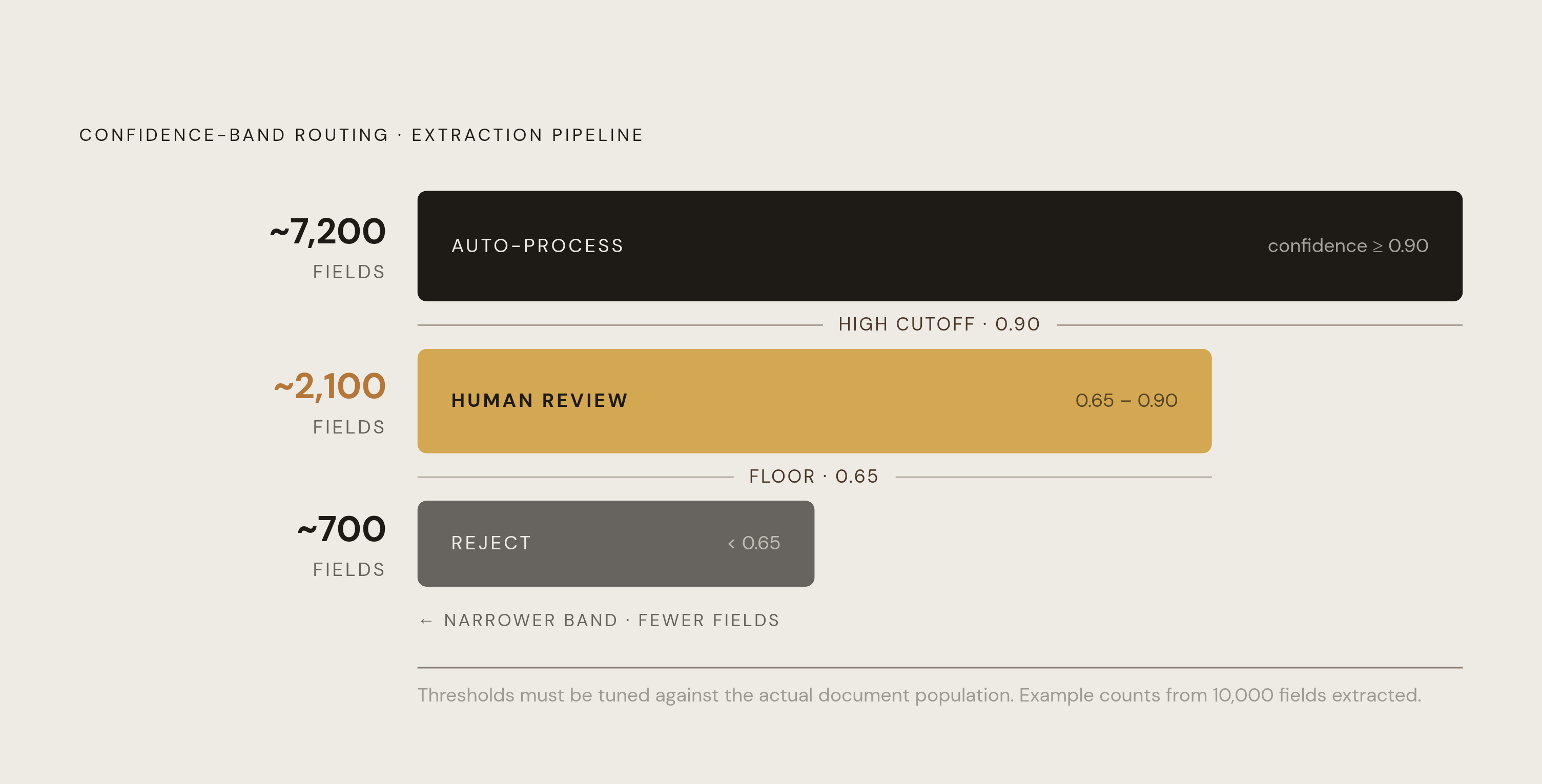
Properly calibrated confidence is what makes automation actually work. It allows a pipeline to route extractions by threshold: auto-process above a high-confidence cutoff, send the middle band to human review, reject anything below a floor outright. Those thresholds have to be tuned against the actual document population running through the pipeline, not carried over unchanged from whatever conditions the vendor used in their own benchmark. Some newer approaches score confidence using an ensemble of evaluation checks rather than a single probability figure, catching problems like rule violations or logically inconsistent field values that a lone confidence score would miss entirely.
So when evaluating a document AI system, the accuracy number is only half the question. The other half, arguably the more important one, is whether the confidence scores attached to that system's output have been calibrated against real outcomes on documents held back from training, or whether they're just raw model probabilities dressed up to look like a measurement of trust. A system with genuinely calibrated confidence catches its own errors before they become someone else's problem. One without it just moves the errors further down the line, dressed up as automation.
Sources
- Best Document AI Evaluation Tools (February 2026) | Extend
- OCR Benchmarks & Real-World Documents (July 2026) | Extend
- Benchmarking the Most Reliable Document Parsing API
- Beyond Accuracy: The Document AI Metrics That Actually Predict Production Success
- ParseBench: A Document Parsing Benchmark for AI Agents
- Top AI Use Cases Transforming Industries in 2025
- GitHub - opendatalab/OmniDocBench: [CVPR 2025] A Comprehensive Benchmark for Document Parsing and Evaluation