Insurance Claims Intake Redesign With AI Document Processing
Clean data at intake prevents rework throughout the claims lifecycle.

Redesigning insurance claims intake with AI document processing is an accuracy problem before it is an automation problem. When structured, complete data enters at first notice of loss, or FNOL, triage, coverage verification, and settlement can proceed without repeated correction. The objective is not to replace adjusters, but to give them and the systems around them reliable data from the moment a claim packet arrives.
Why the claims file starts going wrong before an adjuster touches it
A single mid-size auto claim can arrive as a FNOL form, police report, photos, repair estimates, medical bills, and rental receipts. These documents come through different channels and in different formats. Before an adjuster can make a decision, each must be read, identified, and matched to the claim file. The packet is therefore not yet a usable record, even when all its documents have arrived. Its contents must first become a coherent account of the claim.
That conversion is where errors enter the process. Manual entry can misclassify a document, misread a field, or leave a record incomplete. The error may stay hidden until an adjuster is already checking coverage or preparing a settlement. At that point, the file requires correction rather than a decision, and the downstream process inherits work that intake should have resolved.
Faster review cannot make up for a record that cannot be trusted. An intake error on one claim creates rework, while the same pattern across thousands of claims per month becomes a cycle-time and leakage problem. What appears to be an adjuster productivity issue can therefore begin before an adjuster touches the file.
What OCR alone cannot do with a real insurance document
Digitizing the packet removes one obstacle, but it does not resolve the meaning of its contents. OCR reads glyphs without knowing whether a string of numbers is a policy number, a phone number, or a date. Text recognition alone also cannot tell whether a page is a medical bill, an incident report, or a policy excerpt. A readable document is not necessarily a usable claims record.
Recognition quality also depends on the original. High accuracy on clean digital-born text does not show that a model works as well on degraded scans, handwritten forms, or damaged documents. Document parsing benchmarks have also shown that smaller, purpose-trained document models can outperform large general vision-language models. Model size is therefore a weak proxy for performance on the documents an intake team actually receives.
Document classification establishes what the document is, while semantic extraction determines what its values mean and maps them to the right fields. Cross-document validation then tests whether those values agree with the rest of the packet and the policy record. These are separate architectural responsibilities beyond OCR. Together, they turn recognized text into information that a claims system can use.
The five functions a production claims intake layer must perform
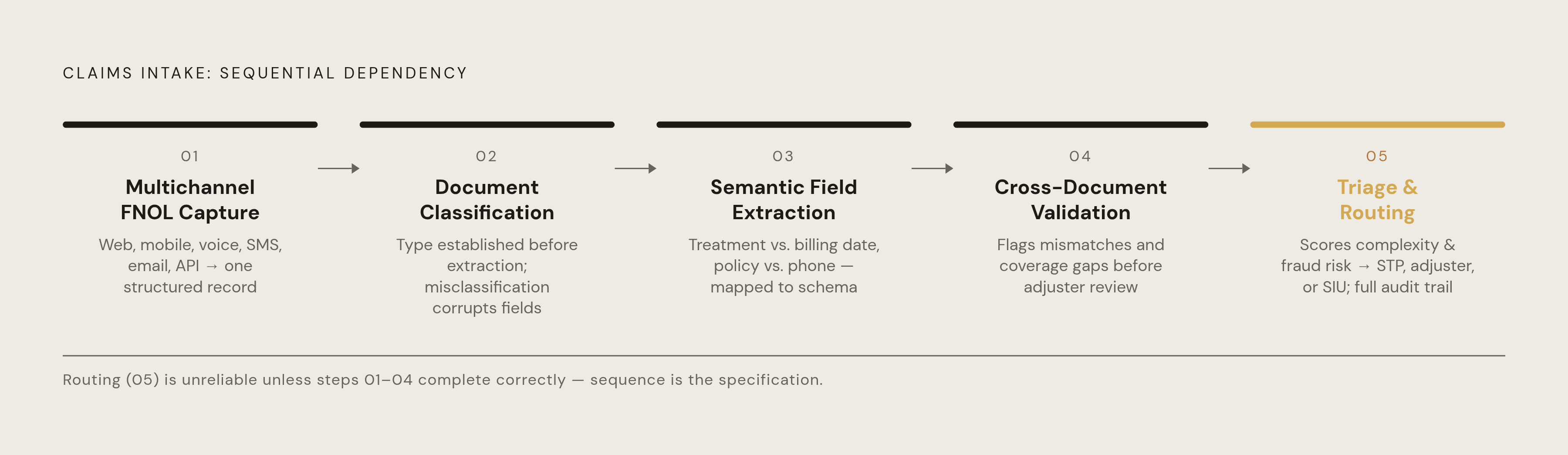
The first function is multichannel FNOL capture. Claims arriving through web, mobile, voice, SMS, email, and broker API must become a single structured record rather than retain the shape of their original channel. The second function, document classification, establishes the type of every document attached to that record. This must precede extraction because a misclassified medical bill or repair estimate can put otherwise legible values into the wrong fields.
The third function is semantic field extraction. It distinguishes a treatment date from a billing date and a policy number from a phone number, then maps each value to the schema the claims system expects. The fourth function is cross-document validation, which tests the extracted record for contradictions. A policy number that does not match or a loss date outside the coverage period must be flagged before the file reaches an adjuster. Extraction supplies the values, but validation establishes whether they form a consistent record.
The fifth function is triage and routing with an audit trail. Once extraction and validation are complete, the system scores complexity and fraud risk, then routes the claim to straight-through processing, an adjuster queue, or SIU. Every action must be logged. The sequence is the specification, because routing cannot be reliable when the fields supporting it have not been correctly classified, extracted, and validated.
Where production intake systems actually fail, and why it is a monitoring problem more than a model problem
Production failures are often silent degradations. A system may extract most fields correctly while still leaving a sizable share of documents with at least one wrong field. Errors at the document level can undermine coverage verification even when the aggregate field score is reassuring. Yet the aggregate document result is also insufficient to diagnose where quality is slipping. Monitoring must reach down to the document type and field.
Confidence drift becomes costly when a poorly handled document subtype starts arriving in volume without triggering attention. If a vendor name has high confidence but a tax total has low confidence, the uncertain field can go to review without returning the entire document. During high-volume CAT events, sending only the uncertain field to review matters even more because manual intake is under its greatest pressure. Confidence-based routing and automatic escalation are necessary to absorb the surge without sacrificing quality across the workload.
Validated records still have to reach Guidewire ClaimCenter, Duck Creek Claims, OnBase, or FileNet through idempotent APIs with reconciliation. These systems stay in use when agents arrive. Implementations can stall at this handoff, which makes integration governance as important as model selection.
How the reference architecture connects intake to the full claims lifecycle
The architecture begins with conversational FNOL, where NLP and LLMs capture structured fields and create the claim record. OCR and intelligent document processing then extract and validate information from PDFs, invoices, and police reports. ML classifiers use that record to assign complexity and route the claim to fast-track processing, an adjuster, or SIU. Each stage depends on the previous stage supplying usable data with interpretation work resolved.
The same dependency extends into assessment and decisioning. Computer vision uses auto and property photos to make repair estimates, while graph analytics and anomaly detection help screen for fraud. Rules engines and ML recommend settlements and include confidence scoring and explainability. After adjuster approval, payment APIs and RPA execute direct ACH, card, or wallet payment. Accuracy at ingestion is therefore a constraint on the whole pipeline.
Allianz's Project Nemo, launched July 2025, makes the agentic structure concrete. Designed for food spoilage claims generated by storm events, it uses seven specialized agents for workflow planning and orchestration, data security monitoring, policy coverage verification, weather event confirmation, fraud detection, payout calculation, and audit logging. Their work depends on structured data flowing from intake. More generally, orchestrated agents can request missing documents, run cross-system checks, and escalate when a threshold is crossed, but unreliable inputs limit those actions. Straight-through processing depends on that reliability, while continuous audit logging across every component makes the decision path reconstructable.
What production deployments show about accuracy, speed, and where gains actually come from
FurtherAI's Claim Intake deployment at a specialty insurer reached high rates of automation, substantial annual savings, and processing markedly faster than the prior baseline. Speed matters, but it is not a sufficient explanation by itself. The relevant gain is less clerical work between receipt of the packet and a claim that can move forward.
Leavitt Group's loss run normalization provides a more demanding document example. Processing loss runs with 130-plus lines, previously measured in hours, now completes in minutes. A Top-10 P&C carrier has seen similar gains when processing schedules of values that list many locations. Its agent finishes each SOV in minutes and has a strong ROI, with field accuracy that was high at launch and rose further within six months. That result depends on handling large-array documents without silently dropping rows.
Peer-reviewed research in IJSRA 2025 describes a healthcare IDP deployment that links intake accuracy to results later in the process. AI-driven intelligent document processing made medical coding much more accurate, cut the time spent on billing per claim, and sharply cut denial rates. When upstream data is more accurate, there is less work later to correct errors and handle rejections.
Compliance and governance requirements that the intake layer must satisfy before deployment
Accuracy and speed do not by themselves make an intake system deployable. As of 2025 and into 2026, compliance is a gate that must be cleared before sensitive policyholder data enters the system. People must still be accountable for high-stakes decisions, especially settlement and denial. AI can draft a rationale and surface supporting evidence for a human decision. It must not automate the denial itself.
That accountability requires a record of how the system reached each handoff. Every extraction, classification, routing decision, and escalation must be logged so that regulators and internal compliance teams can reconstruct the decision path. The logging requirement therefore belongs in the architecture before deployment. An explanation at the end cannot substitute for a trace of the processing that produced the record.
Healthcare claims have specific rules for medical records and billing data that apply even at ingestion. A processing layer handling those claims must operate under a HIPAA BAA and support return or destruction of PHI when the contract ends, with continued protections if that is infeasible. SOC 2, GDPR, and PCI requirements also depend on the carrier's market and the data passing through intake. Deployment design must account for those obligations before procurement. Self-hosted deployment is an important mechanism for protected health information and the most restrictive environments, particularly where payment card data or multiple jurisdictions are involved.
How engineering teams should evaluate and build the intake infrastructure layer
Evaluation should begin with a narrow, high-volume, rules-based claim type, such as auto glass, property FNOL, or loss run normalization. The team should build a claim taxonomy, list its data sources, and set its own baseline before expanding. Tests must use the degraded scans, handwritten forms, and multi-document packets that adjusters receive. Vendor-published accuracy on common formats is not a substitute for that evidence. The pilot should prove that the whole processing layer works.
Field-level confidence is a required capability because selective exception routing depends on it. Integration deserves equally rigorous testing against the intended systems, including Guidewire ClaimCenter, Duck Creek Claims, OnBase, FileNet, CCC, Mitchell, and Xactimate. Idempotent APIs and reconciliation are necessary rather than one-way pushes that cannot recover from partial failures.
FurtherAI's claims intake framework distinguishes four categories of solution, namely insurance-native AI workspaces, document-extraction APIs, workflow and integration orchestration platforms, and conversational intake agents. These categories are not interchangeable, particularly for commercial-lines document volume. Engineering teams that need direct control over accuracy, cost, and latency can build on document-extraction APIs. Parsing, extraction, classification, splitting, and confidence scoring become composable primitives, supported by SDKs in standard languages. Platforms that balance proprietary trained models with frontier AI models by document type, and expose open benchmarks, provide evidence for evaluating those tradeoffs.
After deployment, teams must monitor confidence by document type and field so that changes in how many documents arrive do not hide a drop in quality. Expansion should follow demonstrated accuracy, with iteration focused on the weak points that production reveals.