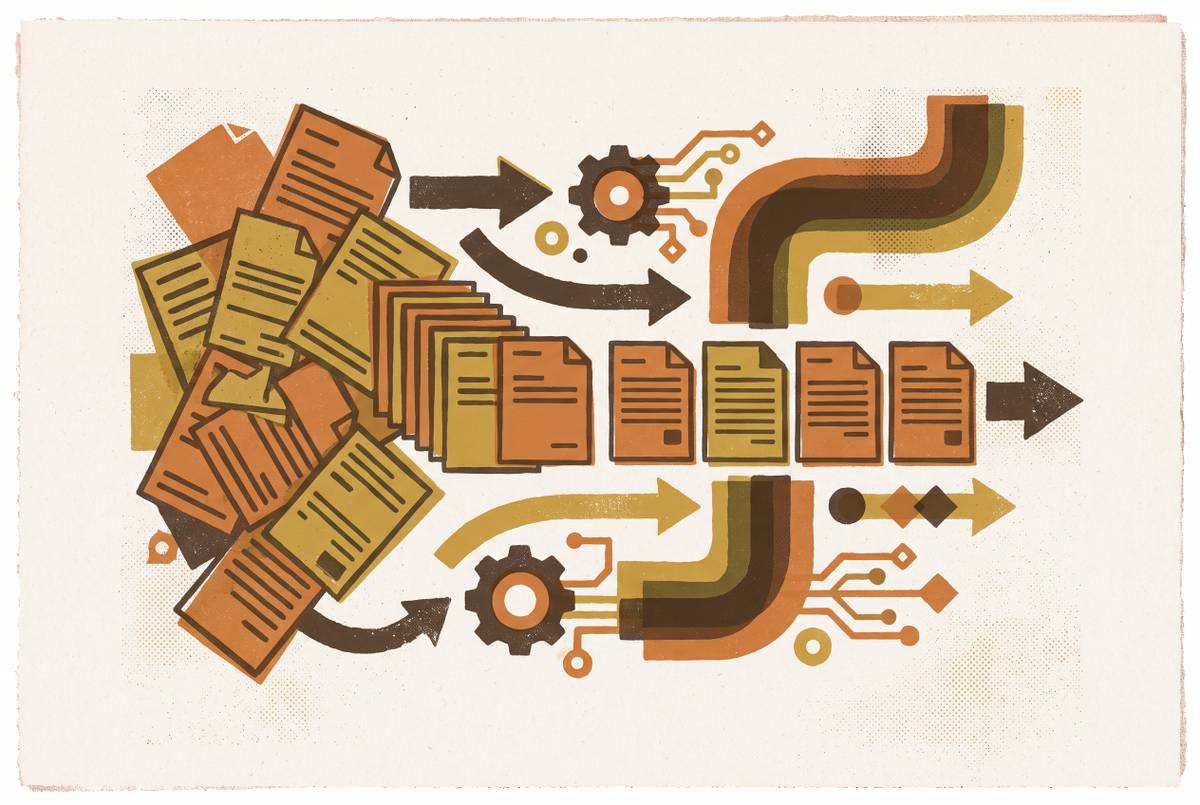
Document-Driven Onboarding Process Redesign for Fintech and Banking
A five-stage document pipeline—not form design—determines onboarding speed and compliance accuracy.

Document-driven onboarding redesign in fintech and banking is a pipeline architecture problem. An application advances reliably when ingestion, classification, extraction, validation, and routing are well ordered and executed, and stalls in review when they are not. Improving that pipeline, rather than polishing the form above it, is the foundation for faster decisions, fewer compliance errors, and less customer drop-off.
Why onboarding in fintech and banking is a document pipeline problem, not a UX problem
A compliance analyst reviewing an application must reconcile an ID document, proof of address, and a source-of-funds declaration before the application can advance. If the extracted address conflicts with the application, the analyst must resolve whether the discrepancy comes from the documents or their processing. The delay originates in the document pipeline, even though the customer experiences it as slow onboarding.
That pipeline receives PDFs, scanned images, digitally generated files, and handwritten amendments through email, portal uploads, API feeds, and field photographs. Pay stubs, tax returns, bank statements, property appraisals, and employment letters add different layouts and interpretation requirements. With manual processing, it is hard to get consistent results from all these documents, especially across countries and regulatory jurisdictions. The architecture must handle those differences before they lead to decisions that an analyst has to fix.
The five stages every onboarding document pipeline must move through
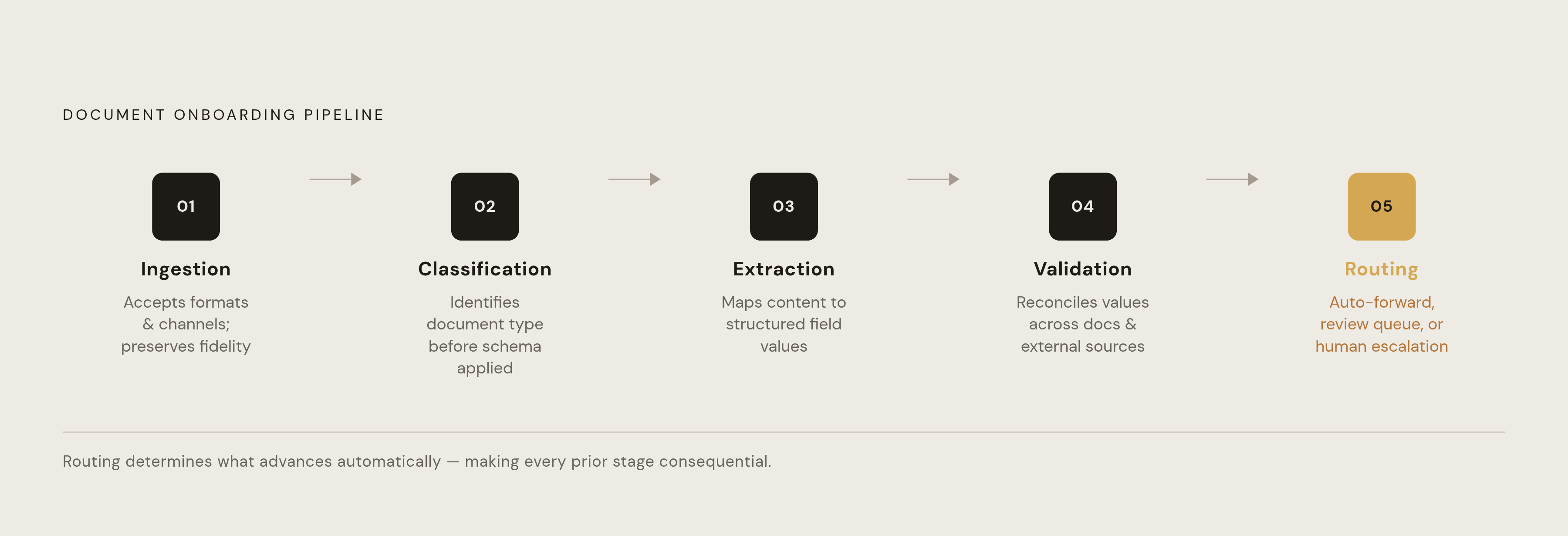
The framework has five stages, each with a distinct responsibility. The first is ingestion, which accepts documents across formats and channels without losing fidelity. The second is classification, which identifies the document type before any document-specific extraction schema is applied. The third is extraction, which turns document content into structured field values while preserving the relationships needed to interpret them.
The fourth stage is validation, which reconciles extracted values across documents and against external sources. The fifth is routing, which sends the output to a downstream system, a review queue, or manual escalation according to confidence and risk. These stages form a dependency chain. Engineering investment decisions must account for the necessity of each stage and the ability of later stages to expose earlier errors.
Ingestion and classification: the stage where format diversity breaks legacy systems
Legacy onboarding systems built for one channel and one format fail in production before extraction starts. Financial institutions cannot control whether customers submit PDFs, images, Word documents, spreadsheets, or scanned paper. Multi-modal ingestion is therefore a baseline requirement. The KYC deployment case reports errors in four in ten manual verifications, linked to the number of documents and the ways their formats differ across countries. That result points to a consistency problem in intake.
Classification must then establish what each document is. If a tax return is labeled as a bank statement, the extraction stage applies the wrong field map and can produce incorrect structured output without triggering an extraction error. This silent mislabeling propagates until validation or compliance review catches it. Country variation compounds the problem because national IDs and proofs of address have materially different layouts across markets. A classifier suited to one country's documents is not, on that basis alone, ready for the jurisdiction mix of production.
Extraction: why accuracy on complex layouts is the variable that determines everything downstream
Once classification is correct, extraction becomes the pipeline's most consequential quality gate. Clean, uniform printed documents are not the difficult case. Onboarding also has to handle handwritten amendments on tax returns, nested tables in bank statements, stamped multi-column forms, and links between fields on different pages. Downstream validation needs accurate extraction from those inputs to have dependable evidence to work with.
A system that reaches the 98% extraction accuracy threshold targeted by modern IDP platforms on a clean benchmark can degrade on production documents. Aggregate scores can also conceal omissions. In large-array extraction, a system may get some rows from a multi-page bank statement right while leaving others out without warning. A metric that scores only the extracted rows does not penalize the missing ones, leaving an incomplete statement looking accurate.
ExtractBench (July 2026), FinDocMRE, and UNIKIE-BENCH (ACL 2026) make the harder problems measurable through enterprise extraction, financial document reasoning, and visual key information extraction tasks. These benchmarks show gaps between leading models and human experts, and FinDocMRE shows an especially wide gap in financial document reasoning. These benchmarks establish why clean-document accuracy is insufficient evidence for an onboarding deployment.
Validation: catching cross-document inconsistencies before they reach a compliance analyst
Correct extraction from individual documents does not establish that an application is consistent. Validation must check that the income stated on an application form agrees with a salary letter from the employer and bank deposit patterns over multiple months. It must also compare reported figures on a tax return, including handwritten amendments, with the income declared in the application. An address extracted correctly from an ID document may also differ from the one on a utility bill or bank statement.
The loan processing example shows the practical value of this reconciliation. An AI agent can extract amended income figures, compare them with the application, flag differences between salary letters and deposits, and prepare a summary of matches and discrepancies for the underwriter. This reduces the back-and-forth needed to establish the facts.
Validation also connects the pipeline to sanctions lists, PEP databases, and credit bureaus. Reliable matching depends on clean, well-formed extracted data. Document context matters as well, since a construction company's transfer to a materials supplier in a flagged country differs from an identical-amount transfer from a newly opened personal account without business documentation. That context helps tell cases apart when rules based on the transaction alone cannot.
Confidence scoring and routing: how the pipeline decides what moves forward automatically and what needs a human
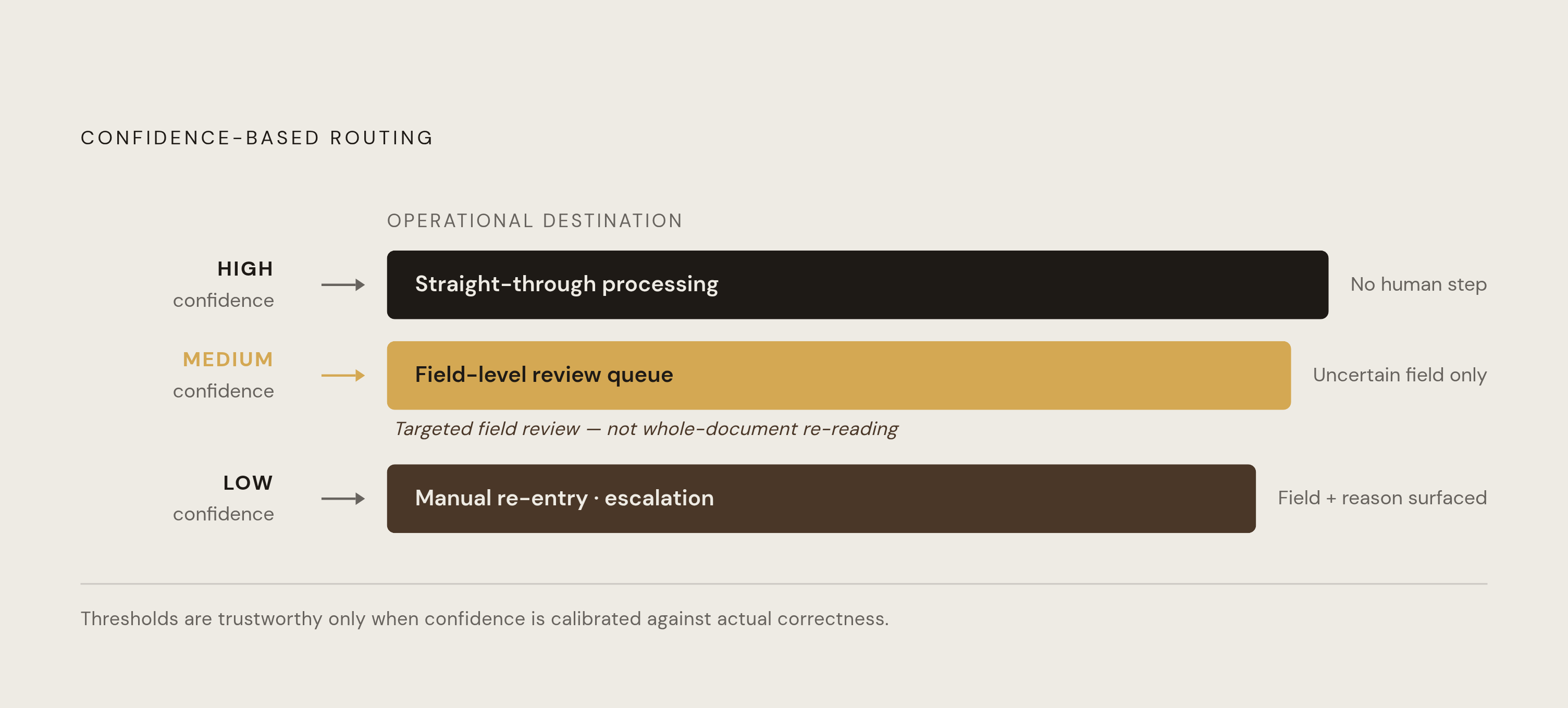
Routing converts extraction quality and validation results into an operational decision. Confidence must accompany each field, because a document can contain dozens of correct values and one critical error. A document-level score masks that asymmetry and can send the entire record down the wrong path. Field-level confidence shows which value is uncertain without making someone reread the whole document.
The operating framework has three tiers. High-confidence extractions go straight to downstream systems without a person having to step in. Medium-confidence outputs enter a review queue for verification of the specific field. Low-confidence predictions trigger manual re-entry or escalation, with the field and the reason for low confidence surfaced to the reviewer.
Those thresholds are trustworthy only when confidence is calibrated against actual correctness. A model that expresses high confidence more often than its accuracy justifies makes straight-through processing unreliable. Built-in evaluations and confidence scoring are therefore responsibilities of the processing infrastructure. This is what a batteries-included platform must provide if automation is to run without constant human oversight.
The pilot-to-production gap: why sandbox accuracy does not predict production performance
Even a pipeline with the right stages can fail when its pilot measures the wrong document population. Curated, pre-cleaned samples exclude much of the variation in scan quality, handwriting, jurisdiction, and layout that arrives through live channels. The resulting accuracy measures the cleaning work as well as the system. When production accuracy falls, the change may expose that mismatch.
Teams should therefore validate against raw production mirrors before declaring a pipeline ready. Unprocessed, uncleaned documents reveal the conditions that the pilot would otherwise hide. The WEF AI Playbook for Financial Services (June 2026) identifies the move from pilots to scaled deployment as a central challenge and stresses the infrastructure foundation needed to support it. A successful sandbox is not a substitute for that foundation.
Transformer-based models add to the variation because changes to a prompt or updates to a model can yield different extractions from the same document from one run to the next. A surrounding system harness must absorb that nondeterminism if downstream automation and SLAs are to remain dependable. Production evaluations and fast failure diagnosis provide stronger grounds for scaling confidence than model choice alone. Without them, a team cannot reliably detect when accuracy has fallen below its acceptable threshold.
Compliance and auditability requirements that the pipeline architecture must satisfy
Accuracy does not by itself make an onboarding pipeline compliant. Every decision needs a traceable chain from the originating document through extraction, confidence, validation, and routing. The evidence kept includes each field's source location, the validation logic used, and the result of routing. It must be stored in a form that supports audit retrieval, rather than merely making the current application view readable.
The EU AI Act treats credit scoring as a high-risk AI application, and KYC as high-risk where it involves biometric identification. Article 86 gives people affected by qualifying decisions made using high-risk AI systems the right to an explanation. These requirements make traceability and explainability design inputs. SR 26-2, which replaced SR 11-7 in April 2026, requires model validation, documented assumptions, and challenge documentation for non-generative, non-agentic models used in financial decisions. Agentic AI remains outside its formal scope pending further guidance, so that distinction matters when defining model governance.
GDPR and applicable HIPAA requirements also constrain retention, processing agreements, and sub-processor controls. AML obligations require an auditable account of what was checked, against what, and by what process. Content-free audit logging and hash-chained log infrastructure help trace the path that led to a decision. Where data sovereignty rules make public SaaS untenable, self-hosted or BYOC deployment becomes an architectural requirement.
What a well-architected onboarding pipeline looks like end-to-end
The reference architecture is a multi-agent system with rules for how it works, records that can be audited, and clear handoffs between stages. Ingestion preserves the incoming document, classification selects its type, and extraction produces structured fields. Each extracted value comes with its confidence score, source location, and a natural-language explanation. Validation then reconciles the evidence, while native tiered routing determines which results advance and which require review.
API-first design and SDKs connect this pipeline to existing loan origination systems, core banking infrastructure, and CRMs without requiring a rip-and-replace migration. Audit logging belongs in every stage so that evidence is kept without a separate wrapper being added later. Deployment options must also accommodate the institution's sovereignty constraints.
Low-risk applications can move forward in minutes, while cases that are unclear go to analysts with the analysis already done. In the loan processing example, document work that previously required three days of back-and-forth between operations and underwriting can move through in hours through automated extraction, reconciliation, and discrepancy flagging.
Where to begin when rebuilding an existing onboarding pipeline
An existing pipeline does not need to be replaced all at once. Before changing it, the institution needs centralized data governance with lineage tracking, a model risk management function that can validate how the models in the pipeline behave, and a legal review of vendor processing agreements and residency obligations. GDPR Article 28 and EU AI Act third-party provider obligations belong in that review before production deployment. Extraction accuracy cannot compensate for missing governance or unresolved data-processing terms.
The first engineering step is a raw production mirror that establishes baseline accuracy at each stage before new tooling is introduced. That baseline identifies where errors propagate furthest downstream, usually classification or extraction. If misclassification is present, address it first because the wrong document type produces extraction errors that downstream validation cannot fully correct. The priority is to remove the earliest source of consequential error.
Next, add calibrated confidence scoring and tiered routing before expanding document coverage. Handling fewer document types with trustworthy uncertainty signals is preferable to broad coverage supported only by opaque aggregate accuracy. Instrument every stage for audit logging from the first production deployment, because retrofitting it into a live pipeline is more disruptive. Keep production evaluations attached to that instrumentation so the team can detect and correct degradation as the document population changes.