Accounts Payable Automation and Invoice Processing Workflow Redesign
Confidence scoring routes routine invoices straight through while flagging exceptions for review.
Accounts payable automation and invoice processing workflow redesign are about changing who does the work. Effective redesign centers on four functions that AI performs well, namely invoice capture, GL coding, three-way matching, and approval routing. Confidence scoring then separates routine processing from genuine exceptions, reserving human judgment for the invoices that need it.
Why the traditional AP workflow fails before AI ever enters the picture
An AP employee opens a PDF, reads the vendor name, looks up a GL code, cross-checks the purchase order, keys the data, and sends the invoice for approval. Each action waits for a person to perform it. The sequence makes human attention a prerequisite for progress, even when the invoice is routine and the relevant information already exists in the ERP. As more invoices come in, people have more work to do by hand, and that work still brings errors.
The weakness is architectural. Automation Anywhere notes that even modern ERP systems depend too much on people to enter data and have no automated invoice processing. Adding extraction may save people from typing, but they still have to handle the other checkpoints. If every invoice still needs someone to interpret, match, code, and forward it, AI has accelerated one task without changing the workflow’s dependence on people.
What AI actually does well in AP — and what it does not
OCR reads text, while AI interprets what it reads. That distinction separates document digitization from a system that can suggest how an invoice should be processed. Zone & Co distinguishes static rule-based automation, traditional OCR, and intelligent machine learning. Static rules apply predefined conditions but can break when formats or organizational structures change. OCR extracts text but cannot decide how to code or match it, while machine learning uses transaction history to suggest coding, flag anomalies, and get better as it sees more examples.
For GL coding, the same source describes a rule-based system that requires an explicit vendor-to-GL mapping, compared with an ML system that references recent invoices from that vendor in NetSuite. When most share a GL code and cost center, the model can suggest the same treatment without a manually authored rule. Ramp notes that learning from past corrections improves invoice processing accuracy over time.
Interpretation still depends on the surrounding workflow. A model cannot compensate for intake that treats several documents as one invoice, or for mandatory human review at every stage. The redesign must address them before stronger interpretation can translate into less manual work.
The four functions that should anchor the redesigned workflow
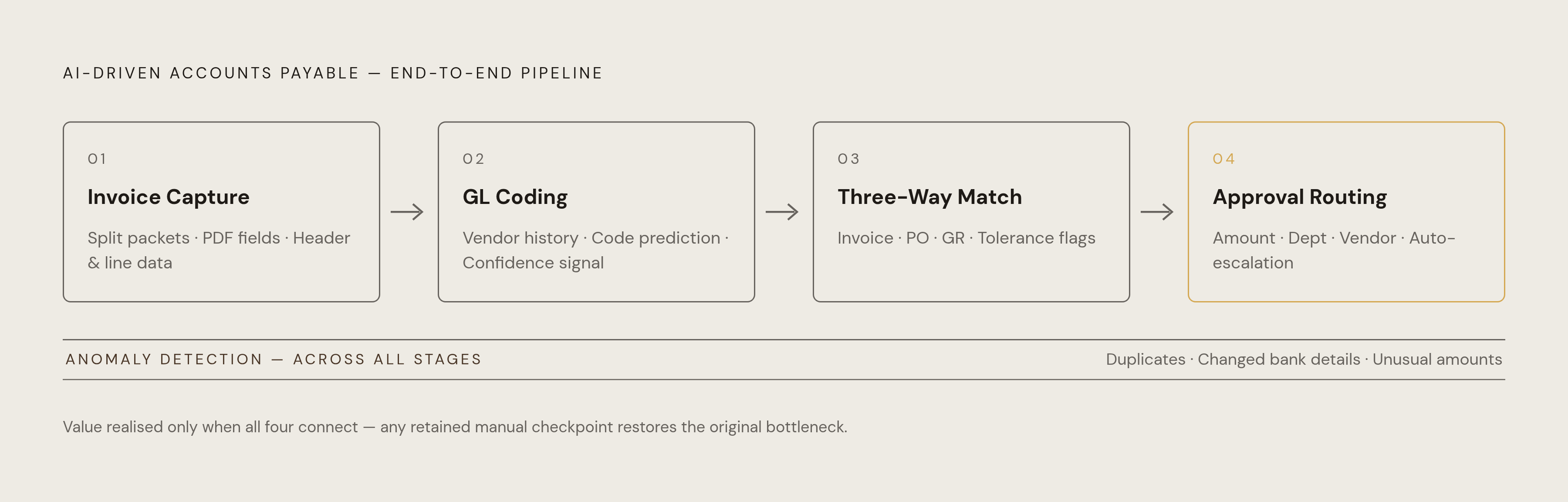
Invoice capture establishes the data used by every later function. Zone & Co describes AI-powered capture that extracts header and line-level data across PDF layouts, vendors, formats, and languages without manual template setup. But capture begins before field extraction does. A PDF that holds several documents must first be split correctly and keep its reading order, or coding and matching will use the wrong document boundaries. Capture belongs at the foundation because downstream decisions depend on its output.
GL coding turns extracted information into an accounting suggestion grounded in the company’s chart of accounts and vendor history. The same source argues that systems inside the ERP can use that context directly. A confidence-backed suggestion lets a reviewer confirm the accounting treatment without entering it again. Review does not have to mean data entry.
Three-way matching tests whether the invoice agrees with the purchase order and goods receipt. Ramp describes real-time verification that flags totals that do not agree or key details that are missing. Tolerances and partial deliveries belong within this logic. Otherwise, routine purchases lead to exceptions that could have been avoided. Matching gives the workflow a basis for passing clean transactions while isolating the discrepancy in those that do not agree.
Approval routing applies the organization’s authorization rules to invoice type, amount, vendor, department, and subsidiary. Routine forwarding should not require another manual handoff. Zone & Co describes automatic escalation when a manager is on leave and higher approval thresholds for invoices outside a vendor’s usual parameters. Ramp also describes reminders based on delays in approval.
Anomaly detection runs through all four functions instead of taking place as a separate check at the end. Zone & Co describes checks against ERP history for duplicates, vendor bank details that have changed, unusual amounts, and vendors the company has not worked with before. These checks run before the AP review queue. As a result, the team receives specific reasons for scrutiny instead of having to search every invoice for possible irregularities.
How confidence scoring determines which invoices need a human and which do not
Confidence scoring supplies the boundary between automatic processing and human review. An invoice that is matched, coded, routed, and within normal parameters should post without a person touching it. A low-confidence field should instead reach someone who can resolve that uncertainty.
Confidence-thresholded extraction can refer an uncertain field to a reviewer, while a coding prediction can show exactly which classification needs confirmation. Anomalies and matching failures also show why a person needs to step in. This changes the reviewer’s task from repeating the entire process to answering a targeted question. Ramp notes that real-time workflow visibility also helps teams identify and resolve approval holdups.
With straight-through processing, the team keeps its authority over authorization. It uses that authority in the workflow and brings transactions to people’s attention when they are uncertain or outside the norm. Human accountability remains part of the design. For finance teams, the calibration task is therefore to set the threshold that separates acceptable confidence from required review, rather than treating the AI model itself as the control.
What the redesigned workflow actually looks like end to end
Intake begins when an invoice arrives by email, PDF upload, or EDI. The system finds the document boundaries and splits a packet that holds several documents before it extracts the invoice data.
Validation then compares the extracted data with the purchase order and goods receipt. Clean three-way matches pass automatically, while discrepancies are flagged with the specific mismatch identified.
GL coding uses transaction history and how the vendor has behaved to predict and assign the accounting codes. The prediction includes a confidence signal so that uncertainty can trigger review.
Anomaly screening checks for duplicates, changed vendor bank details, and amounts outside the vendor’s historical range. These checks precede approval so that a clean match does not become a substitute for fraud and irregularity screening.
Approval routing sends invoices to the appropriate approver according to amount, department, and vendor type. Reminders and automatic escalation address delays without requiring AP staff to forward the invoice manually.
The exception queue receives low-confidence extractions, matching failures, and anomalies in a structured view. Each item identifies the issue to resolve, rather than asking a reviewer to process the whole invoice again.
Payment and reconciliation come after the invoice has been processed and approved. Ramp describes how AI looks at payment terms, due dates, and early payment discount windows to choose a better time to pay.
How the document processing layer underneath determines whether the four functions work
The document processing layer determines what the four functions have to work with. Header extraction is largely solved for clean, digitally generated invoices, but that does not describe the full AP queue. Scans, complex layouts, multi-page line items, and bundled documents test the system in different ways. Poor parsing or a missed document split can propagate through coding, matching, and routing. A later function may then get data that looks ready to use but does not match what is in the source document.
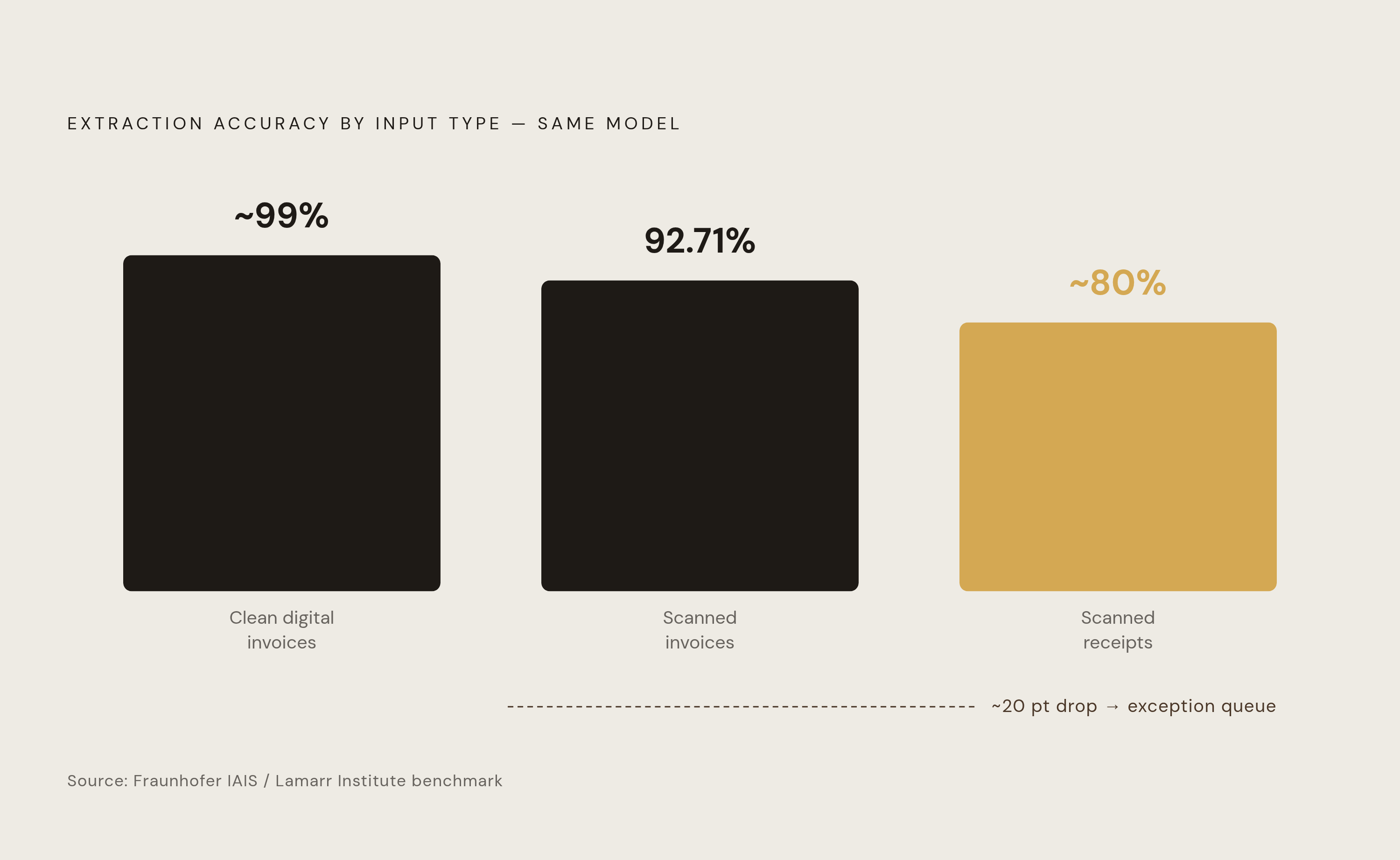
Fraunhofer IAIS and the Lamarr Institute illustrate the input-quality gap in a benchmark where the same top model scored 92.71% on scanned invoices. Its score was significantly higher on clean digital invoices and lower still on scanned receipts. The model did not change between those comparisons.
That gap has a direct consequence for exception-only review. A system that performs well on clean invoices but degrades on scans and complex layouts will send a disproportionate share of production work to people. The exception queue then absorbs weaknesses in document processing instead of concentrating on genuine accounting ambiguity. General-purpose foundation models are not sufficient for this workload. Specialized infrastructure trained on real-world document types, with reliable parsing, splitting, and extraction, makes the system harness around the model more consequential than model choice alone.
Where the redesign breaks down in practice and how to avoid it
The strongest objection to autonomous processing claims is that they often describe clean, repetitive, high-volume invoice flows. That objection is valid and limits what such claims establish. Performance on those inputs does not prove that an organization’s mixed document queue will achieve the same result. The practical response is to set thresholds honestly and design for exception-only review. Retaining a person at every step avoids that distinction but also preserves the original bottleneck.
A second objection is that an exception queue can become the same bottleneck under a different name. Routing every unresolved invoice to a general inbox does little to reduce the reviewer’s work. A low-confidence field, matching discrepancy, or anomaly type should arrive as an identified issue so that the reviewer resolves a question. The queue is a productive part of the architecture.
Accountability also places legitimate limits on autonomous decisions. Finance teams need explanations of matching and decision outcomes, full audit trails, and the ability to keep a human involved. Explainability is becoming a compliance requirement in regulated finance, where black-box models are being examined more closely. Training data provenance requires separate procurement attention. Teams should find out whether a vendor trains on customer data and whether it uses one customer’s data for others, since some systems keep models trained only on each customer’s own history.
How to evaluate whether an AP automation tool is actually built for the redesigned workflow
Evaluation should begin with what the system actually does in each of the four functions. Capture needs to find document boundaries and extract fields that can be used, coding needs to draw on the company’s history, matching needs to handle tolerances and partial deliveries, and routing needs to follow the rules for approval and escalation. Feature labels are not enough to establish this. The decisive distinction is whether those functions connect into exception-only processing or still require a person to advance every invoice through the workflow.
Teams should ask whether accuracy is measured on clean digital invoices as well as scanned, complex, and multi-document inputs. They should also establish whether confidence scores actually control referral to review. Showing a score beside a field does little to reduce the work if a person still has to confirm every field. The evaluation must connect extraction quality to the work that remains for the AP team.
Fit also depends on the organization’s operating context. Mindsprint frames that assessment around five questions covering ERP, monthly invoice volume, approval complexity, budget, and the number of currencies in use. The purchasing decision should therefore turn on how reliably the system completes routine work and how precisely it presents the work that still requires judgment.