Building the Internal Business Case for Document AI Infrastructure
Document AI infrastructure costs less than the exception labor it prevents.

Every retrieval-augmented generation system and every autonomous agent deployed in an enterprise today consumes structured output from a document processing layer somewhere upstream. When that layer extracts a field incorrectly, misreads a table, or flattens a layout it doesn't understand, the retrieval system surfaces the wrong context and the agent acts on bad data, with no warning that anything went wrong. That dependency is why document AI deserves a budget conversation rather than a sandbox: it is not a feature sitting on top of the AI stack, it is a foundation underneath it.
Calling it a pilot program misrepresents what it does. A pilot implies a contained experiment with a defined end date and a single department absorbing the risk if it fails. Document processing, once it feeds agents or retrieval systems used across finance, operations, legal, and clinical teams, behaves as shared infrastructure, and funding it like a departmental trial guarantees it gets resourced like one, underpowered, loosely governed, and first in line for budget cuts when priorities shift.
The technology itself has changed enough to justify the reframing. Template-based OCR did character recognition and nothing else; it had no sense of a table's structure, no grasp of layout, no capacity to tell a header from a footnote. Systems now extract tables, interpret layout, and emit structured data, and downstream software can act on it directly. The distance between those two capabilities is what separates a reliable agent from one guessing at structure it was never given.
What breaks downstream when document processing is wrong
The case for document AI infrastructure rests less on what automation gains and more on what silent extraction failures cost before anyone notices them. Five failure modes recur across production deployments, and each one maps onto a risk an operations or compliance leader already recognizes.
Agents acting on misextracted fields make decisions on bad data, and the decision looks fine until it doesn't: a compliance audit flags a missing disclosure, a payment dispute surfaces a wrong invoice amount, a clinical record shows a code that doesn't match the chart. The error was made upstream, invisibly, long before it became anyone's problem.
A second failure mode appears as an asymmetry: a system can be right without being complete. EnterpriseDocBench, a unified evaluation framework covering parsing fidelity, indexing efficiency, retrieval relevance, and generation groundedness across enterprise document domains, found factual accuracy on stated claims reaching 85.5% while answer completeness averaged only 0.40. A system can be mostly right about what it says while routinely leaving out fields that matter. In a regulated submission, an omitted field carries the same consequence as a wrong one.
Hallucination does not scale the way intuition suggests. The same framework found that hallucination rates do not rise steadily with document length: short documents hallucinated at 28.1% and very long ones at 23.8%, both well above the 9.2% rate for medium-length documents. A team that validates its pipeline only on documents of typical length will miss the exposure sitting at both ends of the length distribution.
Bulk table extraction introduces a fourth failure mode that standard accuracy scoring tends to ignore: silent row drops. If a table loses rows during extraction, it can still produce structured data that passes downstream validation checks, because nothing in the output format signals that records are missing. The output looks complete, but it isn't.
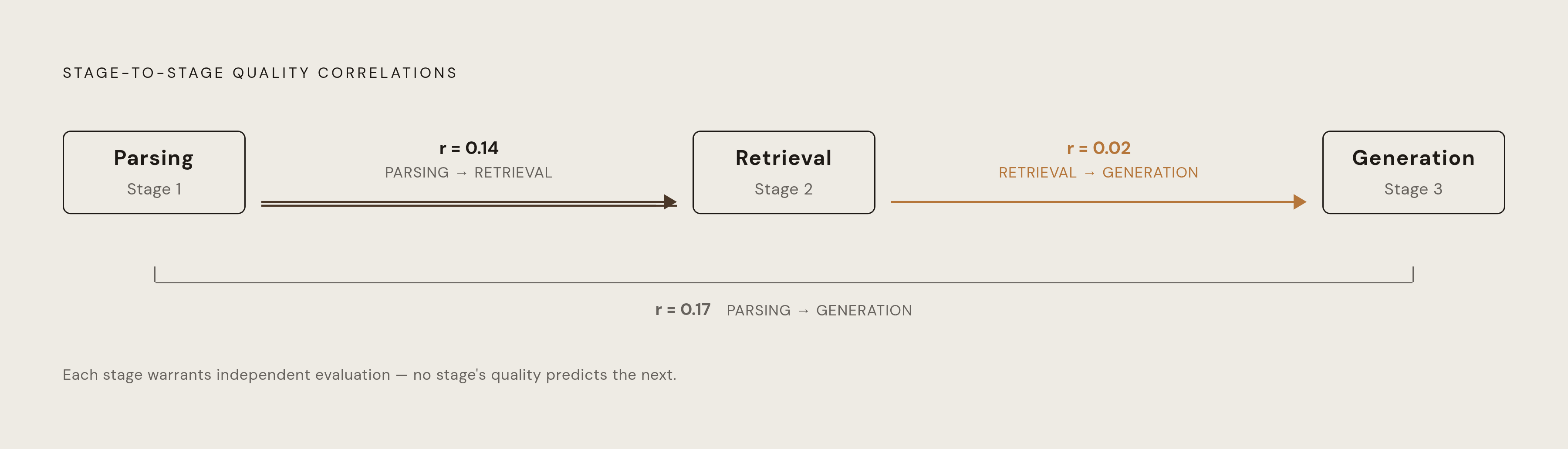
The fifth failure mode concerns how errors move between pipeline stages, and the finding here cuts against what you might assume. EnterpriseDocBench measured cross-stage correlations and found them weak throughout the pipeline: parsing-to-retrieval correlation sat at r=0.14, parsing-to-generation at r=0.17, and retrieval-to-generation near zero at r=0.02. Quality at one stage does not predict quality at the next. A strong parser does not guarantee strong generation, so each stage needs its own evaluation or the risk stays invisible until it appears in output.
Some argue that human review catches these errors before they matter. On high-volume pipelines, review is sampled, and sampling misses exactly the rare, high-consequence errors described above. Confidence scoring with configurable thresholds routes low-confidence fields to a human before they propagate downstream, rather than relying on review to catch them after the fact. The cost these failures carry, in labor, cycle time, and exception handling, is what the next section quantifies.
How document processing errors translate into measurable operational cost
The financial argument for document AI infrastructure doesn't live primarily in a software line item. It lives in the exception-handling labor and the cycle-time losses that accumulate around every extraction error that human review has to catch.
Accounts payable processing offers a concrete anchor. A 2025 Fraunhofer IAIS study found the same model scoring meaningfully higher on clean invoices than on scanned receipts, showing that document quality drives accuracy more than vendor selection does. If a team deploys AI invoice processing without accounting for its own document mix, clean digital invoices versus scanned paper receipts versus multi-layout vendor formats, it will underestimate how many documents end up in exception queues.
Extraction speed rarely determines the bottleneck in these pipelines. Cycle time is dominated by exceptions: missing approvals, failed three-way matches, documents routed to a human for review because confidence fell below a threshold. That's where labor cost accumulates, invoice by invoice, long after the extraction itself finished running.
Industry benchmarks from 2025 show that best-in-class accounts payable teams process an invoice for a fraction of what manual teams pay per invoice. The gap between those numbers is the fully loaded labor cost of chasing exceptions, and that's where most of the money in a document processing budget actually goes.
Honest business cases account for a caveat that vendor decks tend to omit: accuracy figures are reported on clean, controlled document sets, and production document mixes, with scanned pages, handwritten annotations, inconsistent layouts, and multiple languages, perform differently than the curated benchmark did. A business case built on vendor benchmark figures without adjustment for the organization's own document mix will produce a return-on-investment projection that looks compelling in the proposal and breaks on first audit.
Two more factors shape real infrastructure cost at production volume that benchmark scores don't capture at all: per-page token cost and latency under concurrent load. Both are absent from an accuracy percentage, and both determine what the system actually costs to run once it's processing the organization's real volume. Cost alone doesn't close a budget conversation in a regulated industry, because compliance operates as a separate gate that a strong ROI projection cannot open on its own.
Why compliance teams are the second audience
In regulated industries, a vendor's compliance posture functions as a binary procurement gate. A vendor that cannot satisfy it gets disqualified regardless of how strong its accuracy numbers look or how favorable its pricing is.
Healthcare deployments illustrate the gate most clearly. An AI tool qualifies as HIPAA compliant only when the vendor signs a Business Associate Agreement covering every surface that touches protected health information, and that agreement needs to contractually exclude patient data from model training. Excluding patient data from human review as well is a negotiated protection worth pursuing, beyond the HIPAA minimum. SOC 2 attestation, encryption badges, and "enterprise-grade security" language in marketing materials support a compliance case, but none of them substitutes for the signed agreement itself.
Organizations deploying into EU markets face an additional layer. The EU AI Act requires compliance assessments for high-risk AI systems before they reach market, and document processing systems that touch financial or health records are likely to fall within that high-risk scope. That adds a pre-deployment compliance burden that a template-based or lightly documented extraction system is poorly positioned to satisfy.
Healthcare carries a second obligation layered on top of HIPAA: coding accuracy. Systems extracting from clinical notes, discharge summaries, and lab results need to meet both privacy and accuracy standards simultaneously, and a system that improves coding accuracy also reduces first-pass claim rejection, a direct revenue cycle argument that gives healthcare finance teams their own reason to care about the infrastructure.
A business case aimed at a compliance reviewer needs four specific things on the page: a signed BAA, a clear data retention and training-exclusion policy, a SOC 2 Type II attestation report, and documented confidence scoring that shows how low-confidence extractions get handled before they reach a downstream system. If an organization's current document processing produces none of that metadata, it already carries a compliance exposure today, independent of whatever new system gets proposed, so the business case becomes partly a risk remediation argument. Once compliance clears a vendor for consideration, the next question is how to tell which of the cleared options is actually more accurate in practice.
Evaluating accuracy claims without being misled by benchmark theater
Most vendor accuracy figures aren't fabricated. They measure performance under conditions that look nothing like production, and the internal champion's job is to find out what conditions produced the number before it goes anywhere near a business case.
Accuracy isn't a single, stable figure for a given model or vendor. A study from Fraunhofer IAIS and the Lamarr Institute ran multimodal models across multiple invoice datasets and found meaningfully different accuracy rates depending on whether the documents were clean or scanned. Same model, same vendor, but two very different numbers, because document quality decides the outcome, not anything the vendor controls.
Academic OCR benchmark repositories compound the problem. Most of them test clean, single-column documents, so they never surface the layout variability, scan degradation, or cross-page reference failures that a production pipeline processes every day. A high score on one of those clean datasets says little about how the same system performs on a production mix of real organizational documents.
The weak cross-stage correlation described earlier applies here too. EnterpriseDocBench's finding that parsing correlates weakly with retrieval (r=0.14) and only slightly more strongly with generation (r=0.17) means a vendor's parsing benchmark score doesn't predict whether the downstream agent produces a correct answer. Each stage needs independent evaluation, not an inference drawn from one number.
A vendor evaluation checklist should include specific, pointed questions: accuracy figures measured on documents that match the organization's own mix, including scanned, multi-layout, and multi-language documents where relevant; the breakdown between completeness and correctness in that reported score; whether the vendor's benchmark methodology penalizes row omissions in table extraction or simply ignores them; and documentation of confidence scoring that shows how low-confidence fields get routed. Every vendor demo ends the same way, with invoices processed in seconds and the output looking clean. Nobody demos the invoice the model choked on. An evaluation needs to include documents the vendor didn't select. Knowing what to ask matters once there's an architecture capable of answering those questions; that is where the evaluation has to point next.
What a production-grade document AI pipeline looks like
The gap between a document AI demo and a production system is architectural. If a system skips verification, confidence routing, and audit logging, it isn't production-grade, no matter how strong its benchmark scores look.
Most demos show three stages: ingest, parse, extract. That's enough to produce an accurate-looking result on a well-chosen document. Production deployment requires three additional capabilities layered on top: verification, through confidence scoring and threshold-based routing; reasoning, through agents that attempt resolution before escalating a case to a human; and proof, through audit logs detailed enough to satisfy a compliance review.
Agentic exception handling changes the economics of that middle layer. Traditional systems escalated to a human the moment confidence dropped below a set threshold. Agentic systems attempt resolution first, checking whether the same value appears elsewhere in the document or comparing it against a known pattern, before escalating anything to a human reviewer. That reduces review volume without reducing accuracy on the edge cases that used to require a human look.
The MADP multi-agent architecture, evaluated on real-world documents, illustrates what that approach can achieve at scale: a high full-pipeline automation rate, with a human-in-the-loop configuration reaching document-level accuracy near 98.5%. The mechanism behind it, called PFTFI (Prompt Fine Tuning with Feedback Inheritance), uses human corrections to refine extraction behavior over time without retraining the underlying models, so the system can adapt to new document variants without the pipeline needing re-engineering each time a new format appears.
Enterprise deployment adds one more requirement: APIs and SDKs that an engineering team can integrate into existing workflows without building a new ingestion layer from scratch. A platform that demands a custom connector for every downstream system multiplies both the engineering cost and the number of places the pipeline can fail. With that architecture in view, the business case can finally describe both halves of the argument at once: the specific failure modes a weak pipeline produces, and the specific architecture that prevents them.
How to structure the internal business case document itself
A business case built around accuracy improvements loses to one built around failure mode remediation, because budget holders will fund the prevention of specific, named bad outcomes far more readily than they fund diffuse efficiency gains. The document itself should follow five sections, in order.
The first section is a failure mode inventory. Before making any case for new infrastructure, document the specific downstream failures the current system already produces, wrong agent decisions, missed fields in compliance submissions, exception labor volume, so the ROI case anchors to problems the organization has lived through rather than projections it's asking the committee to take on faith.
The second section translates those failures into cost. Exception-handling labor should be converted into fully loaded cost using the organization's own volume and document mix, not a vendor's benchmark figures. The number that survives a finance review is the one built from internal data, not an industry average borrowed from a vendor deck.
The third section lays out the compliance gate. Document which regulatory requirements the current pipeline satisfies and which it cannot satisfy without extraction metadata, audit logging, and a signed vendor BAA, and frame every gap as existing risk exposure the organization already carries, not as a new requirement the proposal is inventing.
The fourth section describes the evaluation methodology: how vendor claims will be tested against the organization's actual document mix, scanned pages and multi-layout formats included, rather than accepted from a vendor's own benchmark report. This is what distinguishes an internal champion who has done the work from one simply relaying a sales deck.
The fifth section states the architecture requirement directly. The solution needs confidence scoring with configurable thresholds, audit logging, and APIs or SDKs that integrate with existing systems without a custom connector for every downstream application. These are non-negotiable conditions for a production deployment, and the business case should state them directly.
One objection tends to surface late in these conversations: the organization could build this internally with prompt engineering. Stitched-together prompt approaches don't produce the extraction metadata, confidence scoring, or audit logs that compliance review requires, and they demand ongoing maintenance as models and document formats change under them. Infrastructure that comes with those capabilities built in lowers engineering cost and compliance risk at the same time.
The strongest business cases for document AI infrastructure show the organization, in its own numbers and its own document mix, what it is already losing, and what it takes to stop losing it.
Sources
- Benchmarking Complex Multimodal Document Processing Pipelines: A Unified Evaluation Framework for Enterprise AI
- [2604.26382] Benchmarking Complex Multimodal Document Processing Pipelines: A Unified Evaluation Framework for Enterprise AI
- MADP: A Multi-Agent Pipeline for Sustainable Document Processing with Human-in-the-Loop