True Cost Calculation for Human Document Review Teams
Hidden costs in contract review labor, infrastructure, and errors dwarf the salary line item.

A finance team pricing out a document review team almost always starts with headcount times salary, and that number is wrong before the first document gets opened. Document review is the largest cost center in e-discovery, and the RAND Corporation's study of federal civil discovery found that review consumed the large majority of total e-discovery expenditure. For every dollar an organization thinks it's spending on document work, most of it is review labor and everything wrapped around that labor. Salary is the visible tip. Everything below the waterline, the rate structure, the volume multipliers, the infrastructure markups, the compliance overhead, and the cost of errors that slip through, rarely gets attributed back to the review function at all, which is exactly why organizations keep underpricing it, matter after matter, quarter after quarter.
Labor rate tiers that make the headline salary number misleading
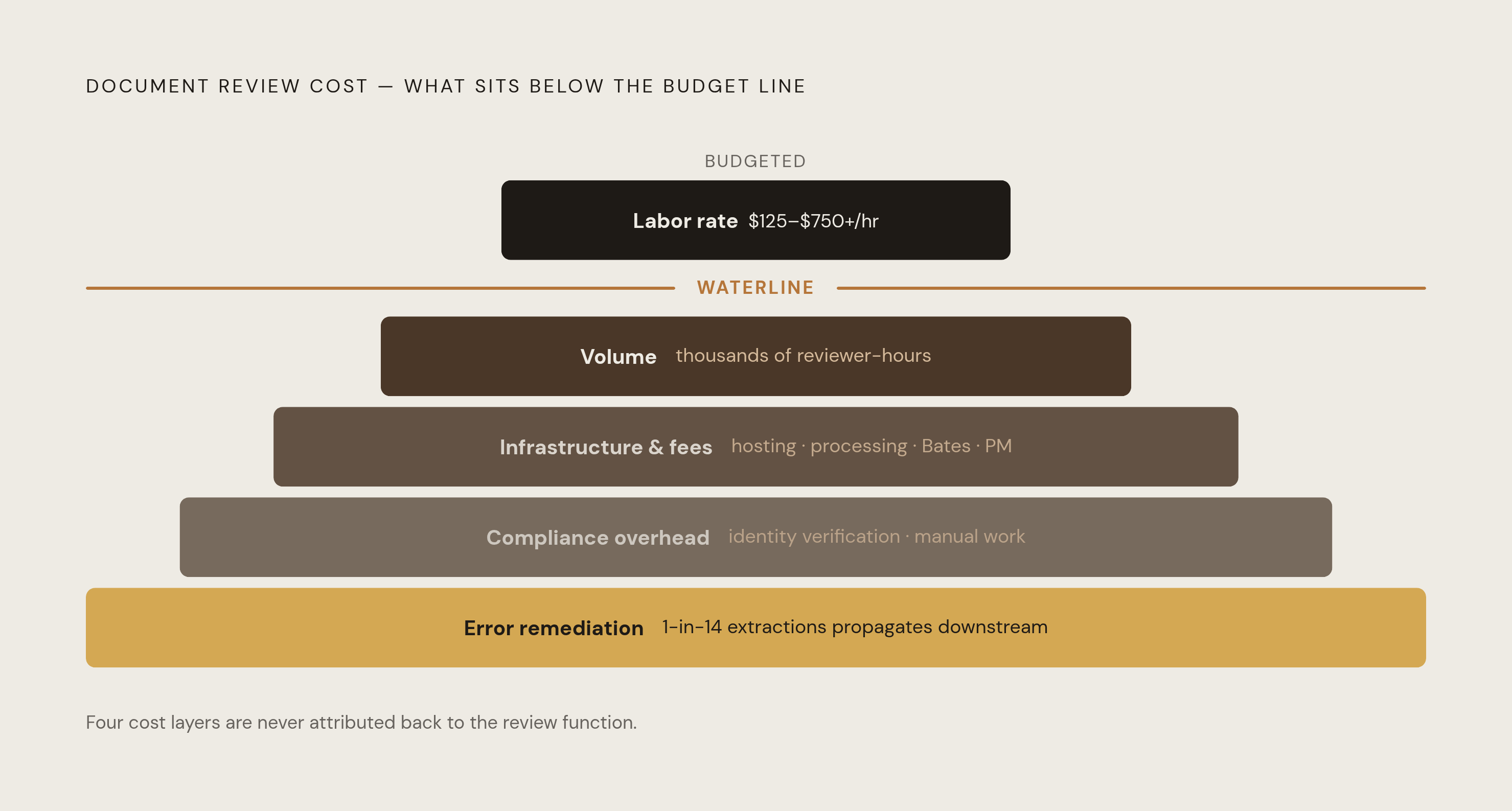
The labor market that actually performs document review has split into two tiers with almost nothing in between, and neither tier's posted rate reflects what the work truly costs. At the top, senior litigators and associates at major firms bill well over a thousand dollars an hour for complex litigation document work, and attorney hourly rates for review work more broadly span $125 to $750 or more. At the bottom, contract reviewers charge a fraction of that, and on paper, staffing a matter with contract attorneys looks like the obvious cost-saving move.
It isn't, once the full picture comes into view. Contract review teams need to be recruited, onboarded, and trained on the specific protocols of each matter, and someone has to monitor their output for quality and consistency. That oversight work falls to senior attorneys, the expensive tier. The cheap labor comes bundled with an ongoing draw on the costly labor it was supposed to replace. A senior associate pulled onto document review administration is an associate not drafting motions, not developing client relationships, and not generating the higher-value work that firms actually price their partners to produce. Across hundreds of billable hours on a single matter, that opportunity cost adds up to a real number that affects firm revenue directly, even though it never appears as a line item on any invoice.
Turnover compounds the problem rather than sitting beside it. Contract review staffing is inherently high-churn work: reviewers rotate in and out of matters, burn out under the repetitive pressure of high-volume coding, and leave mid-matter often enough that retraining becomes a recurring cost rather than a one-time setup expense. Every cycle of hiring, training, and quality-checking a new batch of reviewers draws senior attorney time back into the loop, and every rotation resets the learning curve on a given matter's protocols.
Volume math and the real cost of document review
Per-hour and per-document rates are abstractions until they get multiplied by the volume of a real matter, and volume is where the labor line stops looking manageable. A single complex litigation matter, reviewed at a typical pace of dozens of documents per hour, can require thousands of reviewer-hours before the case is through first-pass review. At a blended contract rate, that labor line alone runs to six figures on one matter, and that total sits there before any infrastructure cost, any management overhead, or any error-remediation expense gets added on top.
Scale the same math across a large-volume matter and the per-document labor line can climb into the hundreds of thousands of dollars in contract review fees by itself, and that's before privilege review even begins. Privilege review commands a meaningfully higher per-document rate than first-pass responsiveness coding, because it requires a more senior reviewer making a legal judgment rather than a categorical one, and that second pass stacks directly on top of the first.
The volume problem also isn't static across time. Data volumes under review keep growing year over year. An organization running the exact same review process on the exact same matter type faces a structurally rising cost even if headcount and rates never change. A review budget calibrated to last year's data volumes will fall short this year because the underlying quantity of documents requiring review keeps expanding on its own, regardless of how well anyone manages the matter.
In Samsung's patent dispute with Apple, processing a large multi-terabyte data set drove total discovery expenditure into the tens of millions of dollars, at a per-gigabyte rate that would strike most IT departments as extraordinary. That figure demonstrates what happens when the volume multiplier and the rate structure compound against each other with no ceiling built into the model, even though few matters reach that scale.
Infrastructure and ancillary fees that sit invisibly on top of labor
Once the labor math is understood, the next layer of cost sits in the pricing structure of hosted review platforms and the ancillary services bundled around them, and budgets commonly leave this layer out entirely. Vendor line items are structured to stay opaque, stacking on top of each other in ways that rarely surface in a headline quote.
Storage itself costs almost nothing at the infrastructure level: hosting a gigabyte of data for a month, at the raw cloud-infrastructure layer, runs to a fraction of a cent. Legal teams routinely pay far more than that for hosted review, and full-service hosting bundled with project-management overhead adds a further markup on top of the hosting fee itself.
Processing surcharges add a material per-gigabyte charge on top of hosting fees, production fees get assessed per page once a document is Bates-stamped and converted to TIFF, and privilege log preparation carries its own per-entry charge. Each of those line items looks small in isolation, a few cents or a few dollars per unit, but stacked across a matter with tens of thousands of documents, each one adds real weight to the final invoice.
Project management hours, often billed at $200 per hour, are frequently the line item that turns an estimate that looked proportionate into a final invoice two or three times larger than the number quoted at the start of the engagement. It's the accumulation of processing fees, hosting markups, production charges, privilege log costs, and project management hours, each reasonable on its own, compounding into a total that bears little resemblance to the labor estimate that started the conversation.
The compliance and error-remediation costs that don't appear on any vendor quote
Beyond the vendor invoice, document review teams generate two further categories of cost that never get attributed back to the review function, even though both originate there. The first is the ongoing overhead of doing compliance work correctly. The second is the downstream expense of doing it incorrectly and having those errors reach systems that depend on accurate output. Both belong in a complete cost model, and both are typically invisible to whoever is pricing the review team's budget.
On the compliance side, a benchmark compiled from Deloitte's Cost of Compliance Survey and Thomson Reuters Regulatory Intelligence puts the annual cost of manual compliance document work for a small analyst team in the hundreds of thousands of pounds, with identity verification and document collection alone accounting for roughly half of that total. That's not a one-time setup cost. It recurs every year the team operates under the same manual process, and it grows as regulatory document requirements expand over time. A team sized correctly for today's compliance volume will find itself undersized for tomorrow's without any change in headcount.
On the error side, the numbers are just as concrete. Manual data entry in healthcare runs at 92 to 95% accuracy at industry baseline, so somewhere between one in twenty and one in fourteen field extractions contains an error that escapes review. Those errors don't stay contained to the document where they originated. They generate downstream remediation work in electronic health record systems, in claims processing, and in audit trails, and that remediation cost is almost never traced back to the review team that produced the original error. It gets absorbed into whatever department discovers the problem months later.
JPMorgan Chase's experience with its COIN system illustrates the scale of that hidden surface. COIN replaced legal review work on commercial loan agreements that had previously consumed an enormous volume of attorney and loan officer time every year, and that prior commitment of attorney hours produced a correspondingly large error-and-remediation burden that automation later reduced. Highmark Health encountered the same dynamic in a different setting: delays in patient onboarding and record updates traced directly back to manual data entry from paper intake forms, with the resulting remediation cost embedded in general operational overhead rather than charged to the document review team's budget. In both cases, the cost was real and substantial, and in both cases, the accounting structure hid it from the team whose process actually generated it.
Building a complete cost model that makes infrastructure decisions rational
A rational decision about document review infrastructure requires enumerating every layer surfaced above in a single model: labor tiers, volume multipliers, infrastructure and ancillary fees, compliance overhead, and error-remediation cost. Pricing the salary line alone and calling that the cost of document review describes a different, smaller question. It's a different, smaller number describing a different, incomplete question.
The right unit of comparison is cost per correctly processed document, inclusive of every layer, software, implementation, setup, maintenance, human review, exception handling, and ongoing administration, rather than the advertised per-page or per-document rate quoted in isolation. APQC's cross-industry benchmark found a median accounts-payable processing cost of $1.36 per invoice line item, and that figure only becomes useful once it's set against what a fully loaded manual process costs to produce the same output, including the error remediation and compliance overhead that a bare per-line-item rate leaves out.
Vendor accuracy claims deserve the same scrutiny that vendor pricing does. Advertised accuracy numbers almost always get measured against clean, digitally native documents rather than the scanned pages, handwritten notes, and mixed-layout files that generate the most exceptions in actual production work, and those exceptions drive the error-remediation cost line discussed above. An accuracy figure that looks strong in a vendor's marketing material can understate the real exception rate an organization will see once its actual document mix runs through the system.
Confidence scoring and human-review routing shape whether an automated system actually closes the cost gap or simply relocates it. A calibrated confidence score routes low-certainty extractions to a human reviewer before they reach downstream systems as errors, which compresses the error-remediation line rather than merely moving the same errors somewhere else in the pipeline. A system without that routing mechanism can post an impressive top-line accuracy number while still generating the same downstream remediation cost the manual process did, because the errors it produces never get caught before they propagate.
Pipeline architecture carries its own cost risk that belongs in this model rather than outside it. Project management hours, billed at $200-$300 per hour, are often the line item that turns a reasonable quote into a final invoice that is two or three times larger. The choice of pipeline architecture, not just the choice of vendor, materially affects the error-remediation cost an organization will eventually pay. A multi-agent system that looks sophisticated on a vendor demo can introduce failure modes that a simpler, well-monitored single-pipeline system does not.
The same discipline applies to the make-versus-buy decision that eventually faces every organization running document review at scale. Building an in-house pipeline, stitching together OCR, extraction, validation, and human-review routing, carries its own ongoing cost in maintenance and accuracy monitoring, and that cost is itself a layer that belongs in the comparison rather than an afterthought bolted on once the build is finished. An in-house system that saves on licensing fees but requires a permanent internal team to keep its accuracy monitored and its failure modes patched has simply moved the hidden cost from a vendor's invoice to an internal headcount line, which is the same structural problem this entire cost model exists to expose.
The organizations that price document review accurately are the ones that refuse to let any of these layers hide. Labor tiers, volume multipliers, infrastructure markups, compliance overhead, and error remediation all draw from the same budget, whether or not anyone bothers to add them up. Building the complete model doesn't make document review cheaper on its own. It makes the number honest, and an honest number is the only foundation on which an infrastructure decision can actually be rational.