Migrating Zonal OCR Configurations to AI Extraction APIs
Teams migrating from zonal OCR must redesign field logic, not just swap vendors.

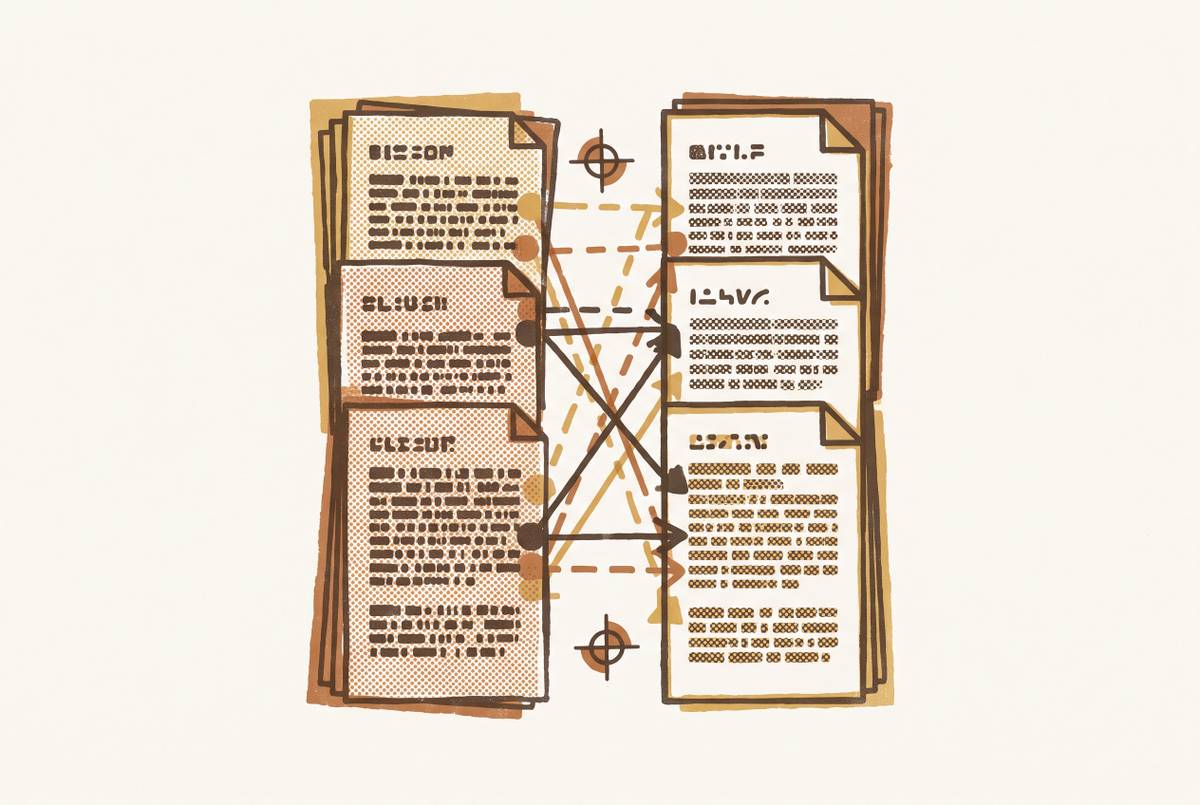
Migrating from zonal OCR to AI extraction APIs is a rewrite of the underlying logic that tells a system where to find a piece of data. It's a rewrite of the underlying logic that tells a system where to find a piece of data, from fixed x/y coordinates on a page to a schema that describes what each field means. Teams that treat this as a lift-and-shift job end up with the same brittleness they started with, just wearing a different vendor's logo. Teams that understand the translation between the two paradigms can move one document type at a time without putting existing pipelines at risk.
Zonal OCR, sometimes called zone-based or template OCR, works by drawing a box on a document image and telling the system that whatever falls inside that box is the invoice number, or the date, or the total. It's a reasonable approach when every document that hits the pipeline looks identical: same vendor, same layout, same font, same field positions, page after page. Under those conditions zonal OCR is fast, cheap to run, and easy to debug.
The trouble starts the moment layout varies. A zone calibrated to pull the invoice total from the bottom-right corner of Vendor A's template returns nothing, or worse, returns the wrong number entirely, when it hits Vendor B's invoice with the total printed on the left. There's no graceful degradation here. The box either lands on the right text or it doesn't, and when it doesn't, it fails silently: no error, no flag, just a bad value flowing downstream into an ERP or a claims system.
Logistics, procurement, healthcare intake, and financial services see this failure mode most often because they process the highest volume of documents from the widest range of sources. Sources on enterprise data commonly put the share of unstructured formats at 80 to 90 percent, and a meaningful chunk of that unstructured mass is exactly this kind of variable-layout document: invoices from hundreds of suppliers, lab reports from dozens of hospital systems, claims forms that change every time a payer updates its template. Every new layout means a new zone template, and teams end up maintaining hundreds of them, undocumented, with no systematic way to know when a vendor has quietly redesigned their invoice.
Migrating away from that doesn't mean replacing OCR with something magical. Text recognition remains necessary and doesn't disappear when migrating to AI extraction. What changes is the field-mapping layer: instead of telling the system where a value sits, you tell it what the value means, and a model does the work of finding it wherever it happens to be.
The conceptual translation: from coordinate-based zones to schema-defined fields
In zonal OCR, a field is defined implicitly, by its position. The field is really just a rectangle of a specific size positioned at a particular spot on a specific template. Moving that rectangle a few pixels, or handing the system a document from a different vendor, makes the field stop existing in any meaningful sense.
In an AI extraction API, a field is defined explicitly, by its meaning. It has a name, a data type (string, number, date, array), and a description written in plain language that tells the model what to look for and where it might appear. Position becomes evidence the model reasons over, not configuration a human has to set in advance.
The mapping between the two systems is fairly direct once you lay it out. A zone name becomes a field name in the schema. Zone position and crop dimensions get replaced by a field description and the surrounding document context, since the model no longer needs coordinates to find the value. A separate zone template for every vendor collapses into a single schema applied across every layout variant of that document type. And any confidence threshold a zonal system might have bolted on gets replaced by a real per-field confidence score the extraction API returns natively.
What disappears in this shift is the template file, the coordinate database, and the calibration step someone used to run every time a new vendor showed up. What has to get built instead is a schema, in JSON Schema or something equivalent, that lays out every field the downstream system expects. This schema is the actual migration artifact. It's not a configuration file to tweak quietly; it's closer to a contract between the extraction system and everything that consumes its output.
Array fields deserve early attention because they're where naive migrations tend to fail without anyone noticing. Zonal OCR handles line items by repeating a fixed-row zone down a table, which works only as long as every invoice has the same number of rows in the same place. AI extraction has to handle arrays of arbitrary length, on tables that might run three rows or three hundred. Reading order is a related problem: zonal OCR never actually has to solve it, since it reads each box independently and doesn't care what order the boxes come in. AI extraction has to correctly assemble a field that spans two pages or gets split across columns, and that assembly work belongs to the extraction engine, not to whoever wrote the schema.
Some teams try to shortcut this by feeding raw OCR text into a general-purpose prompt and asking a model to pull out the fields. That approach tends to reproduce the same fragility zonal configs had, just moved into prompt text instead of a coordinate file. Purpose-built extraction APIs exist specifically to encode the spatial and structural reasoning a model needs to do this reliably, rather than leaving that reasoning to whatever a prompt happens to specify.
Auditing your existing zonal configuration before writing a line of migration code
Before any schema gets designed, the existing zonal setup needs a full inventory listing every template in production, the document type and vendor it applies to, the field names it defines, the coordinates behind each one, and when it was last touched. Teams that skip this step tend to discover missing templates halfway through migration, usually because whoever built the original zone left the company two years ago.
For each zone, three things matter beyond the coordinates themselves. What does the field actually mean, independent of its label? What data type does the downstream system expect it to arrive as? And is it a single value or a repeating row that should become an array? A fourth question matters just as much: how often does this zone fail silently, returning nothing, the wrong text, or a partial value, and has anyone been tracking that.
The highest-variation document types, the ones where zone templates break most often or where vendors change layouts on short notice, are the first candidates for migration. That's counterintuitive if you think of migration as risk to be managed conservatively, but the status quo on these documents is already broken. There's comparatively little to lose by moving them first.
Mapping downstream dependencies matters too, including which fields feed which systems, an ERP, a CRM, a data warehouse, whatever agent or workflow consumes the output, and what happens when a field arrives missing or malformed. That mapping defines what an acceptable failure mode even looks like for the new system. Array fields need to be flagged explicitly in this audit, since any zone configuration that loops over line items, transaction rows, or clinical events will need dedicated design attention later.
The audit should end with real evidence gathered directly from documents. For every document type, assemble a set of actual documents with known correct field values already worked out by hand. That becomes the evaluation set the AI extraction replacement gets measured against, and it should exist before schema design starts, not get thrown together afterward as an afterthought. The two outputs of this phase, a field inventory and a ground-truth sample set, drive everything that follows.
Designing the extraction schema that replaces your zone configuration
The schema structure follows directly from the field inventory built during the audit: each zone becomes a typed field with a name and a description. The description is where most of the engineering leverage sits, and teams most often underrate it.
A field description of "total" tells a model almost nothing useful. A description reading "the final invoice total after taxes and discounts, in USD, as a decimal number" gives the model something to reason against, the same way a precise legal definition narrows an otherwise ambiguous term. The description is doing the work that coordinates used to do. Get it vague, and the extraction quality drops in ways that look a lot like the old zonal failures, just for a different reason.
Scalar versus array is a decision that has to be made deliberately for every field, not assumed. Single-value zones map to scalar fields: strings, numbers, dates, booleans. Repeating-row zones become array fields with a nested object schema describing the properties of each row. This is where production failures concentrate most heavily. A system that silently drops three rows out of forty on a long invoice is just as broken as a zone that was miscalibrated by ten pixels, and the schema needs to make row completeness a testable requirement rather than something quietly hoped for.
Cross-page fields need descriptions that identify meaning rather than page location. Finding the value wherever it happens to live is the extraction engine's job, not something the schema should try to encode positionally. Fields that only show up on some document variants, a purchase order number that appears on some invoices and not others, should be marked optional, so the system doesn't treat legitimate absence as a failure.
Schema versioning needs to start on day one, because any change that adds, removes, or renames a field is a breaking change for every downstream consumer relying on that shape. Treating schema versions the way you'd treat API versions requires a change log and a notification process. And before any of this touches a production pipeline, run the schema against the ground-truth sample set assembled during the audit, field by field. That's where ambiguous descriptions and array boundary problems surface, while the cost of fixing them is still low.
Choosing the right AI extraction API for the documents you process
"Document extraction API" gets used as an umbrella term for products that don't actually do the same job. Some are OCR engines that hand back raw text or markdown and nothing more. Some are cloud document intelligence platforms. Some are structured extraction APIs built specifically to take a schema in and return typed JSON out. Some are full enterprise IDP platforms, and some are just a frontier vision-language model pointed directly at a document with no extraction layer in between. Picking from the wrong category is a common and costly mistake, because a markdown parser and a schema-driven extraction API solve different problems even though both get marketed under "document AI."
For a zonal OCR migration specifically, the category that matters is structured extraction: schema in, typed JSON out, with a confidence score and a source citation attached to every field. A markdown output or a general-purpose RAG preprocessor doesn't give a pipeline anything to validate against.
Before committing to a system, accuracy on genuinely messy layouts affects whether an extraction system will hold up in production, since a clean PDF flatters almost any extraction system and tells you little about how it handles a scanned, skewed, low-resolution vendor invoice. Accuracy on genuinely messy layouts affects whether an extraction system will hold up in production, since a clean PDF flatters almost any extraction system and tells you little about how it handles a scanned, skewed, low-resolution vendor invoice. Array completeness deserves its own line of scrutiny, since a system that silently drops rows on a long document produces a failure that an accuracy headline number won't capture. Failure rate on long documents, separate from accuracy, covers timeouts, context-window overruns, and schema incompatibilities that occur specifically at scale. Per-field confidence scores and source citations are close to a requirement for any workflow that includes human review or an audit trail. Schema versioning and evaluation tooling either comes built into the platform or gets built in-house, and enterprise compliance needs, SOC 2, HIPAA, GDPR, zero data retention, self-hosted or bring-your-own-cloud deployment, matter enormously for regulated industries like healthcare and finance.
Benchmark work on this problem gives a useful, if partial, picture. On LongExtractBench, a 225-document benchmark independently audited by micro1, failure rates across systems ranged widely: one purpose-built extraction system reported a 0 percent failure rate with 99.6 percent recall and 99.6 percent precision. Another structured extraction tool came in at a 9.8 percent failure rate. A raw large language model used directly for extraction posted 12.0 percent. Other systems in the same benchmark ranged from 26.2 percent up to 48.4 percent failure. The arithmetic behind these numbers determines the real cost of a system: even a 12 percent failure rate, at production document volumes, turns into a manual review queue large enough to erase whatever savings the per-page pricing promised.
Individual products in this space differ sharply in scope. Some platforms bundle a full document lifecycle, parsing, extraction, classification, splitting, and reusable pipeline workflows, with deployment options spanning cloud, private cloud, and on-premises installs, and pricing that runs per thousand pages with volume discounts for batch processing. Others, like Mistral's OCR line, focus more narrowly on OCR and structured annotation: bounding boxes, block-type classification, per-word confidence, support for a wide range of languages, and the option to run as a single container on a customer's own infrastructure, priced separately for API and batch use, with an added schema layer available at extra cost. IBM's Docling remains one of the more active open-source parsers in the ecosystem, MIT-licensed, with a managed offering on watsonx and AWS Marketplace as of mid-2026; self-hosting it means the team owns scaling, upgrades, and failure handling directly, with no vendor to escalate to.
Sending documents straight to a frontier vision-language model with no extraction layer in between is the most flexible option and, per the benchmark data cited above, the most failure-prone. A benchmark paper released by an AI research organization, testing six frontier models against schemas with up to 369 fields, found that VLMs in the lower-cost tier don't clear 80 percent F1 on that benchmark, a meaningful gap for anything running in production without a human safety net. No single benchmark, including the ones cited here, covers every failure mode a specific document set will produce. The ground-truth sample set built during the audit gives the most reliable evaluation, because it's built from the documents a given pipeline will actually see.
Running the migration incrementally without breaking production pipelines
The migration should proceed by document type, never by individual field. Swap one template's worth of zone configuration for one schema, validate it thoroughly, then move to the next. Trying to migrate fields piecemeal across multiple document types at once multiplies the number of things that can go wrong simultaneously, with no corresponding benefit.
Sequencing matters. Start with the highest-variation document types, the ones where the existing zonal setup already fails most often. These have the worst status quo of anything in the pipeline, so the risk-reward math favors moving them first. The highest-volume, lowest-variation documents, the ones zonal OCR actually handles well, should be migrated last, once the new system has been calibrated and trusted on harder cases. Migrating the easy, stable documents first just delays the point where the team learns anything useful.
A shadow mode period earns its keep here. Run the AI extraction API in parallel with the existing zonal configuration on the same incoming documents, compare the two outputs field by field against the ground-truth set, and don't cut over any downstream consumer until that comparison holds up. This is slower than a direct swap, but a direct swap on live production data is how migrations turn into incidents.
Every document type needs an evaluation gate before promotion: a minimum acceptable accuracy and failure rate per field, checked against the ground-truth sample set, not a synthetic or vendor-supplied one. Array fields need their own explicit completeness check on top of this. A line-item extraction shouldn't be considered migrated until row count and row content have both been validated against documents where the correct answer is already known, because silent row drops are exactly the failure mode that a clean-looking accuracy percentage can hide.
Confidence scores double as a routing mechanism during the transition period. Fields where the extraction API returns low confidence can get flagged for human review while the old zonal output serves as a fallback value, which lets trust in the new system build gradually instead of forcing an all-or-nothing cutover. Schema changes after deployment need the same discipline as an API version bump: downstream consumers get notified in advance, not surprised after the fact. And the old zonal configuration shouldn't get deleted the moment migration starts. Keeping it operational as a rollback path costs almost nothing and buys real insurance while the new system earns its place.