Cutover Risk Management When Retiring Legacy OCR
Phased cutover and parallel testing prevent production failures when swapping legacy OCR for AI.
Retiring legacy OCR is not a switch you flip. It is a system cutover, and cutovers carry a risk profile of their own, separate from whatever accuracy benchmark convinced someone to make the change. This piece lays out how to run that cutover in phases, so the new system reaches production parity before anyone unplugs the old one.
The pressure to modernize is real and it is growing. Fortune Business Insights, Grand View Research, and Precedence Research each track the intelligent document processing market with different scopes and different numbers, but they agree on direction: sustained double-digit growth for years running. Adoption inside large enterprises backs that up. Docsumo's 2025 rundown of IDP statistics puts implementation at 63% among Fortune 250 companies, with financial services out ahead at 71%. A September 2025 survey from SER found 65% of organizations speeding up their AI-driven IDP projects rather than slowing them down.
The reasoning behind retirement is sound enough on its face. Legacy OCR tops out somewhere between 85% and 95% accuracy on clean, well-formatted documents, and drops to the high 70s or low 80s once the layout varies from one submission to the next. Market Research Future finds AI-native extraction routinely clears 95% on invoices, purchase orders, and insurance claim forms. On paper, that gap alone justifies the switch.
Accuracy benchmarks measure the destination. A big-bang cutover, ripping out the old system and flipping to the new one on a set date, trades a known set of failure modes (template drift, documents that lose context page to page) for an unknown one: regressions on the document types nobody thought to test, agents downstream choking on a changed schema, a gap in processing while the new pipeline finds its footing. The rest of this piece is about closing that gap before it opens, not patching it after production traffic finds it first.
Where legacy OCR breaks in production, and why those failure modes define your cutover risk surface
Legacy OCR was built around a specific bet: documents would be clean, printed, and laid out in predictable ways. The pipeline runs preprocessing, then layout analysis, then pattern matching against a library of stored character templates. That works fine when the bet holds. It stops working the moment a document breaks the pattern the system was tuned for.
Three failure modes recur in production. First, cross-page field reference failure: legacy OCR treats each page as its own island, resetting context at every page break. A loan package or an insurance submission that spans multiple pages, with fields on later pages referring back to values set earlier, loses that relationship. Second, template maintenance turns into a treadmill. Every new layout variant needs its own template, so the maintenance burden grows in lockstep with how many document formats a business actually deals with, forcing someone to hand-configure the system every time a vendor changes their invoice layout. Third, the actual edge cases: handwritten fields come back with digits transposed, complex layouts lose their structure, and difficult scans drop fields that downstream systems may treat as absent data rather than extraction errors.
Those three failure modes are the risk surface for the entire cutover. Every place legacy OCR was already failing quietly is now a live test of whether the new system handles it correctly, and there's no guarantee anyone knows which document types those are until the new system meets them in production.
Manual data entry, for comparison, runs at roughly a 2 to 3% error rate as a baseline. AI-validated automation claims to push past 99%, and that gap is real when it holds, but it only holds if the new system's accuracy survives contact with the actual mix of documents a business processes, not just the clean PDFs used in a sales demo. The Fraunhofer IAIS benchmark shows the same top-performing model, same prompt, scored 96.50% on clean digital invoices, 92.71% on scanned invoices, and 87.46% on scanned receipts. That's a nine-point spread from a single model just by changing the document's physical condition. The documents that pass a pre-migration smoke test are not the ones that will cause trouble later. It's the tail, the scanned receipt with a coffee ring on it, the rotated shipping manifest, that defines actual cutover risk, and that tail only becomes visible once both systems run against live production traffic side by side.
Mapping the full cutover risk inventory before writing a single line of migration code
Before picking a migration approach, someone needs to write down, in detail, everything the legacy system currently touches. Skipping this step is how teams end up rebuilding the inventory mid-migration, under pressure, after something breaks.
Start with a document type catalog: every input format the legacy system handles today, PDFs, scanned images, handwritten forms, contracts in more than one language, each one tagged by volume and by how sensitive the downstream use case is. Then trace the downstream dependency map. Every approval engine, data warehouse, AI agent, and compliance system that consumes legacy OCR output needs to be identified, along with the exact structured fields each one expects to receive. Buried inside that dependency map are implicit contracts nobody wrote down: field names, data types, the order fields appear in, what it means when a field is simply absent. Any of those can differ between the old system's output and the new one's, and downstream logic that was never built to question its inputs will happily process a garbled record as if it were valid.
Build an edge-case document library too: pull together a representative sample of the hardest documents the legacy system deals with right now, poor-quality scans, unusual layouts, the multi-page cross-reference documents that expose the cross-page context failures described above. This library becomes the core of the test corpus going forward.
Accuracy alone is not enough to judge the replacement on. A production-grade OCR system needs to deliver structured JSON output, field-level confidence scores, and throughput that holds up at real volume without needing a separate cleanup layer bolted on afterward. Audit candidates against all three, not just the accuracy number in the vendor's pitch deck. Pay particular attention to silently dropped rows in large tables: a system that looks great on average accuracy but quietly drops rows from a dense table can cause a downstream agent to treat missing line items as though they never existed, rather than flagging them as an extraction error. The inventory should call out high-row-count tables as their own risk category, not fold them into a general accuracy score.
For healthcare, financial services, or any other regulated environment, applicable compliance requirements need to sit in the inventory as hard constraints before vendor evaluation even starts, not bolted on afterward once a favorite has been picked. The output of all this work is a prioritized list: document types and downstream integrations, ranked by how much risk each one carries into the cutover. That ranking is what drives everything in the next phase.
Running both systems in parallel: how to structure the overlap period without doubling your operational burden
Parallel running means sending real production documents through both the legacy system and the new one at the same time, without changing what downstream consumers actually receive from the legacy system. The new system's output gets captured and compared. It doesn't get acted on yet.
This step is the only way to see how the new system behaves on the real document mix, including the tail cases that a curated test corpus, no matter how carefully built, will never fully reproduce. It's the only way to see how the new system behaves on the real document mix, including the tail cases that a curated test corpus, no matter how carefully built, will never fully reproduce.
Structure the overlap in stages. Shadow mode comes first: the new system processes every document, but its output only goes to comparison infrastructure, never to downstream consumers. Zero production risk, full visibility. Once shadow mode shows stable behavior on high-volume, low-risk document types (the ones ranked lowest-risk in the inventory), move to traffic splitting: route a small slice of that segment's volume to the new system for real, with downstream consumers actually receiving its output. From there, expand the percentage and the document types covered, gated by the diffing results and confidence metrics covered next.
Running two systems at once doubles compute for as long as the overlap lasts, so cost needs managing on purpose. Shadow mode adds cost but not risk, which is the right place to spend. Confidence-based tiered routing helps too: there's no reason to run an expensive frontier model against a document a lightweight extraction path already handles with certainty. A practical approach to this problem involves checking for embedded text in a PDF before rasterizing it into an image. Digital-native PDFs often already have perfect text sitting inside them, and routing those straight to a lightweight path instead of full OCR saves real inference cost during the overlap period.
Modular pipeline design makes this easier to instrument. Capture, classification, extraction, enrichment, validation, and consumption can each be watched independently, so running the new system in parallel at the extraction stage doesn't mean duplicating the whole pipeline end to end. Every document processed in parallel should generate a record listing document type, legacy output, new-system output, the new system's confidence scores, processing time, and a diff flag. This record is the raw material for every gating decision that follows.
Gartner's 2025 IDP report found that 67% of enterprise document processing initiatives are now evaluating agentic AI approaches, up from 23% two years earlier. If the replacement system has agentic components built in, parallel running needs to check that the structured output an agent actually consumes is correct.
Output diffing: what to compare and flag
Comparing raw text between two OCR systems is close to useless. Whitespace differences, punctuation normalization, and minor encoding quirks don't affect downstream accuracy, but they appear as noise in a naive string diff. The comparison needs to happen at the level of semantic fields.
A handful of things matter here. Field presence: did the legacy system extract something the new system missed? That's critical, and might point to a brand-new failure mode. Fields the new system finds that the legacy system never did often mean the legacy system was quietly failing all along, and nobody noticed. Value disagreement, the same field showing up in both outputs but with different values, needs to be sorted by field type, since a date field and a currency field and a name field each tolerate variation differently. Row counts on tables deserve their own category of scrutiny: any table where the new system returns fewer rows than the legacy system is a high-priority flag, since silently dropped rows are one of the worst failure modes a production system can have. Reading order across multi-page documents needs checking as well, specifically whether cross-page relationships that legacy OCR happened to get right are preserved in the new system's output.
Sort every diff into one of four buckets. Agreement means the fields match, and that document type clears for wider traffic. Acceptable divergence means the outputs differ, but the new system is verifiably more correct, say, the legacy system was transposing a date and the new one reads it properly, though this needs a human to confirm before it gets reclassified as agreement. Regression means the new system is missing fields or returning values a downstream consumer would reject outright; that blocks any further traffic expansion for the document type and kicks off a root-cause investigation. Unknown means the diff can't be resolved without ground truth, so it goes to a human review queue.
Academic benchmarks, even a thorough one like OmniDocBench with its 981 annotated PDF pages, can't stand in for this work. They measure something general. Field-level diffing on a business's own document corpus is the only ground truth that matters for its own cutover. Diff results should loop back into the risk inventory, too: a document type ranked low-risk going into the process that turns up a high regression rate in diffing needs to get reprioritized before its traffic share grows any further. And the diffing infrastructure shouldn't be treated as migration-only scaffolding to be torn down afterward. Field-level confidence scores and the ability to surface failure patterns at the field level keep paying off long after the cutover is finished.
Confidence-score gating: using the new system's own uncertainty signals to control cutover pace
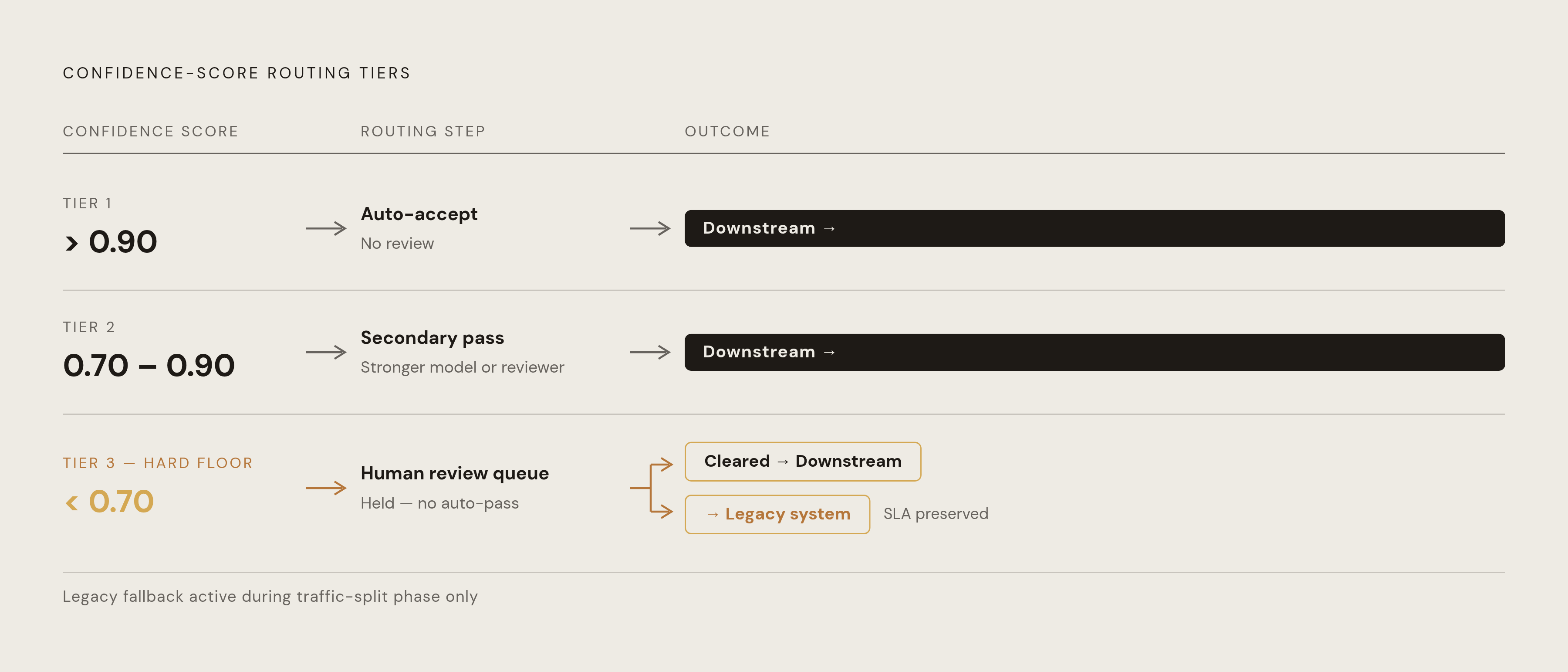
Confidence scores from the new system are the first-order signal for how fast the cutover can safely move. A document processed with high confidence that also clears output diffing is a strong candidate for full migration. A document processed with low confidence is a reason to hold, not push forward.
This matters because general-purpose models don't reliably know what they don't know. A system with no calibrated confidence signal can hand back the wrong answer with total apparent certainty, and that is the worst possible failure mode to have running inside a live cutover.
A 2026 practitioner guide lays out a workable tiering structure. Confidence above 0.90: accept the output and send it straight downstream, no human in the loop. Confidence between 0.70 and 0.90: route it through a secondary pass, either a stronger model or a human reviewer, before it goes downstream. Below 0.70: send it to a human review queue and hold it there, no automatic pass-through. Those numbers are a starting point, not gospel. The diff data coming out of parallel running will show what confidence scores actually correlate with on a specific document mix, and the thresholds should move to match what's actually observed, not stay fixed at someone else's defaults.
During traffic splitting, documents that fall below the confidence threshold don't have to dead-end in a human queue. Routing them back to the legacy system automatically keeps throughput and SLAs intact while the new system is still proving itself on that document type. And confidence needs to be tracked at the field level, not just the document level, since a document-wide average can hide a single critical field, a loan amount, a patient ID, that the system is quietly unsure about while sailing past on every other field. That field-level signal needs to surface on its own, not get smoothed into an average that looks reassuring. Calibrated, field-level confidence scoring should be a requirement teams put on any replacement system during evaluation.
Rollback triggers: defining in advance when to reverse course and what reversal requires
Rollback triggers need to exist before the migration starts. Trying to decide, in the middle of a production incident, whether a regression is bad enough to warrant reversing course, is the worst possible moment to be making that call for the first time.
Set specific thresholds during planning, not after something goes wrong. If the diff infrastructure shows regressions above a defined percentage for any given document type, traffic expansion for that type halts and routing reverts to legacy. If the share of documents falling below the 0.70 confidence threshold climbs materially past the baseline set during shadow mode, treat that as a sign the new system has run into an out-of-distribution document type it wasn't ready for. Row-drop events get zero tolerance: any case where the new system returns fewer rows than the legacy system on the same table sends that document type back to legacy immediately, no debate. And downstream consumer error rates need watching too, since a rise in errors from agents or applications consuming the new system's output is a lagging signal that something upstream has already gone wrong.
Rollback doesn't have to mean an all-or-nothing reversion. Because traffic splitting is already tiered by document type and confidence level, rollback can be scoped just as narrowly, pulling back one document type or one confidence band without touching the rest of the migration. That granularity needs to be decided in advance, alongside the triggers themselves, not improvised after the fact.
None of this works, though, unless the legacy system stays fully operational for the entire length of parallel running. Decommissioning it early, before rollback is no longer needed, removes the safety net the whole plan depends on. Reversal is only real if there's still something to reverse to.
Sources
- Legacy OCR vs. AI for Unstructured Data (2026) - Programming Insider
- OCR Benchmarks & Real-World Documents (July 2026) | Extend
- Transitioning from Traditional OCR to Intelligent Document Processing: Why Legacy Models Fail in the LLM Era | by mehrdad mohamadali | Medium
- extend.ai
- extend.ai
- cygnet.one
- enov8.com
- softwaremodernizationservices.com