Parallel-Run Validation Strategy for OCR Migration
Running both systems in parallel catches migration risks before they cost you thousands per minute.
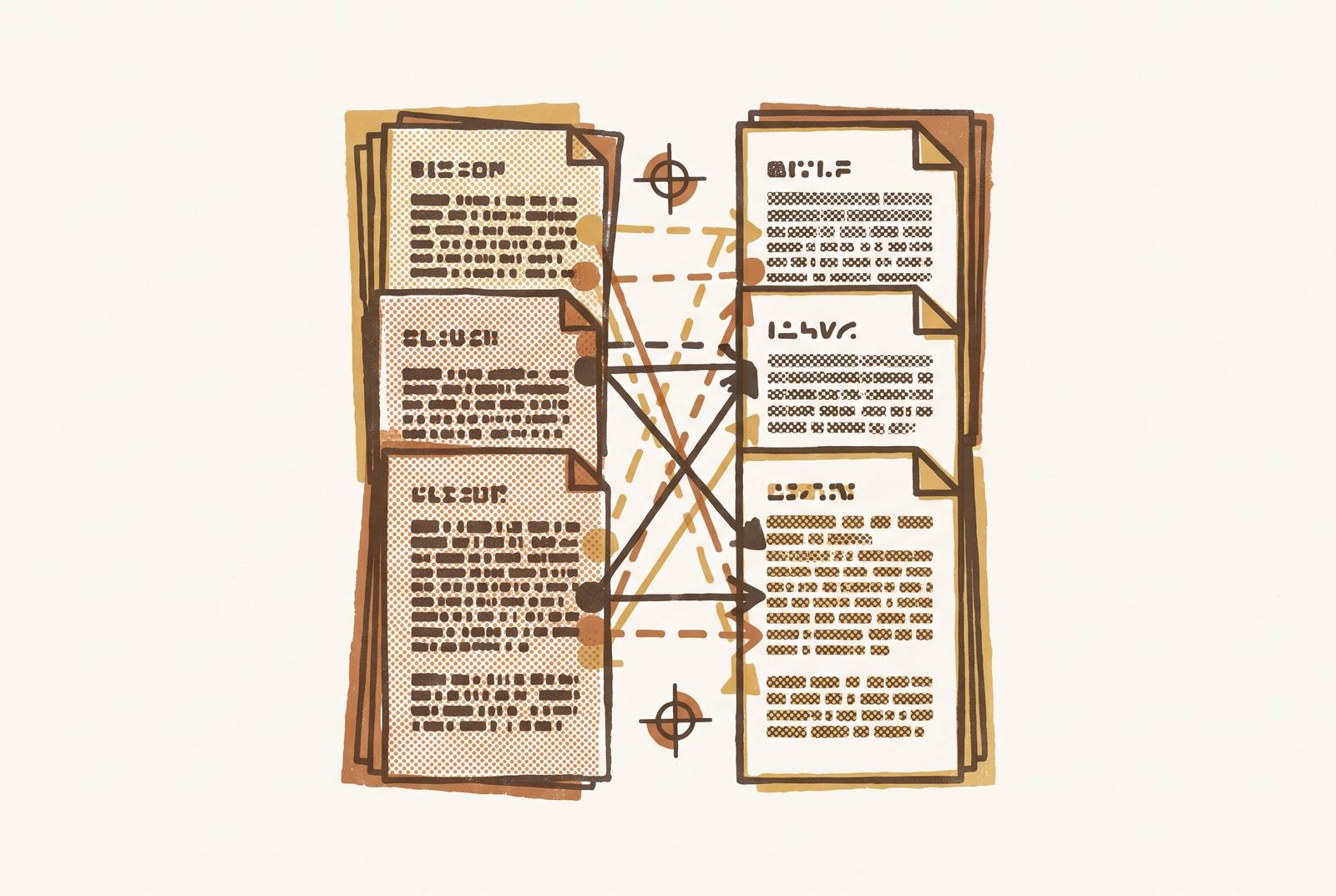
Legacy OCR systems top out around 60 to 80 percent accuracy on real documents. Modern intelligent document processing systems built on large language models push past 99 percent. That gap is the entire business case for migration, but it's also where most projects go wrong: teams chase the vendor number instead of finding out what the new system actually does on their own documents. A structured parallel run, where production paperwork flows through both systems at once and every disagreement gets measured before anyone flips the switch, is the only way to close that gap safely.
The stakes are not abstract. Data migration projects fail or blow past budget and schedule at a rate of 83 percent, and the common thread is a new system that never faced real production conditions before go-live. Unplanned IT downtime runs about $5,600 a minute by industry estimates, so a botched cutover that drags on for a few hours turns into a six-figure afternoon fast. The failure pattern is almost always the same: a team validates against clean, office-quality test files, then meets faded ink, handwritten margin notes, three-column tables, and embedded signatures for the first time in production. Parallel-run validation exists to catch that before it happens, not after.
Before any of this starts, define what success actually means, in numbers. Field-level match rate above 99.9 percent. Record count variance under 0.01 percent. Zero critical defects sustained for 30 straight days. Set those targets before a single server is provisioned, because a threshold decided after the data starts flowing is really just a guess dressed up as a standard.
How to build a representative document corpus before the run starts
Validation is only as good as the documents fed into it. A test set made up of clean, well-scanned samples will pass almost any system and prove almost nothing, because it skips the conditions that break OCR pipelines in the field.
A real corpus needs the boring stuff first: the high-volume, routine documents that make up the bulk of daily throughput, since that's the tail of the distribution driving day-to-day performance numbers. Then it needs the edge cases on purpose, not by accident: faded ink, handwritten annotations, folded forms, dense tables, embedded images, signatures, blank or null fields, maximum-length text fields, special characters. Skip these and the parallel run will look clean until one of them appears in production.
Domain matters here too. Off-the-shelf accuracy benchmarks tested mostly on office text can mislead teams in pharma and healthcare, where handwriting, stamps, and dense clinical formatting are the norm rather than the exception. Logistics manifests and financial statements with nested table structures carry the same risk. Volume itself is a variable to test deliberately, since a system that performs fine on a small batch of documents can behave very differently at a much larger scale, so the corpus needs large-batch samples specifically to surface scalability problems that occur only in large-batch runs, not in a small test run.
Sensitive records, health data, financial statements, need to be anonymized or masked before they ever touch a validation pipeline. HIPAA and GDPR obligations don't take a pause because a migration is underway.
Recent benchmark work puts general OCR accuracy at an average of roughly 96.5 percent across mixed document types as of 2025, climbing to 98 to 99 percent for clean printed text. Those numbers came from benchmark corpora, though, not from anyone's actual archive of scanned invoices and intake forms. The corpus a team builds here is what decides which number applies to their migration, not the published one. A practical rule of thumb: build enough volume to be statistically meaningful, but start contained enough that the discrepancy logs in the first week are still readable by a human being. And write the corpus composition down formally before the run starts. That document becomes the audit trail proving exactly what the new system was tested against, which matters a great deal later if anyone asks.
Shadow mode: dual ingestion with no user traffic on the new system
Shadow mode means every document hitting the legacy pipeline also hits the new system, at the same time, in the background. Legacy stays the system of record. It serves every user-facing output. The new system just watches and processes, quietly, with nobody depending on its answers yet.
Three rules hold from day one, no exceptions. Every input reaching legacy reaches the new system too, with no selective routing that only sends over the "easy" documents. The validation engine starts logging differences from the very first document processed, not after some warm-up period. And nothing coming out of the new system gets served to a real user at this stage, full stop.
Reads and writes split cleanly. Writes go to both systems. Reads only come from legacy, because serving a read from an unvalidated system means putting an unconfirmed extraction in front of an actual person, and that's exactly the risk shadow mode exists to avoid.
Static copies of documents go stale fast in any high-throughput environment, so real-time sync through Change Data Capture keeps every insert, update, and delete reflected in the new pipeline without the copies drifting out of date. CDC tracks every insert, update, and delete happening in the source system and pushes those events into the new pipeline continuously. Miss a delete, or let an update arrive out of sequence, and small errors start compounding into a divergence that's much harder to trace back later. CDC pipelines need active monitoring with alerts that fire the moment replication lag crosses a defined threshold, not a weekly check-in.
Shadow mode doesn't run for a fixed number of days. It ends when the validation engine shows stable, consistent output, and not a day before, regardless of what the original project timeline said.
One engineering detail gets missed constantly: sequential processing turns 100 documents at 2 seconds each into a 200-second bottleneck, and that bottleneck gets worse as volume scales. The concurrency model, process-based parallelism for GPU-bound local models, async execution for cloud API calls, needs to be chosen before shadow mode starts. Retrofitting it after the fact means re-architecting under pressure while documents are already piling up.
What to measure: the validation metric stack for OCR outputs
Three checks run simultaneously, not as a sequence where one waits on the last. Record count matching confirms totals extracted in legacy match totals extracted in the new system at every checkpoint. Checksum and hash validation confirms aggregated field values match, catching silent corruption during transformation. Field-level comparison checks individual extracted values record by record, which is the only one of the three that catches a misread character or a table column parsed into the wrong place.
Beyond those three, the OCR-specific metrics matter on their own terms. Character Error Rate measures the proportion of misrecognized characters and catches single-character substitutions that record counts sail right past, a metric worth tracking separately from the count-based checks. Word Error Rate captures insertions, deletions, and substitutions at the word level. Exact Match Rate, whether a field matches ground truth exactly, matters most for structured form extraction, where a field that is mostly right is still a failed field. And confidence scores, the model's own certainty on individual extracted elements, decide which outputs get routed to human review instead of treated as equally trustworthy.
Schema validation checks that field names, data types, and constraints in the output match what's expected. A system that pulls the right text but drops it into the wrong field produces a silent failure, technically no wrong characters, functionally a broken record. Referential integrity checks the relationships between fields: line items summing to a stated total, dates falling inside a plausible range. Break those relationships and the extraction can look flawless field-by-field while being wrong as a whole.
The dangerous failure mode here is the silent one. A model returns a confidently wrong answer with a high confidence score attached, no exception flag fires, and the error rides downstream undetected until it causes an actual business problem, a mispaid invoice, a misfiled claim. Field-level comparison in the parallel run is the operational check that catches this, because it doesn't trust the confidence score on its own. And confidence scores from different OCR engines are not on the same scale: a 0.80 from one engine does not mean what a 0.80 means from another. Thresholds need to be set per engine, never shared across vendors as if they were interchangeable.
Checking cadence should match transaction volume, not the reviewer's calendar. Hourly checks for high-transaction workflows. Daily checks for lower-frequency domains. Setting the interval by convenience instead of volume is how discrepancies pile up unnoticed between checks.
Pre-defined reconciliation rules before the first discrepancy appears
One rule sits above all the others, and it needs to be written down before migration begins: when legacy and the new system disagree, the new system's output gets corrected. Legacy never gets touched during reconciliation, ever.
Teams that wait to write reconciliation rules until the first discrepancy occurs end up making inconsistent calls under pressure, case by case, engineer by engineer. That's an avoidable problem with a simple fix: write the decision table first, before anyone needs it.
The table itself should cover the recurring cases. A missing record in the new system's output triggers a re-extraction and reload from source. A field value mismatch triggers a documented transformation rule, a reload of that field, and a logged action. A duplicate record triggers deduplication logic with the action logged. A schema conflict pauses the pipeline until the field mapping gets reviewed, no exceptions. A confidence score below threshold routes to a human review queue rather than getting auto-accepted, no matter how close it seems to correct.
At production volume, parallel runs generate hundreds of discrepancies in the early phases, which makes automated reconciliation the only workable path. Manual handling at that scale creates gaps in the audit trail, and in healthcare or financial services, that audit trail is a compliance artifact, not a nice-to-have engineering log. Every reconciliation action needs a timestamp.
There's a useful way to read the discrepancy volume as it drops. Moving from 95 percent accuracy to 99 percent cuts the exception review rate from roughly one document in twenty down to roughly one in a hundred. That's what a healthy parallel run looks like as the new system settles in. If exception rates stay stuck near the legacy baseline instead of falling, that's the signal to stop the ramp and go diagnose why, not to push forward on schedule.
Phased traffic ramp from shadow mode to cutover
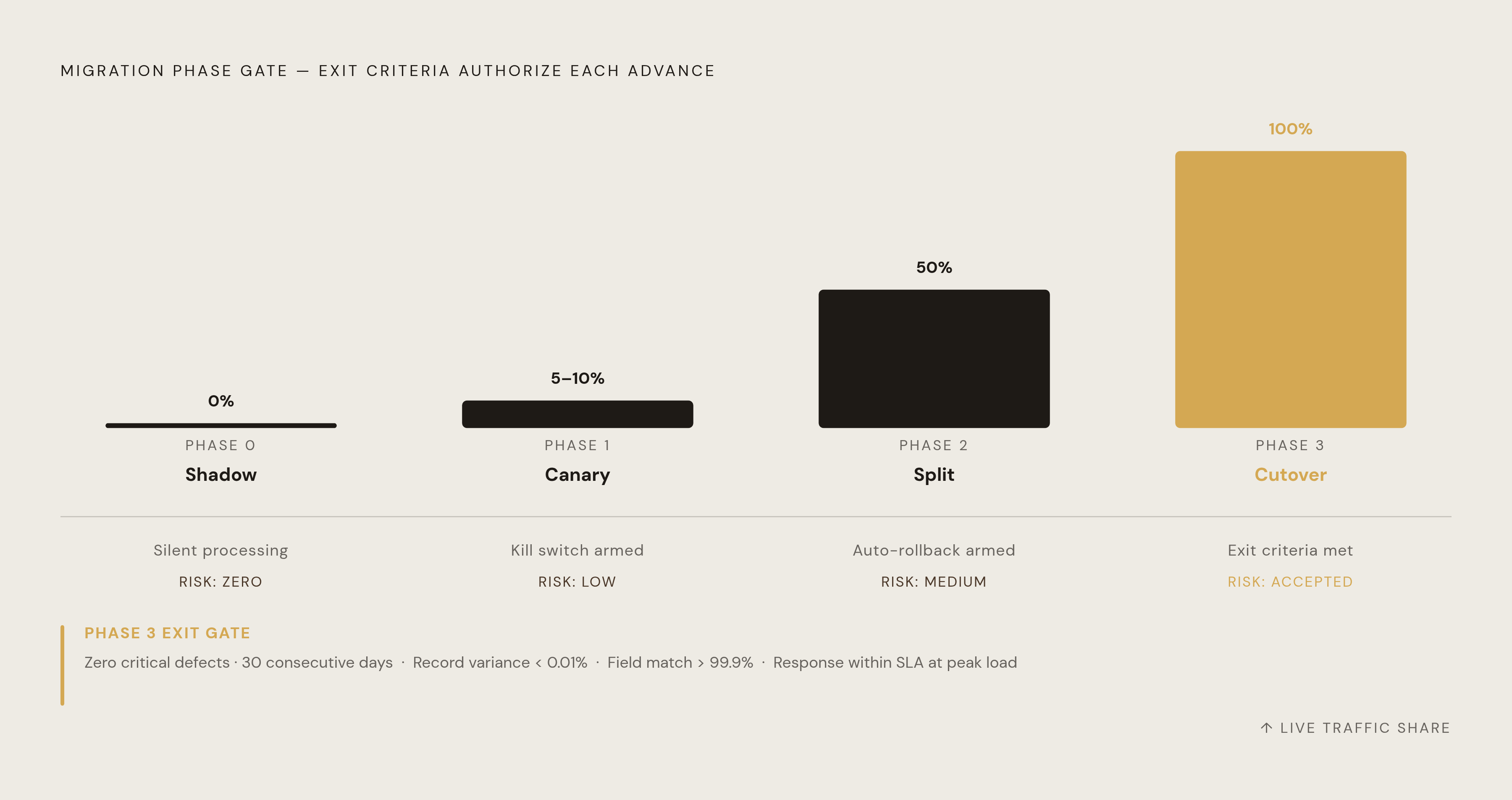
Shadow mode is phase zero. The ramp itself starts only once shadow mode has proven stable, consistent output, and it moves in stages rather than jumping straight to full volume.
Phase one routes 5 to 10 percent of live traffic to the new system, with legacy still the system of record and a kill switch armed and ready. Phase two moves to 50 percent, with validation thresholds monitored in real time and an automated rollback pre-armed rather than assembled on the fly. Phase three is full cutover, and it only happens once exit criteria have been met across every prior phase, not on a date someone wrote in a project plan six months earlier.
The logic behind starting small is blast radius. At 5 to 10 percent traffic, a failure in the new system touches a small slice of production volume while legacy absorbs the rest. That's the entire risk-reduction argument for a phased ramp over a big-bang cutover: it turns a catastrophic failure into a contained one.
Exit criteria decide when cutover happens, not the calendar. Zero critical defects across 30 consecutive days. Record count variance under 0.01 percent across every document domain in scope. Field-level match rate above 99.9 percent. Response time within SLA at peak load. Miss any one of these and the timeline extends, full stop, because the exit criteria are the only authority that gets to make that call.
Rollback needs to be automated and tested before any live traffic ever reaches the new system. A rollback plan that depends on someone manually executing steps during a live incident tends to fail exactly when it's needed most, since incidents are rarely calm enough for careful manual work. The kill switch has to revert traffic to legacy without a human in the loop. Testing that rollback mechanism should be a required precondition for entering phase one, not an optional step someone gets to if time allows.
How open-source benchmarks inform threshold-setting, and where they stop
OmniDocBench, presented at CVPR 2025, covers 1,355 PDF pages spanning nine document types, four layout types, and three languages, evaluating text, tables, formulas, and reading order. Its core metric is edit distance, where smaller values mean better performance, supplemented by BLEU and METEOR for text blocks, TEDS for tables, and CDM for formulas.
The value of a benchmark like this is in its granularity. Per-page and per-attribute results let a team see exactly which document types and layout patterns a candidate system struggles with, before migration even starts. That's genuinely useful input for building the corpus and setting initial thresholds.
The limit matters just as much, though. Continuous metrics like edit distance and BLEU penalize small, harmless formatting differences that don't actually affect downstream use, and the benchmark shows signs of saturation, with top systems clustering near the ceiling in ways that stop reflecting real differences in production performance. For a migration team, that means public benchmark scores can inform vendor selection but can't substitute for validation against a team's own documents. A system leading the public leaderboard can still underperform on the specific industry layouts it was never benchmarked against.
Treat benchmark scores as a starting hypothesis for where thresholds should sit, nothing more. The parallel run's field-level comparison data is what actually confirms whether that starting bar holds up against real production documents. And one precondition produces reliable OCR: documents scanned at 300 DPI or higher are the current best-practice floor for it. That's a decision to make before benchmarking or validation begins, not a fix to reach for afterward when accuracy comes in low.
Confidence scoring as a live signal during the parallel run
A confidence score is a numerical value, typically expressed from 0 to 1 or 0 to 100, representing how certain a model is about one specific extraction. Depending on the engine, it's produced for each token, each word, or each field.
Thresholds set during shadow mode decide how documents get routed once live traffic starts flowing. High-confidence output can be compared directly against legacy without sitting in a review queue. Medium-confidence output gets flagged for a partial review, a spot-check against legacy before it's accepted. Low-confidence output goes to human review regardless of whether it happens to match legacy, because a low-confidence match that's technically correct is still not a validated extraction, it's a coincidence that hasn't been checked.
The harder problem is high-confidence wrong answers that sail through automated comparison because legacy made the same mistake. It's high-confidence wrong answers that sail through automated comparison because legacy made the same mistake. Both systems agreeing on a wrong value is a failure mode confidence scoring alone cannot catch, since agreement isn't the same as accuracy. That's why a subset of documents needs field-level comparison against actual ground truth, not just against legacy's output, however tempting it is to treat legacy agreement as sufficient proof.
Because confidence scores aren't calibrated the same way across different OCR engines, thresholds need engine-specific calibration during shadow mode before any routing logic goes live. The first couple of weeks of shadow mode are, in practice, confidence-score calibration time, even if nobody labels it that way on the project plan.
These thresholds don't disappear after cutover, either. In production, confidence scores keep deciding what gets auto-processed versus what gets kicked to a human, so the thresholds locked in during validation become the operating parameters for the system going forward. Getting them right during the parallel run has a direct cost in downstream review workload if it's done wrong. Teams working with raw model outputs and no system-level confidence layer end up building this routing logic themselves from scratch, which is slower and leaves more room for error than working with a platform that has confidence scoring and evaluation built in from the start.
Domain-specific considerations for financial services, healthcare, real estate, and logistics
Financial services carries the highest migration risk in multi-page statements, tax forms, and loan applications with complex table structures, where line items need to sum correctly or the whole extraction is worthless regardless of how clean the individual fields look. Confidence thresholds here need to align with fraud detection and governance standards already in place, since a misread dollar figure that passes at medium confidence isn't a minor error, it's a material one. Reconciliation audit trails have to satisfy existing compliance requirements, with every discrepancy resolution logged by timestamp and action taken.
Healthcare documents bring their own hazards: clinical handwriting, dense intake forms, stamps and annotations layered over printed text, the kind of material that off-the-shelf benchmarks tested mostly on office documents were never designed to handle well. The corpus for a healthcare migration needs real clinical and pharma documents in it, not proxies, and every one of them needs to be de-identified before it enters a validation pipeline, given HIPAA obligations that apply regardless of what stage the migration is in.
Real estate and logistics each carry structural challenges of their own, tables, manifests, and layouts that vary widely by source and rarely match the clean formatting benchmark corpora are built around. In both domains, the corpus-building principle from earlier in this piece applies directly: representative samples have to reflect the actual document mess in production, not a tidied-up version of it, or the validation numbers coming out of the parallel run will describe a system that doesn't exist in practice.