Cycle Time Compression ROI in Underwriting and Onboarding
Automating document intake rather than credit decisions slashes underwriting cycle time and ROI.

Underwriting teams have spent the last several years buying faster scoring engines on the assumption that speed at the decision point is what shortens a loan cycle. It isn't: credit scoring models have been fast for years, and the actual approve-or-decline computation takes a small fraction of the total time a file spends in process. The hours disappear somewhere else entirely: in the stack of PDFs, scanned forms, bank statements, and tax documents that arrive before any decision engine ever sees the file.
Mapping a loan file at the task level makes the picture precise. Manual document intake and classification alone eats a meaningful block of time per file, as someone opens each document, figures out what it is, and routes it to the right queue. Data extraction across all the documents in a packet runs to several hours of work. Cross-document verification, checking that the income stated on an application matches the bank statements, matches the tax return, matches the pay stubs, consumes the largest share of all. Added up, the credit decision itself is a rounding error against the labor spent moving paper.
Lenders tried to fix this by automating the easy parts first: form collection, bureau pulls, approval routing. Those pieces work well in isolation and the file still stalls exactly where it always stalled, at the document layer, because template-based extraction tools fail the moment a document layout shifts even slightly, kicking the file into a manual exception queue a human now has to clear by hand.
That failure compounds for a predictable set of applicants. A significant minority of applications fall outside automated pipelines entirely because the borrower doesn't fit the standard mold: self-employed applicants, gig workers, SME owners with income spread across several revenue streams. Each one becomes a manual exception, reviewed by hand, on top of the exceptions already generated by layout drift. Those two failure modes together mean any return-on-investment model built around accelerating the decision engine is measuring the wrong part of the process. The return sits upstream, at document intake, not at the moment the system says yes or no.
Document-Handling Time in Agentic Pipelines
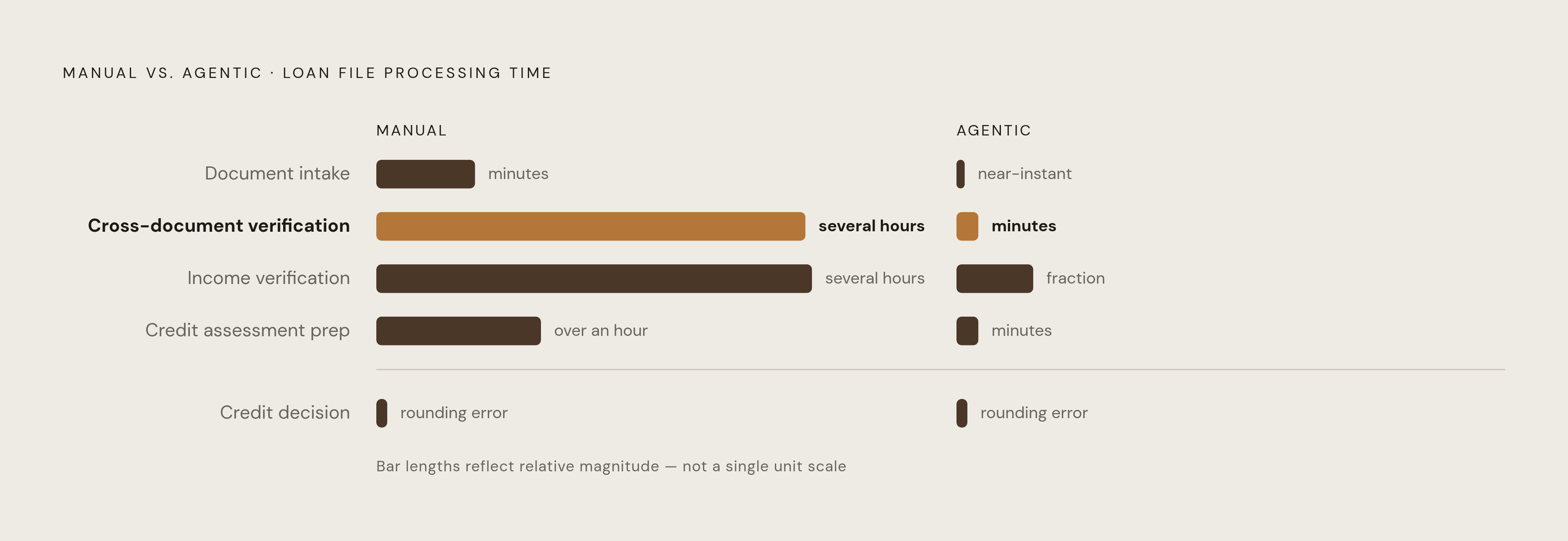
Cycle time doesn't compress because an AI model renders a verdict faster. It compresses because the handoffs between document-handling steps, the sequential human-gated review that used to pass a file from one queue to the next, disappear, and classification and compliance checks run at the same time.
The task-level shift is stark. Document intake and classification, which took many minutes of a person's attention per file, happens near-instantly once an agentic system is reading the file as it arrives. Cross-document verification, previously several hours of a person checking one document against another, drops to minutes. Income verification, also several hours under manual review, falls to a fraction of that. Credit assessment preparation, which used to take over an hour of compiling and formatting data for an underwriter, compresses to minutes. Total wall-clock time for a complete file moves from many hours of labor spread across weeks of end-to-end processing down to a fraction of that, with no queues sitting idle overnight and no backlog building up behind a single overloaded reviewer.
Picture what actually happens when a 30-page bank statement lands in the pipeline. An agent reads the document, identifies it as a bank statement rather than a pay stub or a tax form, and extracts the transaction history as structured data. It checks deposit patterns against the income the applicant declared on the application. If the applicant is self-employed, the system analyzes cash flow consistency across months of transaction records and checks that pattern against the tax filings submitted separately, so it doesn't fail the way a template-matching tool would the moment the income documentation doesn't look like a standard pay stub. For a gig worker, the agent pulls payment histories from multiple platforms and synthesizes a single income profile out of sources that never would have reconciled cleanly under a rules-based system. That's the direct answer to the issue of non-standard borrowers described above: the exception doesn't vanish, but it stops requiring a person to resolve it by hand.
The document-handling bottleneck that template-based systems can't escape, where layout variation and non-standard income documents push files into manual exception queues, is what specialized document processing infrastructure is built to close. Extend, a document processing platform built for production AI agents, handles parsing and extraction on complex, irregular layouts well enough that operators can process the share of applications that would otherwise fall outside a standard pipeline without routing them to a human for a first pass.
None of this removes the underwriter from the loop. Agents process incoming files, extract structured data, and flag anomalies within seconds of submission, and the underwriter's time shifts from data entry toward exception handling, borrower-specific judgment calls, and compliance sign-off. The question that follows immediately is what happens when the extraction itself is wrong.
Extraction Accuracy and Compression at Scale
The speed gains above hold only as long as extraction is accurate, because every field the system gets wrong goes right back into a manual queue and erases the time that was just saved. Cycle time compression is a direct function of how reliably the system reads the document in front of it, not a property of pipeline architecture by itself.
The structural failure mode is visible in bolt-on automation tools that process a single step correctly but leave everything around it untouched. The delay was never trapped inside any one step; it lived in the handoff between steps. A tool that automates extraction without producing accurate output doesn't eliminate the verification bottleneck, it just relocates it, creating a new queue at the point where someone has to catch and correct the system's mistakes.
The variance between two deployments of the same tool is often larger than the variance between two different vendors. Submission volume, document quality, line of business, and how deeply the system integrates with existing workflows move the outcome more than which product a team picked. So accuracy on the specific documents a given team actually processes matters more than a headline benchmark number pulled from a vendor's marketing page.
Those benchmark numbers deserve real scrutiny before anyone trusts them. Different benchmarks measure fundamentally different things: raw OCR character accuracy on clean PDFs, downstream answer accuracy on scanned contracts, hallucination rate on summarization tasks. A figure is only comparable to another figure when the document type, the degradation level, and the task definition all match, and vendors rarely disclose enough detail to confirm that they do. Handwriting and degraded scans remain the weakest point across every engine on the market, and even when every system looks nearly identical on clean, printed text, the gap between them widens sharply on messy inputs. Underwriting files are multi-document packets with mixed layouts, inconsistent scan quality, and fields that relate to each other across pages, and that is precisely when general-purpose models tend to lose accuracy. Extend's RealDoc-Bench, for instance, is built specifically to test production documents where layout, reading order, and field relationships determine the correctness of the downstream answer, rather than testing clean, isolated pages the way many benchmarks do.
One failure mode deserves specific attention because standard benchmarks don't catch it: silently dropping rows in a large array of extracted data, transaction line items on a bank statement being the clearest example, doesn't register as an error on a benchmark that scores field-level accuracy. It produces a structured output that looks complete and is quietly wrong, which then corrupts whatever risk score gets built on top of it. A system needs to be evaluated against that specific failure mode, not just against whether it got the borrower's name and loan amount right.
Confidence scoring is the mechanism that keeps the whole system from degrading silently. A platform that attaches a numerical reliability signal to each extracted field makes threshold-based routing possible: high-confidence fields move straight through, low-confidence fields get flagged for a human to check. Extend builds this in as a core feature rather than an add-on, running a multi-pass review agent that checks output before it reaches production, so an underwriter spends review time on fields the system is genuinely uncertain about rather than re-keying data that was already extracted correctly.
Sizing the return across lending, insurance, and onboarding workflows
The return from compressing document handling is real and measurable, but it doesn't take the same shape everywhere. In lending, the dominant value is revenue retained that would otherwise walk out the door. In insurance, it's cost reduction and throughput. In onboarding, it's abandonment reduction and lower compliance cost.
In lending, every additional day a loan file sits in processing raises the odds the borrower closes with a competitor instead. If you cut cycle time meaningfully, that fallout drops, and across a large loan portfolio, even a modest reduction translates into a substantial number of additional originations retained per cycle. Leading lenders report auto-clearing 70 to 75 percent of credit, income, and asset conditions with no underwriter involved, and they're pushing that rate higher as extraction accuracy improves, which changes the underwriting headcount math directly. OakNorth Bank built AI-augmented underwriting into its SME lending process and maintained a default rate materially below the industry average while doing it, which answers a question lenders ask reflexively: whether faster processing and sound risk management can coexist. The evidence says they can. McKinsey's pilot of a multiagent credit memo process at a retail bank found meaningful productivity gains for credit analysts and faster turnaround on credit decisions, a result consistent with the broader pattern even without a named institution attached to it.
In insurance underwriting, the pattern across credible sources is directional rather than exact to the decimal point: document-heavy intake work collapses from days down to minutes, cycle times on complex risks fall by roughly a third, and productivity gains cluster somewhere in the tens of percent. Swiss Re's Underwriting Assistant combines OCR, natural language processing, and large language models to support manual underwriting work, and both SBLI and Swiss Re have reported meaningfully reduced manual effort on referred cases since deploying it. That's the concrete anchor worth trusting in a category where plenty of widely cited vendor figures can't be traced back to a clear methodology and should be labeled accordingly rather than placed next to numbers that can be verified. The underlying problem those figures are responding to is well understood regardless: underwriters routinely toggle between six to ten disconnected systems in a single day, and the "inbox underwriting" model, emails, PDFs, spreadsheets, consumes a real share of their effort on deals that never end up binding. Disciplined adopters report gains in sales conversion, premium growth, and reduced onboarding cost, but the size of those gains varies enough by source that they belong in the directional category.
In client onboarding, professional services firms have brought onboarding time down from a multi-week average to a matter of days, with straightforward engagements clearing even faster, and the amount of partner time spent on onboarding administration has dropped sharply. The hidden driver of return in this category is abandonment: an application that stalls during document collection is lost to friction rather than a bad credit decision, and compressing that friction improves conversion without touching credit policy. Compliance cost reduction rides alongside it. Automated audit trails and compliance validation running in parallel rather than sequentially cut audit preparation time materially, since in a manual workflow those checks proceed one after another, with each stage waiting on the one before it to finish.
A related pattern occurs in logistics and adjacent back-office workflows, where proof-of-delivery documents, bills of lading, and related paperwork form a critical chokepoint before an invoice can even be issued. Pulling days out of that invoicing cycle frees up working capital on a lasting basis. It's a structural change to the balance sheet, not a one-time cost saving.
A CFO evaluating any of this will accept three categories of claim as defensible: revenue retained through lower fallout, higher throughput achieved without adding headcount, and reduced compliance cost. Vendor-reported percentage improvements that don't come with a named methodology belong in a separate column from independently verified figures, not blended into the same table as if they carry equal weight.
What a reliable document intake layer requires in production
Capturing any of the returns described above depends on a document intake layer accurate enough to sustain straight-through processing at real production volume, not a set of prompt-engineering tricks that perform well in a demo and degrade the moment they meet actual files. Evaluating a document processing platform against that standard means checking it against a specific list of requirements, not taking a benchmark score at face value.
Parsing and extraction need to hold up on complex layouts, multi-document packets, and degraded scans, since production underwriting files are rarely clean single-page PDFs. Splitting needs to correctly segment a multi-document packet before extraction even starts, because an extraction system can only be as accurate as its understanding of where one document ends and the next begins. Classification needs to route by what's actually in a document rather than by its file type, so a self-employed applicant's income package or an unusual commercial loan file doesn't fall into an exception queue by default. Confidence scoring needs to be part of the output itself, so that the decision to auto-clear a field or send it to a human is based on evidence. And workflow orchestration needs to connect intake to whatever systems sit downstream, so a team doesn't have to build and maintain that connective tissue on its own.
The dramatic compression on data extraction described earlier only holds if the extraction system runs reliably across every document type in the mix, so it doesn't quietly create a new manual queue further downstream. An agent can move a file from submission to a packaged summary in minutes instead of days if the platform is API-first, handles parallel compliance checks, ingests multiple document formats, and produces structured output.
Enterprise deployment adds a layer of compliance requirements that can't be bolted on after the fact: SOC 2, HIPAA, and GDPR certification, options for zero data retention, and self-hosted or bring-your-own-cloud deployment for sensitive financial and health records. In financial services and healthcare, these are baseline requirements, not features that distinguish one vendor from another.
Developer experience ends up deciding how quickly any of this reaches production, and time-to-production decides how quickly the return actually arrives. A team that can go from integration to a live pipeline in days instead of months captures the ROI sooner and spends less getting there. Extend publishes open benchmarks against real-world complex document layouts rather than curated test sets, which gives underwriting teams a way to check extraction accuracy against their own document mix before committing to a build. Platforms built API-first, with SDKs across the major languages, open-source tooling, and pre-built agent skill templates, cut that deployment timeline down meaningfully, and the team that ships first is the team that starts collecting, on day one, the hours that used to sit buried in a document queue nobody was watching.