Reviewer Role Redesign After AI Document Automation
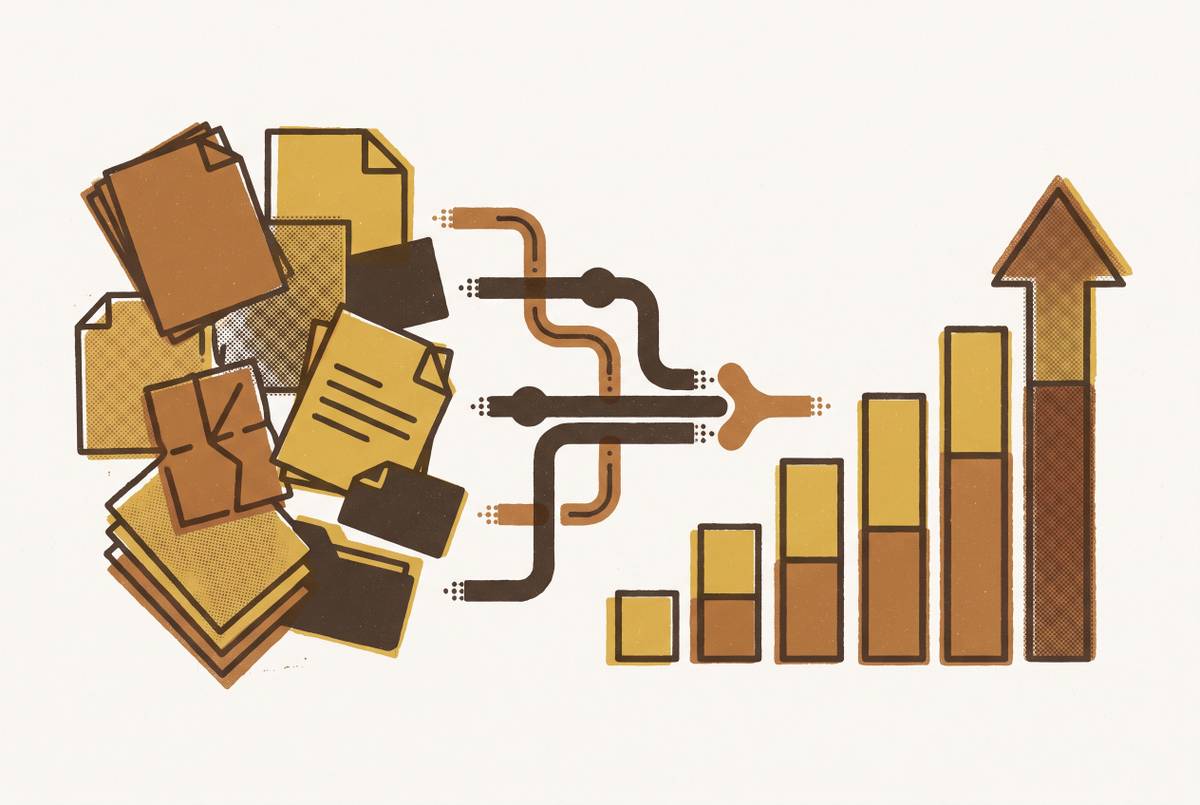
Reviewers now handle harder cases as AI automation removes routine documents from their queue.

The job title on the org chart still reads "document reviewer." The title stays the same, but what that person does all day has changed underneath it, and the change is large enough that the title barely describes the work anymore. A reviewer today sits at the same desk, works the same queue, signs off with the same audit trail as a reviewer five years ago, but the documents arriving in that queue are no longer a cross-section of what the business processes. They are a concentrated residue of everything the system couldn't handle on its own.
But the reviewer at the desk knows something the org chart doesn't capture: the documents in front of them now are harder, stranger, and more consequential than the ones a reviewer used to see, because the easy ones never make it to a human at all anymore. The gap between how the role looks from outside and how it feels from inside is the whole story this piece is built to explain.
How extraction accuracy at the AI layer changes what reaches a human reviewer
Older document processing systems sent almost everything to a human because the system had no reliable way to tell which documents needed a person's attention. Confidence in the machine's own output was low across the board, so the safe default was to route nearly all of it for a human check. That approach wasted enormous reviewer time on documents that needed no judgment at all, a clean invoice with every field machine-readable, a form filled out exactly the way the system expected.
Modern AI extraction pipelines work the opposite way. What's left in the queue is no longer representative of the document population as a whole. It's a sample pulled from the cases the system found genuinely difficult, and that distinction matters enormously for understanding what the reviewer's job has become.
What makes a document land in that difficult pile tends to follow a pattern. Document variants the model hasn't seen in enough volume to calibrate against round out the list.
Medical documents illustrate this better than any other category. RealDocBench reports a persistently hard medical subdomain across eighteen evaluated systems, meaning clinical paperwork surfaces more edge cases than other regulated document types regardless of which system is doing the parsing. That persistence across eighteen separate systems points to a property of the documents themselves as the real difficulty: they are dense with abbreviations, handwriting, and layout conventions that vary by provider and department.
The consequences compound once extraction feeds into agent-driven decisions, where no person is positioned to catch a wrong read before it becomes a wrong approval. A misread character is a nuisance when a person is the one reading it. The same misread character becomes a wrong approval when an autonomous agent acts on it without pausing to question what it saw.
Confidence scoring as the operational handoff point between AI and human judgment
None of this filtering works without a mechanism to decide, document by document and field by field, what the system can handle alone and what it needs to hand off. That mechanism is confidence scoring, and it functions as the operational hinge the entire redesigned reviewer role swings on.
In practice, confidence thresholds operate at the level of individual fields. Crucially, these thresholds aren't uniform across a document. A payment amount field might require a much higher confidence score before it's allowed to auto-process than a reference number field would, simply because the cost of getting the payment amount wrong is so much greater than the cost of a typo in a tracking code.
This only works if the confidence score itself can be trusted, and that's where a real complication sets in. A stated confidence number isn't inherently reliable just because a model produces one. A model that claims high confidence but is right only a fraction of the time at that confidence level gives a reviewer a false sense of security.
There's a specific failure mode confidence routing can't catch on its own: systematic errors the model makes with total confidence. If a model is consistently wrong about a particular field type or document structure, and it assigns high confidence to those wrong answers every time, routing logic will wave that error straight through without ever flagging it for review. The only way to catch this pattern is to periodically sample from the high-confidence auto-accepted pile and check it by hand, treating the auto-accept lane as something that still needs spot audits. This reframes what the reviewer is actually for. The reviewer isn't only validating cases the system already marked as uncertain. The reviewer is also the backstop for cases that should have been flagged as uncertain and weren't.
What reviewers are doing differently when they work exception queues
Working an exception queue is a different cognitive task from reading through a sequential stream of documents, not a faster or slower version of the same task. Sequential review mostly asks a person to confirm that a value was read correctly. Exception review asks a person to adjudicate a case the system has already flagged as ambiguous. The easy confirmations have been stripped out, and what remains requires actual judgment.
That judgment takes several distinct forms. Structural edge cases demand a different kind of attention too, recognizing when a document's own layout has caused a field relationship to break, say a table header that got associated with the wrong column, rather than treating it as a simple character-level misread. And escalation judgment matters on top of all that: knowing when a case has exceeded the reviewer's own authority and needs a specialist or a formal regulatory process.
Legal document review shows this shift clearly. Associates who once spent most of their time reading documents line by line now spend that time making decisions on the subset of documents that actually require legal judgment, a different job built around different skills than the one it replaced. The same shift appears in accounts payable automation, where a team that once reviewed a large share of every invoice that came through now reviews only a small fraction, the ones the system flagged.
ParseBench's five capability dimensions, tables, charts, content faithfulness, semantic formatting, and visual grounding, map closely onto the categories of failure a human reviewer is now most likely to run into. The easy cases, clean text in a predictable layout, don't make it to the queue anymore because the system handles those reliably on its own.
Why the productivity gains from exception-based workflows depend on how the review role is structured
The productivity gains from this shift translate into reviewers handling a far smaller volume of documents while spending their time on the ones that actually require judgment. They depend entirely on whether an organization actually redesigns the reviewer role around the exception queue, or simply inserts AI into the old full-review workflow without changing anything else about how the job is structured.
The two models produce very different outcomes. In an approval model, a human still reviews every single AI output, one by one, approving a machine's work where they once extracted the data themselves. That's faster than manual extraction, but the reviewer is still processing the full volume of documents, just wearing a different hat while doing it. In an escalation model, the AI handles the high-confidence majority of documents entirely on its own, and a human only ever sees the flagged exceptions, so the reviewer's time concentrates on the small set of cases where judgment actually matters.
The approval model is tempting because it requires almost no organizational change. It preserves the shape of the old job and simply adds AI as a layer in the middle. A company using it gets some speed gain without ever doing the harder work of redesigning what the reviewer role is for. That half-step becomes a ceiling on how much productivity the AI investment can actually deliver.
Verification effort can rise even as the time spent on initial extraction falls. Trust in the system can make a reviewer less careful at the exact moment careful attention matters most.
Skill atrophy is the other structural risk. A reviewer who hasn't looked at a normal, clean mortgage disclosure in months may struggle to recognize what's actually unusual about the next one that lands in the queue. That's a workflow design failure, something an organization can fix by rotating reviewers through some routine documents or by building deliberate exposure into the job, not a limitation of the AI itself.
How benchmark reliability shapes the threshold decisions reviewers depend on
Everything in the confidence-routing model depends on the accuracy figures behind it being honest. If the benchmarks a vendor cites, or the calibration methods behind a stated confidence score, don't hold up under scrutiny, then the entire triage system built on top of them is unreliable, and reviewers will encounter far more errors than the system led anyone to expect. Benchmark gaming is a live risk, not a hypothetical one.
The scale of the gap is visible in results from the Office Comprehension Benchmark, where the strongest frontier system in its default reasoning mode scores only 59.3% on the Domain Q&A track. A model can look strong in a demo and still fail unpredictably once it's handling the actual volume and variety a business throws at it.
Part of the problem is what these benchmarks measure. Most public benchmarks evaluate parsers against clean academic layouts or synthetic prose, text that was never meant to resemble the documents a mortgage underwriter, a hospital billing department, or a logistics company actually processes. RealDocBench tests parsers against dense fillable forms, checkbox grids, multi-column tables, handwriting, and scanner artifacts, the features that make real regulated documents hard to begin with. ParseBench makes a related point from a different angle: metrics that lean too heavily on surface-level text similarity miss the failures that actually matter to an agent, since a parser can score well on a benchmark that rewards text matching while still producing output that causes an agent downstream to make the wrong decision.
Teams building document pipelines need to ask vendors a direct question: were these accuracy claims produced under a methodology that specifies document distribution, field types, layout complexity, and scoring protocol? Reliable benchmarking is the foundation the whole reviewer workflow rests on, because if the accuracy numbers are inflated or the confidence scores are miscalibrated, the queue a reviewer sees stops matching the queue the system was designed around.
What the redesigned reviewer role looks like in regulated industries where human oversight is mandatory
In regulated industries, this redesign is a legal requirement layered on top of the operational case for it.
Healthcare is the clearest example. Humans end up reviewing the cases that are simultaneously the highest-stakes and the structurally hardest to parse correctly.
Finance shows a parallel pattern. Accounts payable automation gives a practical picture of what exception-based review looks like once it's running: a team that used to check a large share of every invoice that came through now checks only the fraction the system actually flags.
Logistics and supply chain carry a version of the same risk, driven by layout. Exception-based review in this domain concentrates reviewer attention on the documents where a vendor's formatting departs furthest from what the system expects.
Regulation is moving to make all of this explicit. The EU AI Act requires human oversight for high-risk AI systems, including credit scoring and employment screening, and while the compliance deadline has been deferred by subsequent regulation, the direction is clear, with significant regulatory movement elsewhere pointing the same way. That turns the reviewer role into a compliance requirement rather than a workflow choice a company can opt out of if the economics stop favoring it.
What engineering teams need to build into document pipelines to make the reviewer role function well
None of the redesigned reviewer role functions without deliberate engineering behind it. A well-built exception queue is something a team constructs on purpose, not a byproduct that appears once a company bolts AI onto an old workflow, and the quality of a reviewer's judgment depends directly on what the pipeline puts in front of them.
The first requirement is confidence scores that are actually calibrated, not merely reported. A number labeled "confidence" that hasn't been checked against real outcomes gives a reviewer nothing to act on, and a reviewer who can't trust the confidence score can't tell which flagged cases genuinely need deep scrutiny and which were flagged for a minor, low-stakes reason. Pipelines also need routing logic specific enough to reflect which fields carry real consequence, so a payment amount and a reference number aren't held to the same threshold just because they live on the same form. Periodic sampling of the auto-accepted majority has to be built in as a standing practice, not an afterthought, since that's the only way to catch the confidently wrong cases that routing logic alone will never flag. And pipelines need enough transparency into why a case was escalated, which field triggered it, what threshold it crossed, what about the layout looked unusual, for a reviewer to resolve it quickly rather than re-deriving the problem from scratch every time.
Get these pieces right and the reviewer role does what the redesign promises: concentrated judgment applied to the cases that actually need it, with the routine work cleared reliably before it ever reaches a desk.