SLA Design for AI-Driven Document Processing Pipelines
Contracts must measure field-level accuracy by document quality tier, not blanket percentages.

Document processing has moved from a task performed by software and checked by people to a task performed and acted on entirely by machines. That shift changes what a service-level agreement has to promise, because the old assumption, that a human somewhere would catch a bad extraction before it did any damage, no longer holds.
The scale of the shift is already visible in how enterprises are building. A majority of enterprise document processing initiatives, as of 2025, are specifically evaluating agentic AI approaches, up from roughly a quarter of them just two years earlier. That is not a forecast about where the technology is heading. It describes systems already running in production, making decisions off documents with no person in the loop until well after the decision is made.
Under the older model, OCR fed a queue, and a person reviewed the queue before anything downstream happened. That review step was a checkpoint almost by accident: it existed because full automation wasn't trusted yet, but it also happened to catch misread fields, mangled tables, and misclassified forms before they cost anyone money. Agentic pipelines remove that checkpoint by design. The entire pitch of the architecture is that a document gets read, understood, and acted on without a human touching it. ParseBench (2026, arXiv) frames the shift precisely: the relevant standard has shifted from "good enough to read" to "reliable enough to act on". An agent approving an insurance claim can read the wrong number off a table if the header row is misaligned by one column. An agent summarizing a quarterly filing can miss a material figure entirely if a chart gets flattened into text with no numbers attached.
What makes this dangerous is that the failures involved don't announce themselves. A dropped field, a misclassified document type, a table that collapses two rows into one, a hallucinated total: none of these throw an error or trip an alert. The pipeline reports success. In a financial workflow, a wrong vendor name or a mistyped total produces a payment sent to the wrong place, or for the wrong amount, discovered only during reconciliation weeks later. In healthcare, a prior authorization form that drops one required field does not fail loudly; it stalls, and the delay appears as a care gap rather than a system error.
An SLA has to solve for that structural problem, which availability or throughput metrics were never built to catch. None of that says anything about whether the value the system extracted was correct. Accuracy, extraction completeness, and error-handling behavior have to be written into the contract as commitments the vendor is held to, not metrics someone checks in a dashboard after the system has already shipped bad data downstream.
A single accuracy number cannot anchor an SLA for real document archives
The instinct, when drafting an SLA, is to pick one accuracy number and hold the vendor to it. That instinct produces a commitment that is almost never honest, because accuracy in document processing is a function of what kind of document gets fed into the system.
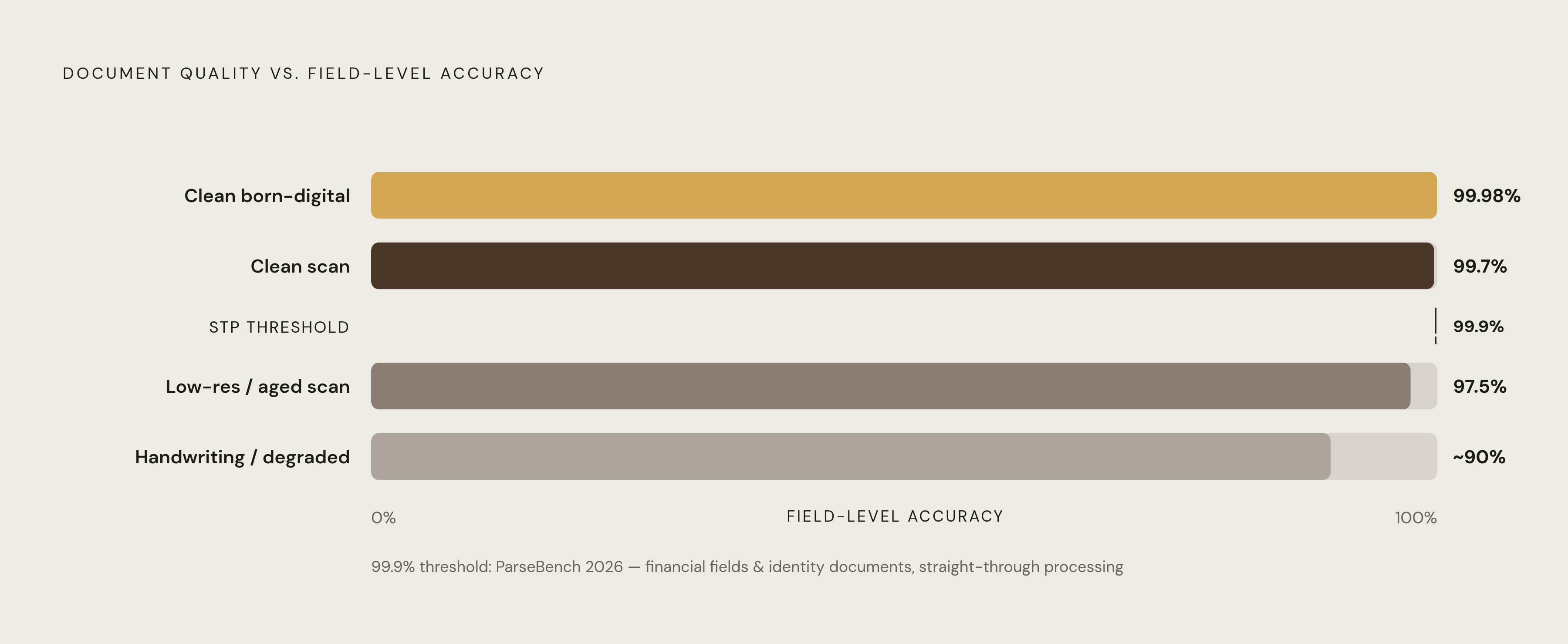
Real archives are not one thing. Real document archives span at least four quality regimes, each with a different achievable accuracy ceiling: clean born-digital, clean scan, low-resolution or aged scan, and handwriting or degraded archive. Per the research brief, the achievable range across these regimes spans from a low end well below most SLA targets to above the threshold required for straight-through processing at the high end. Write a single number into a contract, and you have quietly assumed a document mix. If the archive actually skews toward degraded scans and handwritten forms, that number may be unreachable no matter which vendor is running the pipeline.
Benchmark scores make this worse, not better, when they get copied straight into a contract. An arXiv preprint on OCR robustness for retrieval-augmented systems found that multiple architectures, including ones that score well on published leaderboards, lose meaningful accuracy once tested against real industrial document distributions rather than curated benchmark sets. That regression appeared across architectures, not just one vendor's model. The gap between benchmark and production is a property of the evaluation, not a flaw in any single system. An SLA written against a benchmark number will misstate what the system can actually deliver once it's processing a customer's real documents, and that misstatement cuts against whichever party didn't see it coming.
Even a well-chosen accuracy number can measure the wrong thing. Character Error Rate, the standard OCR metric based on Levenshtein distance between the extracted text and a reference, is precise and well understood but is the wrong metric to anchor a contract governing financial or clinical decisions. A system can post a very low character error rate on clean printed text and still get an invoice total wrong by transposing two digits, because that single error lands on the one character that decides how much money moves. CER treats every character as equally important; a downstream agent does not.
The metric that actually determines whether an output is usable is field-level accuracy: does the vendor field, the total, the date of birth, the policy number come out correct, in full, every time. The 2026 benchmark figure cited for financial fields and identity documents sets that bar at 99.9% field-level accuracy, the threshold at which straight-through processing without human review becomes viable. ParseBench, the 2026 benchmark for document parsing, calls this "semantic correctness": the parsed output preserves the structure and meaning a downstream system needs to make the right call, independent of how closely it resembles a reference character by character. Its five capability dimensions, tables, charts, content faithfulness, semantic formatting, and visual grounding, track exactly the kinds of failure that break agent-facing workflows even when overall text similarity looks fine.
The design conclusion follows directly: an SLA has to stratify its commitments by document quality tier and measure field-level accuracy, not character-level accuracy, for any field a downstream decision depends on. Concretely, the contract should name the document type and quality tier each commitment covers, list which fields are decision-critical and held to a field-level accuracy figure, and separate those from informational fields that can tolerate a looser, CER-based bound. This is not a way to soften the commitment; it is the only version of the commitment that matches how the system actually behaves across a real archive, and it is the only basis on which anyone can later calibrate error budgets or decide what gets routed to a human.
Staged Pipeline Architecture and SLA Attachment Points
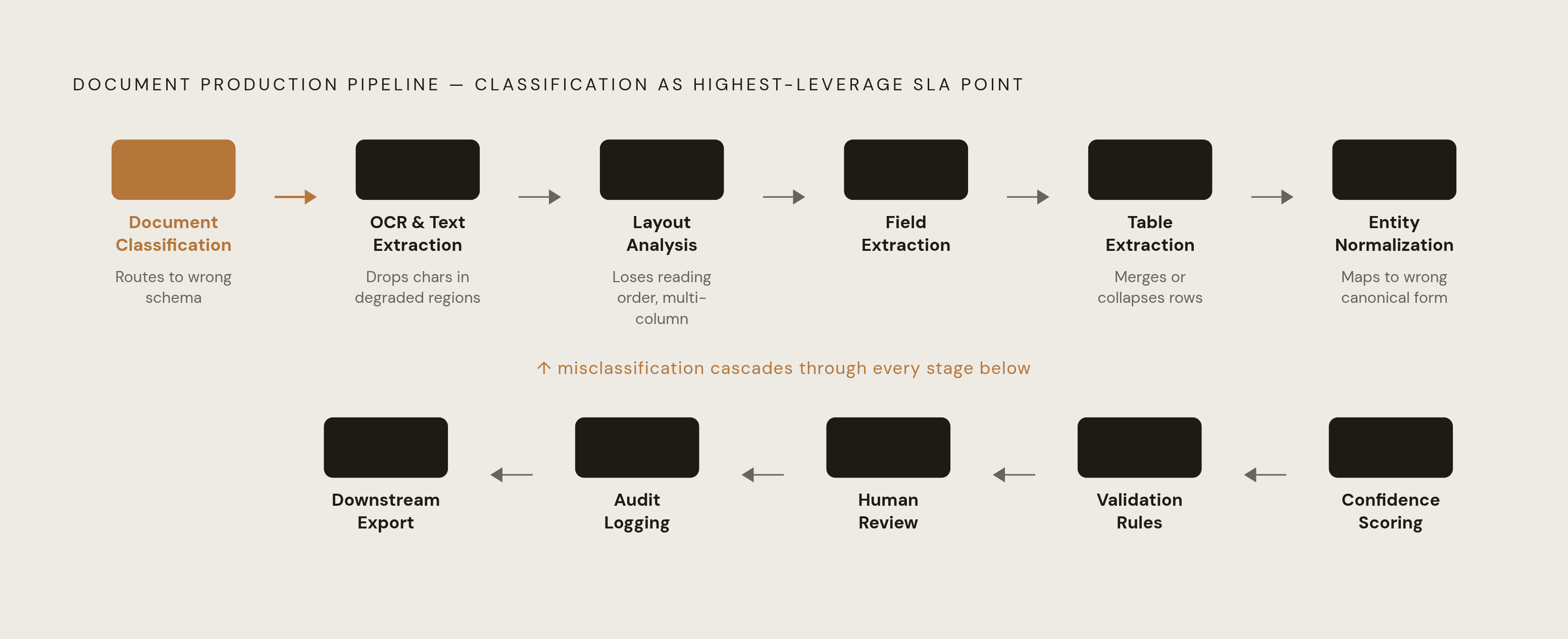
Accuracy commitments only mean something once they are attached to a specific point in the pipeline, because a document processing system is not one process, it is a chain of them, and each link fails in its own way. A full production stack runs through document classification, OCR and text extraction, layout analysis, field extraction, table extraction, entity normalization, confidence scoring, validation rules, human review, audit logging, and downstream export.
Each stage breaks in a different way. Classification can route a document to the wrong schema. OCR drops characters in degraded regions of a scan. Layout analysis loses the correct reading order on a multi-column page. Table extraction merges or collapses rows that should have stayed separate. Entity normalization maps a correctly extracted value to the wrong canonical form, turning "St." into the wrong street type or matching a customer to the wrong account. A pipeline-level accuracy figure blends all of that into one number and hides exactly which stage is dragging the system down, so a vendor can post a strong aggregate score while quietly failing on the one stage, often table extraction, that every downstream total depends on. ParseBench's own findings back this up directly: across the systems it tested, none stayed consistently strong across all five of its capability dimensions. Capability in this field is fragmented stage by stage, not evenly distributed across a single model.
Classification is worth its own line in the contract because a misclassification error doesn't stay contained, it multiplies. Every stage after classification inherits its mistake. If a healthcare prior authorization form gets classified as a general medical record, the field extraction schema applied to it will never look for the authorization-specific fields the downstream decision actually needs, and nothing in the pipeline will flag that omission until an agent acts on an incomplete record. A classification SLA should state accuracy by document type rather than as one blended figure, define what happens when a document falls outside the known distribution (rejected with a flag, versus force-matched to the nearest known type), and set a latency commitment for classification itself, since every later stage waits on itc21.
Table extraction deserves the sharpest attention of any stage, and for financial and logistics documents, it is where the highest-stakes failures live. Dropping rows silently, rather than throwing an error, is one of the most damaging production failure modes in the entire pipeline: a table that returns 47 of 50 line items still looks complete to anything checking for a populated table, right up until an agent sums the column and produces a total that's off by three line items with no indication anything is missing. RD-TableBench, an open benchmark built specifically to test extraction on complex tables, shows real, measurable spread in table accuracy across systems, so this cannot be treated as a solved problem folded into a generic accuracy figure. A table extraction clause in an SLA should commit to row completeness, not just cell-level accuracy, specify how header hierarchies get preserved, and define behavior on merged cells and multi-header layouts, which ParseBench identifies as recurring failure points, alongside charts, which its data shows current systems fail on more often than any other category.
Latency needs the same kind of split, because batch and real-time processing are built on different architectural assumptions and a single latency number applied to both will either choke batch throughput or leave real-time workflows exposed. Batch systems get their efficiency from large batch sizes and heavy GPU utilization; real-time systems get theirs from warm model instances and fast preprocessing built to respond to one document at a time; a hybrid design runs urgent documents through the real-time path while routine ones queue for batch. An SLA should say which mode governs which document class. A prior authorization request that's holding up patient care belongs on a real-time, per-document latency commitment. A month-end batch of routine invoices does not need that, and can run against a throughput commitment instead.
Using confidence scoring and error budgets as the operational mechanism of an SLA
Every commitment described so far needs a mechanism that runs at the moment each field gets extracted, not just a number checked after the fact. That mechanism is a confidence gate, calibrated against a held-out set of real documents, that decides field by field which outputs get auto-approved and which get sent to a person.
The gate works on a threshold. A field gets accepted automatically if its calibrated confidence score meets or clears a value, called λ, chosen against a held-out calibration set so that the error rate among everything accepted, the selective risk, stays at or under a budget the operator sets, called α. The Learn-Then-Test framework, from Angelopoulos and colleagues in 2025, gives that threshold search a statistical guarantee that holds regardless of the underlying data distribution, so whatever gets auto-approved carries error at or below α, and everything under the threshold routes to a person. A September 2026 paper applying conformal prediction to financial documents builds directly on this, giving SLA designers a rigorous way to write the error budget into the contract itself. The commitment is "fields the system auto-approves carry error no higher than α, and everything else goes to review," not "the system is X% accurate".
Setting α is a business decision, not one handed down by a model's performance characteristics. It's a business decision, and it belongs in the SLA in plain terms, because the right value changes with the document type, the field's criticality, and the industry the pipeline serves. A line-item total that determines how much money moves cannot tolerate the same error rate as a vendor's mailing address, which shows up only for display and changes nothing if it's wrong. The contract should separate those cases explicitly rather than run one α across every field a system touches. In healthcare, FDA CSA guidance (September 2025 final) and FDA-EMA joint AI principles (2026) formalize a risk-based approach to software validation. A risk-tiered error budget matches that posture directly, and a set of named α values by field class holds up far better under audit than a single blanket accuracy figure ever could. In finance, the threshold required for straight-through processing without human review is field-level accuracy at 99.9% per the research brief, which maps to a very narrow error budget for decision-critical financial fields.
None of this works if the confidence scores themselves are wrong. A model that reports high confidence on fields it's actually getting wrong at a meaningfully higher rate than it claims will route too few of them to review, and the whole guarantee collapses regardless of how carefully α was chosen. Calibration has to run against a held-out set of real customer documents rather than a benchmark dataset, because the relationship between a confidence score and actual accuracy is specific to the document distribution it was measured on. A model calibrated against clean PDFs will misread its own confidence on the degraded scans sitting in the same production queue. For an SLA to hold up, it needs to name the calibration set and set a recalibration cadence alongside the accuracy commitment itself. A commitment with no defined calibration process behind it is not something anyone can actually enforce.
Everything the confidence gate routes away from auto-approval lands somewhere, and that somewhere needs its own commitments. Human review is not a fallback bolted onto the system for edge cases, it is a designed part of the SLA with its own throughput and latency terms. The gate decides which fields enter the review queue, but the contract still has to state how long a field waits there, who is qualified to review it, and how the correction feeds back into the model that made the original mistake.
How SLA commitments change when documents carry regulatory weight
Once regulation enters the picture, human review changes from a design choice into a legal requirement written into the same architecture. Under the EU AI Act's Article 14, deployers of high-risk AI systems have to maintain effective human oversight, with those Annex III obligations now set to take full effect on December 2, 2027, following the AI Omnibus's postponement of the original date. Building human review into the SLA, with defined queue times, named reviewers, and a documented feedback loop, is what that oversight requirement actually looks like in an operating pipeline. It is not an engineering nicety layered on top of compliance, it is the compliance.
That changes what an SLA has to contain once documents feed into a healthcare or financial decision. An SLA that names explicit α values by field class, tighter for a dosage field, looser for a provider's office address, mirrors that regulatory logic directly and gives an auditor something concrete to check against, rather than a single aggregate accuracy figure that says nothing about where the risk actually sits.
In finance, the number that matters is the same 99.9% field-level accuracy threshold: below it, a document cannot move through straight-through processing without a person touching it. Below that line, on decision-critical fields, review isn't optional, and an SLA that doesn't say so in explicit terms is leaving the riskiest part of the pipeline unmeasured. Above it, a system earns the right to skip the human step on exactly the fields the contract names, and no others.
What ties the whole design together is the same principle running through every section here: an SLA for a document pipeline has to describe behavior at the level where errors actually occur, the field, the table row, the document type, the confidence threshold, rather than a single number that sounds reassuring and describes nothing real. Regulation raises the cost of getting that wrong and gives auditors a reason to check that the contract matches how the system actually runs.