Vendor Evaluation Criteria That Predict Real-World Invoice Parsing Failure Before You Buy
Test vendors on your actual invoices—scanned and irregular—before committing to a contract.

A high-accuracy document extraction API for complex real-world layouts must show how well it reads the buyer’s invoices, including irregular tables, scans, and long documents. Headline scores and clean-PDF demos cannot establish that reliability. Before signing a contract, buyers should test vendors for known failure mechanisms and measure errors by field type and document quality.
Why standard vendor evaluation methods fail to surface invoice parsing failures before deployment
The problem buyers face is that the evaluation tools available to them are designed by sellers. A demonstration built around a clean digital PDF, familiar supplier layout, and header fields leaves out scanned paper, line items, and format changes. Feature checklists show that a system has a capability but leave open whether it works under those conditions. The evaluation is structurally misaligned with the work the parser will receive.
Accuracy claims can therefore be accurate but unrepresentative. Hypatos’s 2026 production benchmarks describe vendor-published measurements on curated datasets that favor the vendor’s capabilities. OmniDocBench covers categories including books, financial reports, academic papers, and handwritten notes, but has no invoice, receipt, or business-form category. Performance on that population cannot establish whether a model will read an invoice total correctly.
Where accuracy actually degrades — the field hierarchy and document quality axes buyers don’t test
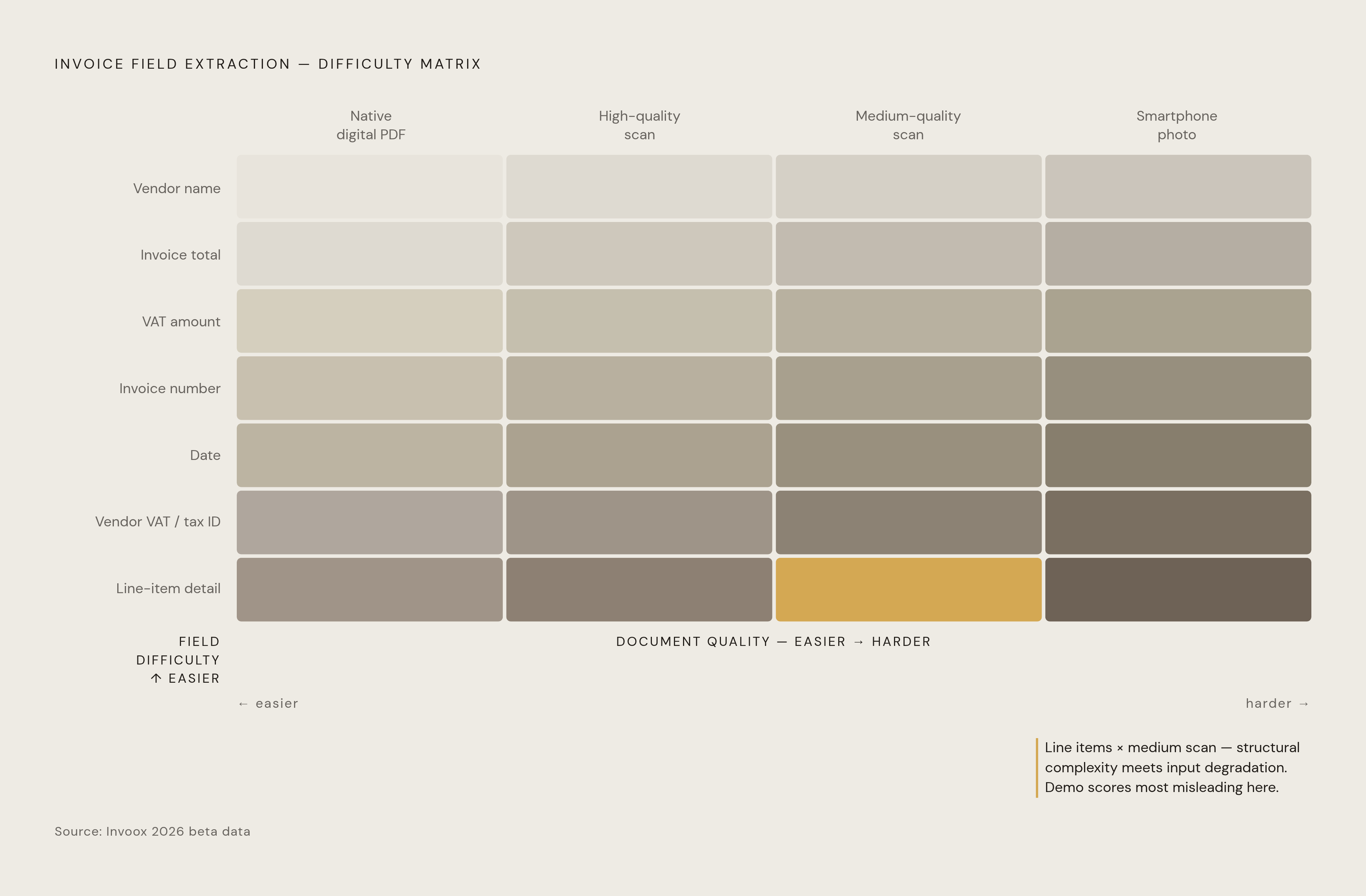
Invoice extraction has a hierarchy of difficulty. Invoox’s 2026 field-level data from its own beta operation places vendor name first, followed by invoice total, VAT amount, invoice number, date, vendor VAT/tax ID, and line-item detail. That evidence from one operation identifies an important evaluation boundary. Reading a header is different from reconstructing a table. Line items contain variable row counts, vendor-specific column headers, merged cells, multi-line descriptions, and subtotals inside the table.
Document quality is a second axis along which extraction can fail. The Fraunhofer IAIS / Lamarr Institute 2025 benchmark tested eight multimodal models across three public datasets. Its top model performed materially better on clean digital invoices than on scanned invoices, with scanned receipts yielding its lowest results. Invoox’s data shows a similar gradient from native digital PDFs through high-quality and medium-quality scans to smartphone photos. Photos also showed high variability, making a clean-document score particularly unsuitable for organizations receiving mixed inputs.
The two axes must be measured together. A blended score should reflect the buyer’s actual distribution of document quality, while field-level results should expose where that blend conceals weak extraction. Otherwise, strong header performance on digital PDFs can obscure poor table reconstruction on paper-derived documents. Line-item extraction on a medium-quality scan is the clearest counterexample to demo conditions because it combines structural complexity with degraded input.
The three architectural approaches to invoice parsing and the failure mode each one inherits
Template-based and layout-heuristic systems identify fields through page position, using configured templates or layout rules. They can provide fast, inexpensive per-page processing, consistent output schemas, and built-in table detection. Their weakness is dependence on a familiar arrangement. A supplier rebrand, ERP switch, or reformatted PDF can invalidate rules that previously worked. The failure can be silent because the system does not know that its template is stale.
Hybrid text-conversion systems separate reading from interpretation. OCR converts the document into text or markdown, and an LLM extracts fields from that representation. This approach can cost less than pure LLM processing and scale reasonably, but conversion can discard spatial information. A number whose meaning was clear from its position after “Total” may become ambiguous once the layout disappears. Where spatial context is the only usable signal in a scanned invoice, the downstream model cannot recover it from text alone.
Native multimodal or AI Vision extraction receives an image or rendered PDF and interprets text and visual layout together. It can handle non-standard layouts, reason about implied values, and interpret context without per-supplier templates. Long multi-page invoices can expose context loss, while numeric fields require checks for hallucinated values. Architecture therefore determines the stress test, with unseen suppliers probing template dependence, scans probing spatial-information loss, and long tables and numeric checks probing multimodal extraction.
Why aggregate accuracy scores hide more than they reveal, and what field-level measurement exposes
An aggregate score compresses the distinctions that evaluation needs. Hypatos’s production data shows that overall accuracy can remain stable while performance on a particular document type degrades significantly. A steady monthly score is therefore compatible with worsening line-item extraction on scans from a new supplier category. RealDocBench likewise distinguishes field-level performance from stricter scoring that requires all keys to be correct. The metric must reveal whether individual fields are right and whether the complete output is usable.
Confidence scores need their own measurement discipline. DocILE is a benchmark of real invoice-like business documents with 55 field types. Findings from GPT-4o on that benchmark showed that raw token log-probabilities and the model’s stated confidence performed only modestly above chance at separating correct from incorrect answers. Combining disagreement across multiple runs with OCR quality, image quality, and layout signals produced substantially better separation. Routing only the least certain fields to human review then raised accuracy on the remainder to near-perfect levels.
Buyers should ask how confidence is computed and how its relationship to observed errors has been validated. They should also request accuracy by header, financial-summary, line-item, and inferred field, broken out across digital PDFs, high-quality scans, medium-quality scans, and photos. The overall figure should be weighted by their actual document volumes. Disclosure of the test set, its size, and its coverage of the buyer’s document types is necessary to interpret those measurements.
How do you pick a document parsing API that won’t fail on scanned invoices with irregular layouts?
The first test should probe generalization to unseen suppliers. Give the system invoices from vendors absent during configuration, using a mix of digital PDFs, high-quality scans, medium-quality scans, and smartphone photos. Measure results by field and document type instead of relying on a pass rate for the whole document. A system that handles configured suppliers but degrades on unfamiliar ones has not demonstrated template-free generalization.
For each row in the second test, check that quantity × unit price equals the extended amount, and compare the number of extracted rows with the number in the source. Plausible-looking values are not enough when they fail internal cross-validation. Long tables should be included because large-array extraction can silently omit rows while returning output that appears complete. Score each line item on its own so that correct headers cannot make up for failed rows.
The third test should isolate scan degradation. Include medium-quality scans and smartphone photos as well as digital PDFs, then compare field-level accuracy for each of those quality bands. For hybrid text-conversion systems, check cases where what a field means depends on its visual position. Those cases target the loss of spatial information between OCR output and LLM interpretation.
The fourth test should audit confidence calibration. Ask the vendor to return confidence with the test extractions, then check whether low-confidence fields actually have higher error rates than high-confidence fields. Ask whether the score uses raw log-probability, ensemble voting, or OCR, image-quality, and layout signals, and require evidence for its calibration. The DocILE findings make this a measurement task.
The fifth test should simulate supplier template drift. Provide two rounds from the same supplier, one matching the configured format and another following a rebrand, ERP switch, or PDF layout change. Measure the accuracy drop between rounds. Unlike the unseen-supplier test, this checks whether a previously successful relationship becomes a maintenance burden. A collapse after the change demonstrates template dependence regardless of the vendor’s stated architecture.
The sixth test should probe long-document context and splitting. Compare extraction of line items on page 3 of a 5-page invoice with extraction on page 1. A decline across pages indicates lost context. Separately, check that multiple invoices in one file are split correctly, because boundary errors compound downstream extraction errors. Row completeness, page-level consistency, and document boundaries are distinct checks even when they use the same long-document set.
Introduce severely degraded images, unrecognized formats, and documents that are not invoices, then examine whether uncertain cases reach review or pass silently. Safe failure is part of production reliability. The MADP paper describes a production deployment in which modular design enabled fallback from unreliable silent extraction to manual inspection. Measure straight-through processing as well as extraction accuracy, because the share completing without human intervention reflects more than whether fields were read correctly.
What the evaluation must also account for — the production context beyond the parser itself
Correct extraction does not guarantee a touchless accounts-payable workflow. PO mismatches, missing goods receipts, tax and freight variances, duplicate checks, and vendor master problems can all create exceptions after parsing succeeds. These failures belong to the surrounding process. Hypatos’s benchmark explicitly counts correctly extracted invoices that matching cannot resolve as exceptions. PO discipline and supplier data quality therefore constrain the achievable touchless rate independently of parser quality.
Launch accuracy also cannot establish lasting performance. Models can drift as incoming documents move away from the distribution represented in training data, including changes in supplier mix and document formats. The breakdown of measurements that buyers ask for during evaluation must still be available after deployment. Buyers should ask whether the platform has accuracy dashboards and sends alerts when field-level or document-type-level performance falls below the thresholds they have set. With only a launch report and no such monitoring, later shifts in the document mix are hard to diagnose.
The input population itself is also changing. Buyers evaluating in late 2026 should ask how the system handles structured XML input as e-invoicing mandates change the document mix, and what accuracy claims mean for that input type. An evaluation confined to PDF and image parsing would leave that question unanswered. Industry-specific document types and validation scenarios should also be included in the test set. Those requirements may call for checks that need more than extraction alone.
What a production-ready invoice parsing infrastructure looks like when evaluated against these criteria
A production-ready system is defined by demonstrated behavior under these tests. Layout-aware extraction without per-supplier templates can handle both suppliers the system has not seen before and formats that change. Hypatos’s benchmark identifies template-free generalization as the differentiating capability on novel document formats. Yet generalization is only one requirement. It must also have engineered, calibrated field-level confidence and a fallback path that sends uncertain work to human review instead of accepting unreliable output without warning.
API-first document processing infrastructure exposes parsing, extraction, classification, splitting, and confidence scoring as controllable APIs. That gives the team a way to tune the accuracy-cost-latency tradeoff rather than accepting the fixed behavior of a black-box AP application. The integration boundary is therefore part of the purchase decision. The system must support both extraction and the workflow ownership the team intends to retain.
Evaluation then becomes an ongoing operating practice. Field-level accuracy by document type, confidence calibration audits, and row-count validation provide the basis for monitoring after deployment, while disaggregated alerts make emerging failures visible. The same measurements also keep acceptance criteria tied to actual production inputs as the document mix changes. A vendor that cannot support those measurements in production cannot be held accountable against them after go-live.