Total Cost of Ownership for In-House Document Extraction Infrastructure
Building document extraction in-house costs far more than the prototype suggests.
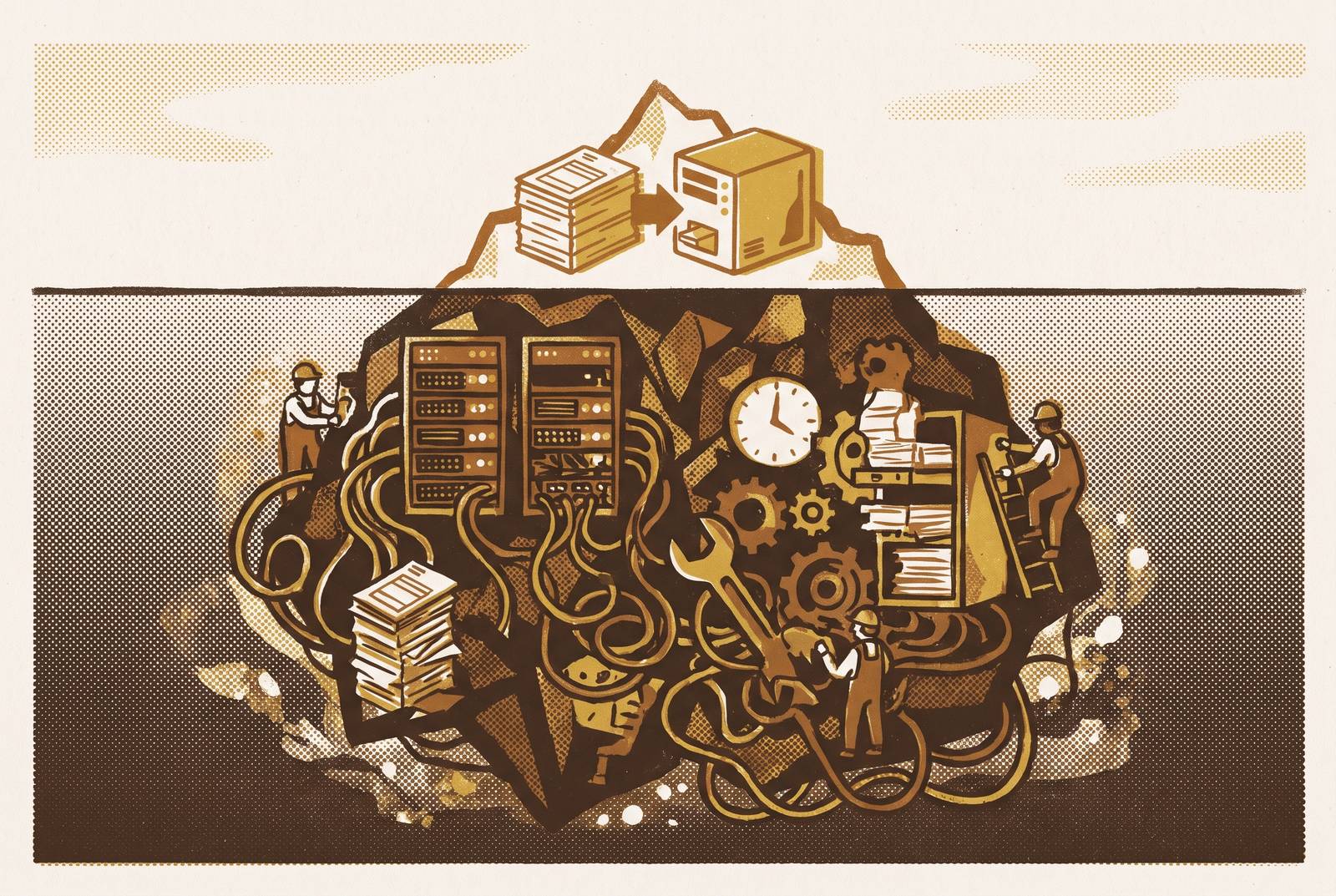
A self-hosted document processing API can keep medical documents that contain sensitive patient information inside an organization’s network, but where it runs does not by itself ensure HIPAA-compliant handling. Total cost of ownership for in-house document extraction infrastructure includes access controls, audit trails, validation, accuracy maintenance, and operational ownership. Whether building is cheaper than buying depends on the cost of that ongoing work as well as the afternoon prototype.
Why the prototype cost is not the build cost
An afternoon demo can combine an LLM, a PDF library, and a sample invoice into a convincing extraction workflow. The fields appear, the output looks usable, and the cost seems trivial. That experience becomes the budget anchor. Engineering leaders remember “we stood it up in a week” and judge future work against that memory. The estimate often remains tied to the demonstration even after the requirements have changed.
The initial integration sprint connects OCR, the LLM, parsing, and retries, but it does not establish production readiness. It shows that the system works on a small set of chosen inputs. A clean sample invoice does not expose the work required by scanned PDFs, rotated images, handwritten fields, multi-column layouts, or low-quality faxes. Layouts that change quarterly add work that must be done again and again. Each condition can become a separate engineering project because production must handle the document population.
The maintenance burden that replaces feature development
The dominant hidden cost is engineering time spent keeping extraction working. A broken parser consumes the same senior capacity that would otherwise advance the feature roadmap. The maintenance load can exceed 200 hours quarterly. That commitment continues after the initial implementation has stopped appearing as a distinct project in the budget. Treating it as incidental support understates both its direct cost and the product work it displaces.
Automation does not make that work disappear. To detect layout changes automatically, a team needs labeled test data, a monitoring harness, and someone to triage alerts. The automation therefore has its own implementation and operating burden, even when it reduces manual intervention later. An estimate that includes only the time needed to fix known failures omits the machinery needed to discover new ones.
What accuracy drift actually demands: the evaluation harness
A wrong field value may pass schema validation and reach downstream systems without triggering an alert. Structural validity is not evidence of extraction accuracy. Without a labeled test set and a scoring harness, a team cannot reliably establish its baseline or detect a prompt change that regresses results.
An evaluation harness requires a representative document corpus, labels, field-level scoring metrics, and comparison logic. Character accuracy is not enough for that purpose. The harness must run on every deploy and whenever models, prompts, or layouts change, while the corpus must expand as new document types appear.
RealDocBench was designed to expose the divergence between clean academic benchmarks and real-world documents across mortgage, finance, supply chain, and medical/healthcare domains. Choosing a benchmark that covers the right documents takes expertise. A strong result on an unsuitable corpus does not establish production accuracy for regulated documents. Building the relevant harness after an error surfaces also costs more than establishing it before deployment, when evaluation can shape the implementation.
Confidence scoring: the infrastructure most teams never build
An evaluation harness measures how well extraction works across a corpus, while confidence scoring helps the system decide what to do with each extraction at runtime. These are separate engineering problems. A calibrated score enables the pipeline to distinguish results suitable for automatic processing from results that need human review. Raw token-level probabilities do not provide that distinction because confidence in generated text is not confidence that the source was readable or unambiguous.
Beyond Logprobs: A Multi-Signal Confidence Engine for LLM-Based Document Field Extraction, an extended version of research accepted at the RobustifAI Workshop at IJCAI-ECAI 2026, identifies this structural mismatch. Document extraction errors arise from unreadable material, ambiguous layouts, and OCR noise, while logprobs measure a different signal. The research looks at uncertainty through document-side grounding.
A reliable confidence layer combines signals from generated output, image quality, spatial location, OCR agreement, and agreement between structurally distinct extraction calls. Each signal requires an engineering component of its own. Without calibrated routing, teams face two poor extremes, automatically approving silent errors or reviewing everything and losing the automation benefit. Selective prediction remains largely unsolved for LLM-based document extraction, so this prerequisite can involve research-level engineering.
Compliance overhead in regulated industries: the cost multiplier nobody budgets
Compliance is a recurring operational discipline. Healthcare, finance, and legal requirements can add 30–60% to baseline implementation cost through private infrastructure, audit logging, role-based access controls, agreement negotiations, legal review, and extended validation cycles. These requirements change what the systems already used for extraction must do. They also add work that a model or a general-purpose pipeline cannot do on its own.
For medical documents, the first architectural question is whether sensitive patient information can leave the network at all. Healthcare workflows still require HIPAA-compliant data handling, clinical validation, and human review for patient-facing outputs. Queryable, retained audit logs must also be built and operated, while applicable data processing agreements and BAA negotiations remain part of the organizational workload.
Finance adds error thresholds for compliance reporting, demonstrable audit trails, and, in some jurisdictions, explainable model decisions. An audit trail is infrastructure. It must record what was extracted, the source document version, the model used, and the confidence attached to the result, with records retained and queryable. Data residency requirements can set the rules for how the system runs before anyone writes extraction code.
The full-stack infrastructure cost of self-hosting
Box’s infrastructure cost analysis identifies GPU compute, OCR engines, layout-aware parsers, vector and search retrieval pipelines, orchestration layers, security guardrails, and ongoing MLOps tooling as components of the operating stack. Each has a cost and a failure mode. Raw model weights alone cannot do all the work needed to parse tables, handle skewed scans, isolate key-value pairs, and route data into enterprise workflows. Those capabilities require components around the model, and the prototype rarely exposes their full operational scope.
With on-premise deployment, a team must spend heavily on hardware, software licensing, and implementation upfront, while cloud costs vary per document. The economic crossover depends on sustained, predictable volume.
MLOps monitoring, retraining, and optimization run roughly 15–25% of initial build cost annually. This expense continues beyond the first installation. It sits within the broader requirement to keep the stack working as documents and models change. Every layer is consequently a staffing and operational commitment.
Engineering turnover and the key-person risk embedded in every in-house pipeline
Keeping those systems running takes people who know how they handle exceptions. The engineer who built the pipeline knows why a prompt uses particular wording, which layouts required special-case logic, and which document types were never fully solved. Much of that knowledge can remain undocumented. When that person moves on, an ordinary maintenance event becomes an investigation before it becomes a repair.
The exposure is greater when the same engineer built the evaluation harness. A successor must then reconstruct both the extraction logic and the system used to judge its accuracy. Confidence drift creates another dependency on undocumented design choices. The pipeline’s maintainability depended on knowledge held by the engineer who left.
Hiring a replacement is only part of this cost. Ramp time can leave the pipeline unmaintained while silent errors accumulate, and senior engineers must divert time to reverse-engineer the original design. In-house infrastructure concentrates this knowledge burden within the team operating it. Managed infrastructure changes that boundary by placing ownership of the commodity extraction components outside the customer’s engineering organization.
What the year-one comparison actually looks like when all costs are counted
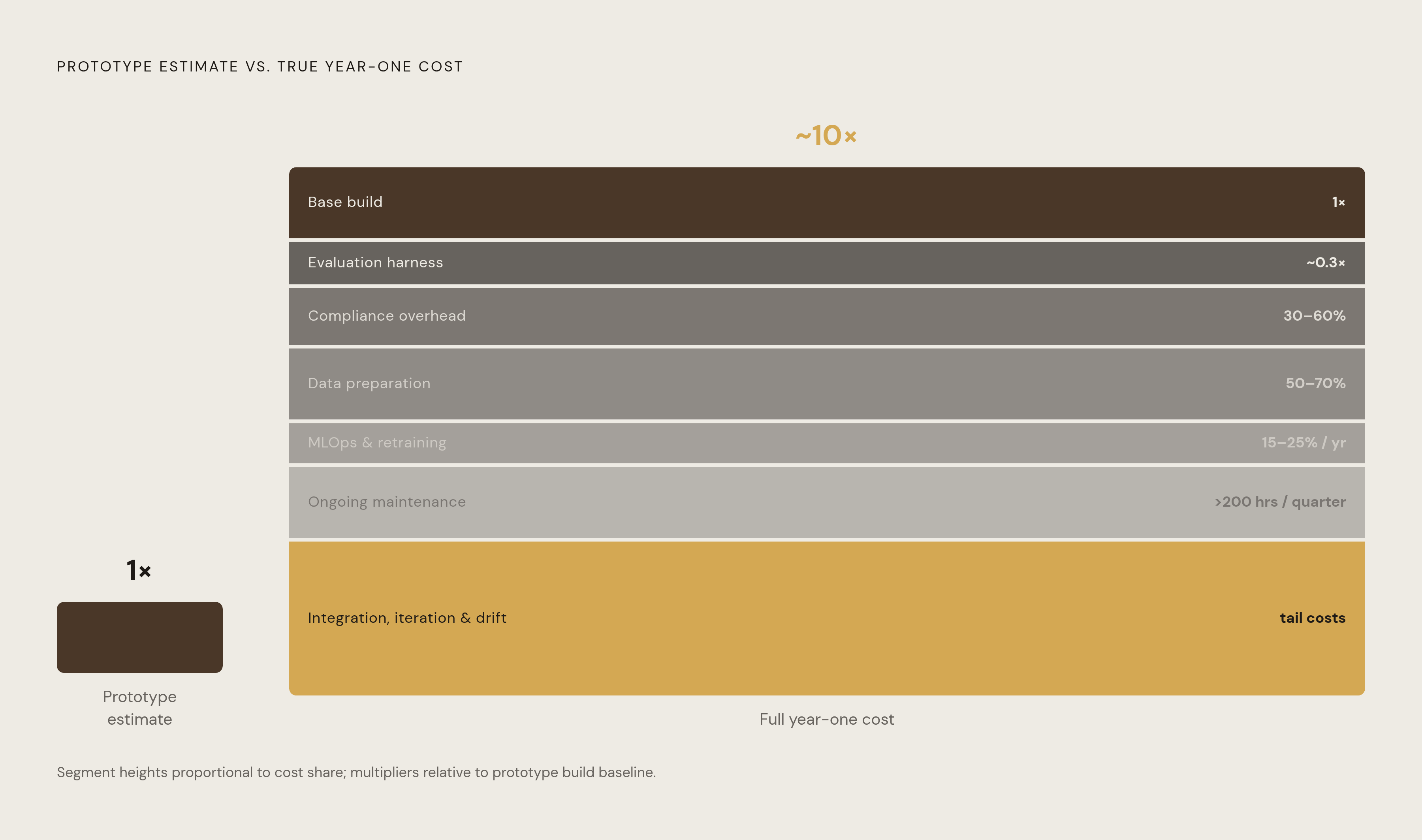
A full year-one estimate includes engineering at fully loaded rates, infrastructure, the evaluation harness, domain-specific validation logic, compliance overhead, and maintenance. The prototype estimate contains only a small subset. Once these costs are included, the total can reach an order of magnitude above the initial estimate and exceed what teams expected to spend over several years.
Data preparation is a particularly large omission in regulated work. For healthcare or finance datasets, it can represent half to more than two-thirds of build cost. The implementation estimate must include that work and its cost to model development. The recurring maintenance burden then extends beyond year one, consuming senior capacity simply to preserve existing behavior.
A managed API does not make the alternative cost-free. The team is still responsible for integration engineering, schema design, and validation rules. The purchased extraction layer can remove responsibility for OCR, format handling, model maintenance, compliance infrastructure, and the provider’s evaluation harness. A fair comparison counts the full cost of the in-house system and the cost of the managed service plus the work the customer still does, going beyond prototype cost and the service’s sticker price.
When building in-house is still the right call — and when it is not
Building in-house remains defensible when the extraction capability itself provides competitive advantage and the team can fund its continuing operation. Sustained, predictable volume can also support the economics of on-premise infrastructure. Neither condition settles the decision alone. The estimate must still account for document variability, evaluation, confidence scoring, compliance, and ownership after the original builder leaves.
The case for building weakens when volume grows while layouts keep changing, extraction quality affects revenue or customer trust, and engineers’ time is worth more when spent on the core product. Compliance and data residency add to the work of running the system. A requirement to keep documents inside the network establishes a deployment constraint that the available architecture must satisfy.
The practical alternative is not necessarily an all-or-nothing purchase. Teams can buy the commodity extraction layer, including OCR, format handling, field extraction, compliance infrastructure, and confidence scoring, while owning validation rules, risk logic, output schemas, and decision models. That division preserves control over the intelligence applied to extracted data. For teams whose advantage lies there, maintaining the underlying extraction machinery adds a liability.
A checklist for sizing the real cost before the build decision is made
The complete system should be estimated before the prototype establishes the anchor. Each cost category needs a concrete number or a named owner. The quarterly maintenance budget should specify engineering hours and who will own the pipeline 18 months from now. The evaluation plan should identify who labels the corpus, who runs scoring, and how often the harness is maintained and executed.
The same audit should establish how calibrated confidence scores will be produced and how low-confidence extractions will be routed. Compliance requirements need an explicit cost allocation. That includes applicable HIPAA, SOC 2, GDPR, and data residency requirements, together with the audit infrastructure they require. The infrastructure estimate should identify the full stack and its annual operating cost at expected volume.
Finally, the scope must address what happens when the builder leaves, including ownership of the pipeline and its evaluation system. Unanswered questions are unresolved operating commitments. Teams that can assign credible costs and owners have the information needed to build responsibly. Teams that cannot have identified the risk before it becomes a production obligation. Honest scoping makes the decision possible on the costs the team will actually bear.